
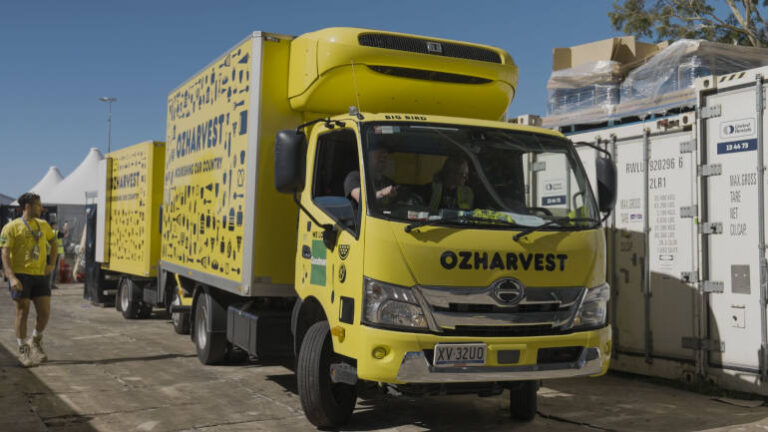
Every day, the bright yellow trucks of OzHarvest head out across cities and suburbs collecting surplus food and delivering it to community organisations. It’s a routine built on timing, coordination and reliability. When a supermarket calls with excess produce or a major event finishes with leftover meals, the response needs to be quick and organised.
As the organisation has grown, so has the complexity of managing those daily operations. More vehicles, more locations and more food means more moving parts to coordinate. That’s where technology has stepped in to help the team work smarter behind the scenes.
Geotab’s telematics platform is now playing an important role in supporting the OzHarvest fleet, providing the visibility and data needed to keep deliveries running smoothly and efficiently.
A relationship built on support
For OzHarvest, the relationship with Geotab started with a simple offer of support — and it quickly became a valuable part of the organisation’s daily operations.
Victorian Engagement Manager, Alana Roberts explained how the relationship works.
“Geotab are a huge supporter of OzHarvest,. So they kindly donating a Geotab device in all of our fleet around the country, and they do that completely in kind, which we are so, so grateful for.”
Having devices installed across the national fleet provides a clear picture of where vehicles are and how they are being used. That visibility makes it easier to coordinate deliveries and respond quickly when new food donations become available.
Roberts said the biggest benefit is knowing exactly what is happening across the operation.
“So this means that we can monitor our trucks and accurately track our trucks and our stats throughout the country.”
It’s a practical capability that supports the organisation’s mission every day.
Moving from guesswork to precision
Before telematics, tracking vehicle data relied heavily on manual processes. Drivers recorded kilometres during refuelling, and fleet teams used that information to estimate servicing schedules and utilisation.
It worked, but it wasn’t always accurate.
Brad Esmore, Fleet Manager at OzHarvest, described the challenges of relying on manual reporting.
“We used to have the fuel card, the driver then would have to tell them the kilometres. The kilometres then gets fed back into the system and then it sort of feeds dashboards. But there’s so many human errors that happen in that all the time.”
Today, the data is captured automatically, providing a clear and reliable picture of vehicle performance and usage.
“Just trying to keep track of when trucks need to be serviced, when they come up to kilometres, it was always just a vague, that’s roughly what it is. But now with Geotab, it’s spot on perfect.”
That level of accuracy helps ensure vehicles are serviced on time and ready to support daily food rescue operations.
Knowing where the trucks are
One of the most useful features of telematics is the ability to see where vehicles are located in real time. In busy urban areas, this visibility makes a noticeable difference to daily operations.
Esmore shared a simple example from the Sydney fleet.
“The warehouse in Sydney is in a busy industrial estate with limited parking, so trucks are often parked on the surrounding roads. The app makes it easy to see the truck location, saving time and helping drivers start their day quickly.”
The same visibility also allows the logistics team to respond immediately when new food becomes available.
“If some job comes in, a phone call comes up, says we’ve got some sandwiches here, you can just have a quick cheque and like, okay, we know exactly where they are.”
That responsiveness helps ensure food is collected quickly and delivered while it is still fresh.
Data that supports the mission
As the fleet has expanded, OzHarvest has become increasingly focused on using data to guide decision-making and demonstrate impact.
Vehicle movements, delivery volumes and service activity are now tracked through dashboards that combine information from multiple systems, including Geotab.
Esmore said data plays a central role in managing the operation.
“We use Power BI, which creates multiple dashboards for us, which get used pretty much every sort of facet of the business – logistics is especially data heavy. .”
This information helps the organisation plan routes, manage vehicles and report outcomes to donors and supporting organisations.
It also supports one of OzHarvest’s core commitments — delivering measurable results. Roberts explained how performance is tracked.
“The tangible impact of what we do is for every $1 donated, enables us to deliver two meals. Measuring how many meals we’ve delivered is hugely important, accurate data makes it possible to show exactly how resources are being used to support communities in need.”
More than technology
While telematics has improved efficiency and visibility, the relationship with Geotab is also built on people.
During the Australian Formula One Grand Prix® food rescue operation, members of the Geotab team joined OzHarvest volunteers and drivers to help collect surplus food from the event.
OzHarvest Melbourne’s Alana Roberts recalled the experience.
“Alkan from Geotab, he also loves to jump in and volunteer on top of all that they donate to us. So he actually was in the truck with our drivers on F1 day and he helped us rescue the food.”
It’s a reminder that behind every delivery is a team working together to support the community.
And each day, as the yellow trucks head out on their routes, the combination of people, vehicles and data helps ensure that more food reaches more people — efficiently, reliably and with purpose.