
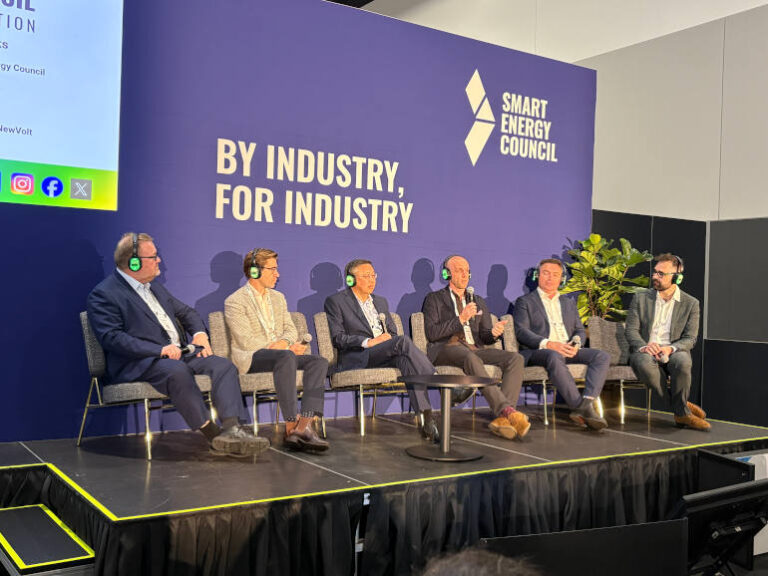
One of the clearest messages from the electric truck panel at the Smart Energy Conference and Exhibition in Sydney was that the technology for electric trucks already exists. The real challenge facing Australia is building the charging infrastructure fast enough to support large-scale fleet electrification.
Throughout the discussion, panel members argued that truck manufacturers, charging providers, retrofit companies, investors, and energy businesses are all ready to move. However, grid connection delays, infrastructure planning, charging network coordination, and policy uncertainty are slowing progress.

Rainer Knobloch, Co-Founder and Chief Strategy and Operating Officer at NewVolt, said the freight industry is already at the point where charging infrastructure timelines are becoming the major constraint.
“If you are not today in the planning process of pouring concrete or the grid augmentation in play, you’re potentially 24 months away from having a site operational,” said Knobloch. “That is the duration we are right now. We have to get moving here.”
Knobloch said NewVolt initially expected regional freight corridors would be the starting point for electrification, but the economics currently favour metropolitan freight operations where trucks have predictable routes and high utilisation.
“The reality is where the economics are the closest today are in the cities,” he said. “Port shuttle runs, double shifted trucks running 200 or 300 kilometres a day, six and a half days a week — that’s where the economics make sense.”
NewVolt is currently developing three truck charging sites in Melbourne, which Knobloch said should all be operational by the end of next year.
The discussion highlighted that charging infrastructure for heavy vehicles is far more complex than passenger vehicle charging because freight operators rely on uptime, scheduling certainty, and route reliability.
Richard Zee, CEO and Founder at Solarh2e, said infrastructure must be treated as the foundation of the entire transition.
“We need to get the charging infrastructure in place. Without the infrastructure, you won’t have electric trucks full stop,” said Zee. “We need to build a backbone that connects every major city.”
Zee said charging hubs must remain open-access to support operators of all sizes, not just large fleets with dedicated infrastructure.
“They should all be open hubs, not closed hubs that feed only to some of the larger operators,” he said. “The mums and dads and everyone else can get access to the hubs at a price point where the electricity is low enough that they can see the savings.”
The panel also discussed the importance of integrating charging infrastructure with renewable energy generation and battery storage to reduce charging costs and improve energy reliability.
Ben Hutt, CEO at Janus Electric, said there are already practical pathways available for fleets that do not require waiting years for major grid upgrades.
“Where it works right now is places where Janus can put charging infrastructure that doesn’t need a special grid connection,” said Hutt. “It’s basically like a big five megawatt community battery with swappable batteries.”
“You can put them on pretty much any industrial facility, next to a solar farm, or on any commercial and industrial business precinct.”
Hutt said the industry must focus on deploying infrastructure immediately while governments work through longer-term grid and corridor planning.
“We’ve got to do what we can do right now,” he said. “There are some policy things the government could do right now.”
The discussion also highlighted that private capital is increasingly interested in freight electrification infrastructure, but investors still require policy certainty and long-term direction.
Gareth Ridge, Director at Zenobe Energy Australia, said Zenobe is already taking an aggressive approach to charging infrastructure development, including open-access charging hubs and depot charging solutions.
“We’re trying to get an anchor tenant, or any tenant who wants to join that hub at a subsidised rate, and then take the risk on to try and get other customers in to increase utilisation of those sites,” said Ridge.
“We don’t just build for the size of one customer. We’ll build for two or three, and then we will try to maximise utilisation and the cost of energy.”
Ridge said the industry is still in the early stages of adoption and infrastructure deployment.
“Wave one is just getting people started on the journey, getting them into the sites, getting comfortable with the technology,” he said. “Wave two will be this optimisation phase where we can actually then start to really drive down the cost even further.”
The panel repeatedly warned that Australia risks falling behind international markets if infrastructure deployment does not accelerate quickly.
Andrew Dickson, Director & Senior Advisor at Smart Energy Council, said competitive electricity access will ultimately determine how quickly truck electrification scales.
“Unless we can get access to competitive cost of electricity, electrified trucks are really not that much cheaper than diesel trucks,” said Dickson.
Dickson also questioned whether Australia is treating freight charging infrastructure with enough urgency given the country’s growing concerns around fuel security.
“We might be faced with the idea that only electric trucks will be able to deliver our food and medicine,” he said. “That says to me that it’s not something that we should just be treating as a business-as-usual endeavour.”
As the session concluded, the panel agreed that electric truck technology is no longer the limiting factor for fleet electrification in Australia. The challenge now is building a coordinated, scalable charging network that gives operators confidence they can charge vehicles reliably, access affordable electricity, and maintain operational certainty across the freight network.