




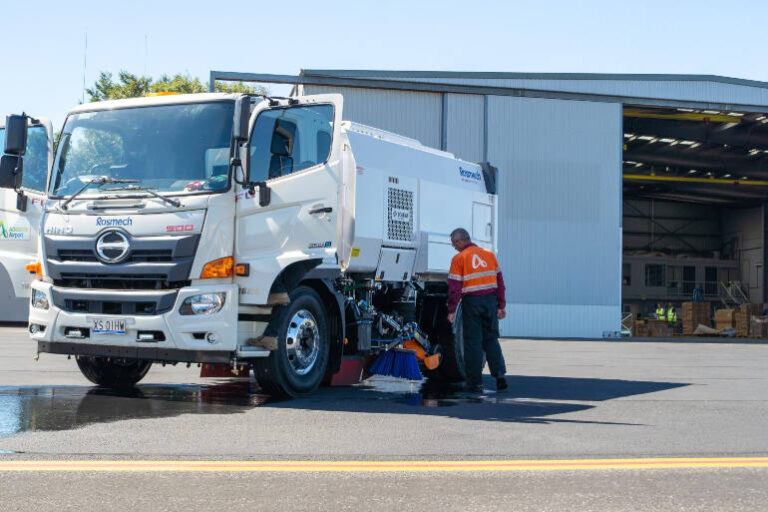
Street sweepers are highly specialised fleet assets, but knowing whether they are being used efficiently can be surprisingly difficult.
A vehicle can be operating for an entire shift, kilometres can accumulate and the operator can report that the scheduled work has been completed. But how much of that time was actually spent sweeping?
It is a question Geosecure National Fleet Consultant Travis Weir has been examining while working with councils on the development of Optimize, a new AI-powered route optimisation solution.
The work has exposed a challenge that may be familiar to many local government Fleet Managers and operations teams: street-sweeping schedules that have developed over many years but have never been fundamentally redesigned.
According to Weir, some councils told Geosecure that their schedules had simply grown as new streets and subdivisions were added.
“Some of them come back and said, ‘Look, these are historically done. We just try and add to them as new suburbs come on or new subdivisions come on.’”
Other councils indicated creating a completely new schedule could take many months because planners need to account for the size of the road network, kerb and gutter lengths, service frequencies and other operating considerations.
Lots of movement doesn’t always mean lots of sweeping
The problem becomes more apparent when planned routes are compared with what vehicles actually do.
Weir said one pattern identified during the work was street sweepers moving between different parts of an LGA rather than completing geographically grouped areas.
“What we typically see for a schedule for an operator is, say you’ve got a large LGA, they’ll go and sweep two roads or three streets on the eastern side of the LGA, and then the very next one will be over the far western side, and then they’ll go and do a customer request in the northern suburbs.”
Every kilometre travelled between sweeping locations consumes operator time and fuel without necessarily contributing to the council’s street-sweeping service level.
Historical telematics data can make that difference visible.
During a demonstration, Weir showed an example where the relationship between travelling and sweeping raised questions about asset efficiency.
“No, well 30% broom down is not very good, and it’s purely because, like we said, they’re driving to one side of the LGA to the other instead of.”
For a Fleet Manager, that measure is potentially more useful than looking at kilometres or operating hours alone. A street sweeper with high utilisation can still be poorly productive if much of its operating time is spent travelling rather than sweeping.
Are service levels actually being achieved?
There is another issue: proving that the organisation has delivered the service promised to the community.
Street-sweeping service levels vary considerably between councils. Weir used Blacktown and Forbes as examples, explaining that some streets might only require an annual service while smaller councils may aim to sweep their entire network every four weeks.
That means simply knowing a sweeper was operating isn’t enough.
Councils need to know which streets were completed, which were missed and whether the required service frequency was achieved.
During the development work, Geosecure analysed historical data for Forbes. Weir said the council’s expectation was that the full network was being swept within its four-week target.
The data suggested otherwise.
“We can backdate their data to show them they’re only 74% compliant to that contract or that SLA, and then we can show what streets they’ve missed very quickly and highlight it.”
That distinction is important. A council may be overservicing some streets while simultaneously missing others.
More operating hours or another street sweeper will not necessarily solve that problem.
Turning operational data into useful information
The approach being developed for Optimize combines several datasets.
These can include the council’s GIS road information, sealed and unsealed roads, kerb and gutter networks, medians, islands and roundabouts, together with the existing street-sweeping program.
The system can also account for whether streets need to be serviced daily, weekly, fortnightly, monthly or annually.
Telematics adds another layer.
Where the required PTO information is available, the system can distinguish between a sweeper travelling and a sweeper actually operating its brooms.
That gives managers the opportunity to compare plan versus actual performance rather than relying solely on vehicle utilisation or operator reporting.
A different question for Fleet Managers
For Fleet Managers, the important question may therefore be less about whether the street sweeper is being used and more about what it is achieving when it is used.
Before adding another machine, extending shifts or approving additional overtime, understanding broom-down time, dead running and service-level compliance could reveal whether the real constraint is fleet capacity or operational planning.
Street sweepers are only one example, but they demonstrate a wider principle for fleet management.
High utilisation isn’t necessarily the same thing as high productivity.
And sometimes the biggest opportunity isn’t buying another asset. It’s getting better information about how the existing assets are being used.
- Scania 4×4 XT Breaks New Ground in Mining
 Perth-based Premium Plant Hire is expanding its Scania fleet with four P 280 4×4 XT rigids, including three trucks that will be converted into 11,000-litre water carts for mining operations in Western Australia’s Pilbara. The fourth vehicle will be configured as a service truck, extending Premium Plant Hire’s use of Scania equipment beyond the larger
 - IVECO S-Way Takes on Timber TransportCity Timber has added two new IVECO S-Way AS 550 prime movers to its Melbourne-based fleet, continuing a relationship with the truck manufacturer that stretches back almost five decades. The timber wholesaler now operates 15 IVECO vehicles, including S-Way, Stralis and Eurocargo models. Its connection with the brand goes back to company founder Con Peluso,
- Halton Joinery Finds the Right Fit with Isuzu NQRFor Hobart-based Halton Joinery, choosing its latest truck was about more than adding carrying capacity. The business wanted to reduce manual handling risks, protect high-value finished products and make deliveries easier to plan. The family-owned joinery business has added an Isuzu NQR 88-190 fitted with a fully enclosed van body and hydraulic tail-lift, replacing a
- Cascadia Joins a Heavyweight FleetHeidelberg Materials has added five Freightliner Cascadia 126 day cabs to its Australian fleet, with the new trucks set to operate from depots around the country. Formerly known as Hanson in Australia, Heidelberg Materials selected the Cascadia 126 for truck and dog operations, where payload capacity and tare weight are important considerations. Daimler Truck says
- Scania Super 11 Makes Australian Agitator DebutQueensland-based G&H Civil Contractors has taken delivery of the first of two Scania 8×4 concrete agitators powered by the newly launched Super 11 powertrain, giving the contractor greater control over concrete supply to its piling operations. The trucks are the first Scania agitators delivered to Australian customers since the arrival of the Super 11 engine