
Hino’s Euro 6 300 Series diesel update combines revised engine hardware with the next generation of its six-speed automatic transmission, increasing torque and expanding the operating capability of selected models.
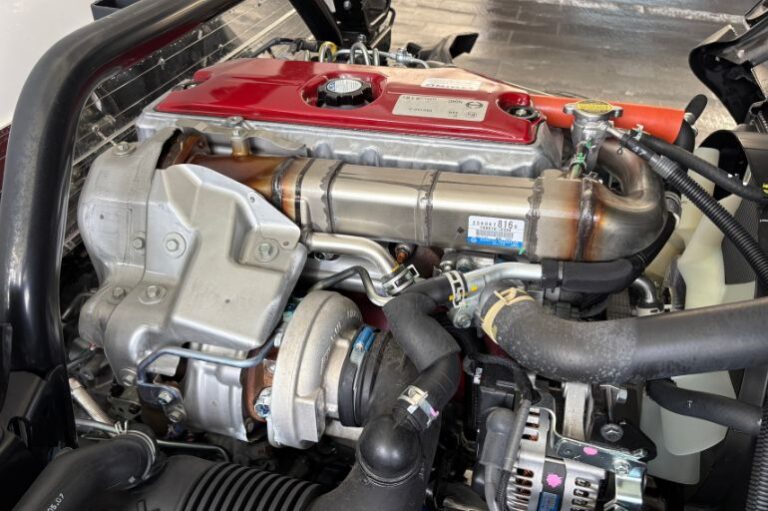
The four-litre N04C diesel now delivers 440Nm, up from 420Nm, with maximum torque beginning at 1,300rpm rather than 1,400rpm.
However, Daniel Petrovski, Department Manager of Product Strategy for Hino Australia, said the revised powertrain represents a broader engineering programme than the figures alone suggest.
During the discussion with Fleet News Group, he outlined changes to engine components, emissions equipment, transmission electrics and gear selection.
Changes beneath the torque figure
The Euro 6 diesel gains a revised turbocharger and injectors, together with changes to the pistons and cylinder liners.
Petrovski also identified cooling-system revisions, including a larger-capacity oil cooler.
These changes accompany the addition of selective catalytic reduction, which uses AdBlue to control nitrogen oxide emissions, alongside Hino’s diesel particulate reduction system.
He also described an after-turbo catalyst and an exhaust fuel-injection arrangement intended to help raise exhaust temperature and support particulate-filter operation.
The result is a package of combustion, thermal-management and after-treatment changes supporting the move to Euro 6.
Hino has previous local experience with this emissions approach. Petrovski explained that the 300 Series hybrid had already used a Euro 6 diesel engine since 2020, providing an established operating history in Australia.
Earlier torque delivery
The increase to 440Nm is accompanied by maximum torque becoming available at a lower engine speed.
Petrovski said this was important to the truck’s response on hills, where the engine needs to accommodate increasing load as road speed and engine speed change.
Hino’s emphasis is on how the revised torque delivery interacts with the automatic transmission across the working range.
That distinction matters in a light-duty truck, where operating conditions can change quickly between low-speed manoeuvring, urban acceleration and sustained climbing.
Next-generation six-speed automatic
The updated truck retains a six-speed torque converter automatic, with revisions to its electrical system and operating behaviour.
Petrovski said the transmission now operates on 12 volts, matching the engine system. The previous arrangement used a 24-volt transmission alongside the 12-volt engine, with converters between the systems.
He described quicker shifts and quicker torque converter lockup in the updated combination.
The torque converter remains central to the transmission’s response under changing loads. Lockup provides a direct mechanical connection, while unlocked operation allows the converter to accommodate differences between engine and transmission input speed.
Petrovski explained that this flexibility can help the truck respond to a gradient without immediately requiring a downshift.
The six available ratios therefore tell only part of the story: converter operation and shift control also influence how the truck behaves.
Sequential selection adds operating flexibility
The updated transmission controls include a sequential shifter, allowing manual selection of gears one through six.
Drivers can continue to use Drive for normal automatic operation, then select a gear when the task requires more direct control.
Petrovski highlighted low-gear selection with the exhaust brake for downhill operation as a key benefit.
The change gives drivers more flexibility when approaching a descent and managing the truck through steep terrain.
Combined changes support increased GCM
Hino attributes the higher combination ratings to the engine and transmission revisions working together.
Selected 816 diesel models now offer an 11,500kg Gross Combination Mass with an 8,000kg Gross Vehicle Mass. The 716 has a 10,000kg GCM at 6,500kg GVM, while the car-licence-compatible 616 offers a 7,999kg GCM at 4,499kg GVM.
These ratings broaden the range of applications available to operators seeking an automatic truck for both load carrying and towing.
The Euro 6 update consequently reaches beyond exhaust emissions. Revised engine hardware, earlier torque delivery, transmission control and manual gear selection collectively change how the 300 Series can be specified and operated.