

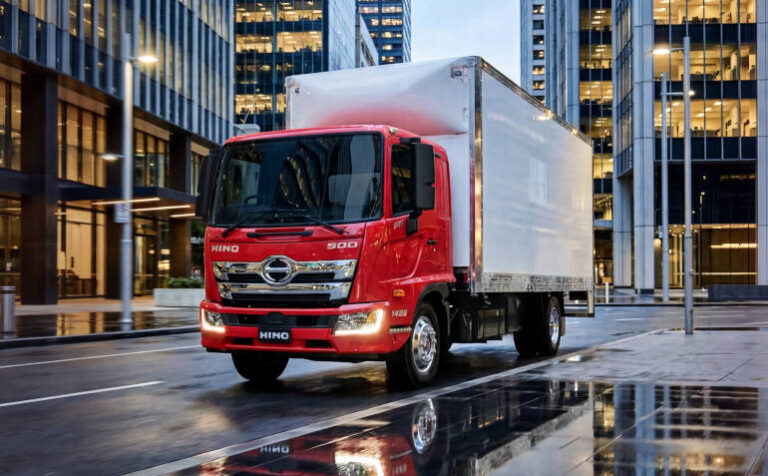
Hino is putting Australian operating experience at the centre of its 2027 medium-duty 500 Series, highlighting an established driveline alongside standard safety technology and connected fleet support.
Since the platform’s introduction in 2019, the 500 Series has worked across applications ranging from freight and construction to council services and towing. For fleet managers assessing replacement vehicles, that operating history provides context for evaluating reliability, maintenance requirements and suitability for the task.
“The Hino 500 Series was engineered to meet the demanding needs of Australian operators, and the established A05C engine and driveline have demonstrated their performance, reliability and capability across a wide range of working applications,” said Daniel Petrovski, Department Manager – Product Strategy for Hino Australia.
Looking beyond the purchase decision
Hino’s ownership proposition combines the truck’s mechanical package with telematics and customer support designed to keep vehicles working.
The A05C 5.1-litre four-cylinder diesel engine produces 240hp and 794Nm of torque and is paired with a six-speed Allison True Automatic transmission across the range.
Hino says the transmission provides smooth acceleration through gear changes without torque interruptions. It also removes the need for clutch replacements, a consideration when assessing maintenance expenditure over a vehicle’s life.
“The true automatic transmission also eliminates the need for clutch replacements, helping businesses manage whole-of-life operating costs,” said Mr Petrovski.
A standard engine Jake Brake works with the transmission to assist downhill control and auxiliary braking. FE models feature electronically controlled full air brakes, while a wheel spring park brake is now fitted across the range.
According to Hino, the 2027 model meets ADR80/04 emissions requirements using Japan’s pPNLT exhaust emissions standards, which are equivalent to Euro 6.
Turning operating data into useful information
Hino-Connect telematics is standard across the 500 Series, providing access to vehicle utilisation, fuel efficiency, driver behaviour and safety information.
For fleets operating trucks across different sites or services, this visibility can help identify how assets are being used and where further investigation may be needed.
The system is available through a desktop portal or mobile app and includes remote diagnostics and proactive maintenance support. Severe vehicle fault alerts can be sent to the driver, operator and a dedicated Hino-Connect Specialist to help coordinate dealer communication and repairs.
“Hino-Connect gives businesses access to information that can help them better understand how their trucks are being used and identify opportunities to improve productivity and manage operating costs,” said Mr Petrovski.
The range is also backed by Hino Advantage, its customer care program focused on supporting uptime throughout ownership.
One range, different working roles
The 500 Series covers FC and FD models at 11,000kg gross vehicle mass and FE models at 14,000kg, with Standard Cab and Crew Cab configurations.
Body applications include trays, tippers, pantechs, tilt trays, tow trucks and crane trucks. The range also caters for refrigerated transport, fire and emergency services, council operations and specialised vocational work.
“Medium-duty applications can vary significantly from one business to another, which is why flexibility is such an important part of the Hino 500 Series,” said Mr Petrovski.
FC models offer a Day Cab, while FD and FE models are available with an ADR42 sleeper-compliant Rest Cab. Crew Cab options in the FD and FE ranges cater for tasks requiring crews to travel with their equipment.
The Built-to-Go offering now includes an FC 3.6-metre Factory Tipper and an FC 4-metre Tipper Pro, giving operators two options to match different tipper requirements.
Supporting the person behind the wheel
Standard Hino SmartSafe brings together a Pre-Collision System with Autonomous Emergency Braking and Pedestrian Detection, Lane Departure Warning System, Vehicle Stability Control and a reverse camera.
A driver’s SRS airbag and seatbelt pretensioner provide additional protection, while LED headlamps and fog lamps are fitted throughout the range.
Cabin features include an adjustable ISRI driver seat with lumbar support, a tilt and telescopic steering column, steering wheel controls and a seven-inch Multi-Information Display. Storage, charging outlets and LED interior lighting support everyday use.
Hino links these features to the broader challenge of making trucks accessible to drivers with different levels of experience.
“Easier operation of the 500 Series enables businesses to recruit and retain drivers with a broad range of experience,” said Mr Petrovski.
For fleet buyers, the 2027 500 Series presents a package built around familiar mechanical hardware, application choice and support during operation. Assessing those elements together can help determine how well a truck will fit the organisation’s service requirements over its working life.