


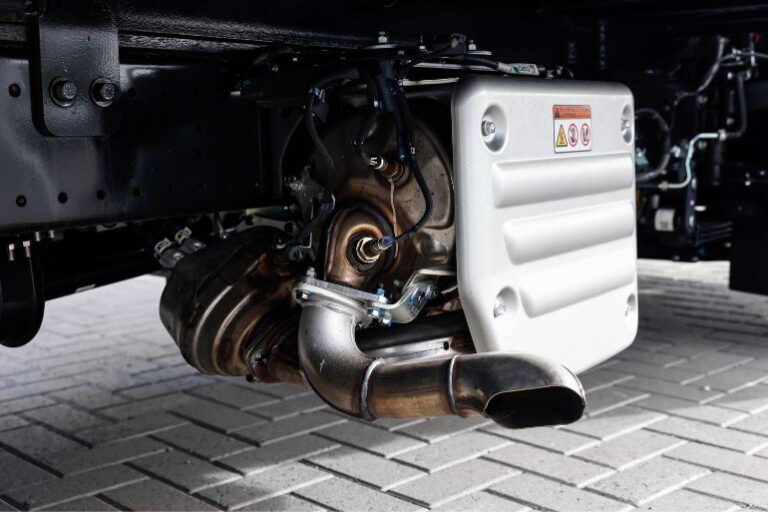
Hino’s move to Euro 6 for its 300 Series diesel range has required a rethink of chassis packaging, with additional emissions equipment changing the space available for fuel tanks, batteries and body installations.
While the updated engine and automatic transmission deliver increased torque and combination ratings, the changes behind the cab are equally relevant to bodybuilders and operators specifying a working truck.
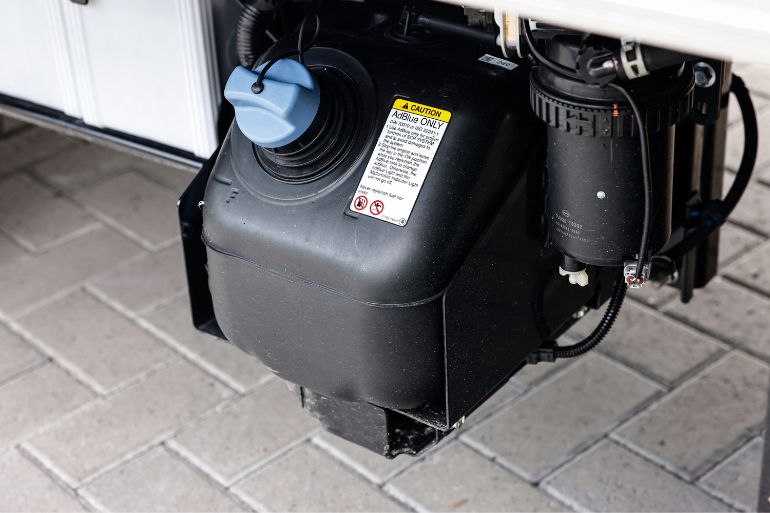
Daniel Petrovski, Department Manager of Product Strategy for Hino Australia, said accommodating an AdBlue tank and revised exhaust equipment had required changes across the range.
“We needed to do a chassis repackaging,” he said during the product presentation.
Fuel tank capacities and component locations have consequently changed on some models, with short-wheelbase configurations presenting a particular challenge.

More equipment in a limited space
The Euro 6 diesel combines Hino’s diesel particulate reduction system with selective catalytic reduction, which uses AdBlue to control nitrogen oxide emissions.
The additional equipment must share chassis space with the fuel tank, batteries and the components needed to support the truck’s body and application.
On a light-duty truck, particularly a short-wheelbase model, there is limited room to accommodate those requirements.
Petrovski explained that some configurations now place the fuel and AdBlue tanks on the left-hand side, with battery positioning also adjusted to suit the revised layout.
Those changes matter when planning toolboxes, hydraulic equipment, auxiliary tanks and other chassis-mounted accessories. An installation used on a previous truck may need to be reconsidered for its Euro 6 replacement.
Fuel capacity changes vary by model
The packaging programme has produced a mix of fuel tank capacities rather than a uniform change across the range.
Petrovski identified capacities of 80, 100 and 150 litres during the presentation, explaining that some models had gained capacity while others had less.
One example was the shortest-wheelbase Standard Cab tipper, where the fuel tank changed from 100 to 80 litres to accommodate the revised equipment.
The variation makes model-specific information important. Buyers should check the selected truck’s specification rather than assuming an existing fuel capacity carries across to the updated version.
For operators, the practical assessment is how that capacity fits the working day, including route distance, fuel use and access to refuelling.
The presentation did not establish a quantified fuel-consumption improvement for the conventional diesel that could be used to calculate the effect of tank changes on range.
Spare-wheel placement becomes part of the discussion
Petrovski also highlighted spare-wheel accommodation as an example of the pressure on available chassis space.
For a particular tipper body supplied from Japan, he said the revised layout left no room for the spare wheel in its previous chassis location. The wheel was carried in the body for transport, with an alternative mounting arrangement required for operation.
The example illustrates how emissions equipment can affect details beyond the powertrain.
Spare-wheel access, storage and mounting need to be considered alongside body dimensions and payload, particularly where the truck carries equipment that competes for the same space.
That arrangement should be checked for the specific model and body combination rather than treated as a change applying to every 300 Series.
Involve the bodybuilder early
For fleets replacing an existing truck, the updated chassis layout makes early coordination between the operator, dealer and bodybuilder particularly useful.
The starting point is the complete working vehicle: what it carries, which equipment it needs and where that equipment can be installed.
Fuel and AdBlue filling access, battery access, spare-wheel accommodation and service access all need to work with the completed body.
A familiar model designation does not necessarily mean the available installation space is unchanged.
Hino is also developing additional Built to Go configurations, including steel tray and van-body prototypes with Alltruck Bodies. These provide another option for customers whose requirements suit a ready-bodied vehicle.
The Euro 6 300 Series demonstrates that an emissions update reaches well beyond the exhaust system. For bodybuilders and fleet operators, understanding the revised chassis layout is an essential part of turning the cab-chassis into a truck that suits the job.