


Australia’s heavy vehicle industry is exploring new ways to reduce fuel consumption and emissions, but one of the most promising technologies might not be found in the truck itself.
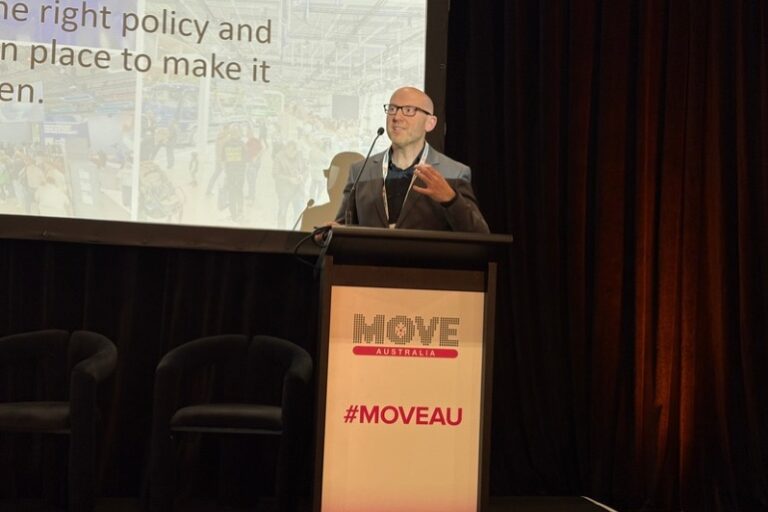
Speaking at MOVE Australia 2026, Adam Ritzinger, Chief Technical Officer at Heavy Vehicle Industry Australia (HVIA), highlighted how powered trailer axles could change the way heavy vehicles operate, while warning that existing regulations are struggling to keep pace with innovation.
The technology allows trailers to recover energy normally lost during braking and downhill travel, store it in batteries and use it to power onboard equipment or even assist with moving the trailer.
It’s a different approach to improving heavy vehicle efficiency because it doesn’t necessarily require replacing the prime mover.
Turning wasted energy into useful power
Ritzinger explained that conventional heavy vehicle braking systems convert kinetic energy into heat, which is then lost to the atmosphere.
By installing energy recovery systems on trailer axles, some of that energy can be captured and put to work.
One example highlighted during the presentation was a McDonald’s refrigerated semi-trailer displayed at the 2025 Brisbane Truck Show.
The trailer uses an energy recovery axle to generate electricity for its refrigeration equipment while travelling, reducing the energy required from other sources.
Ritzinger described it as a practical example of technology already operating on Australian roads.
The next development takes the concept further by adding an electric motor capable of providing motive power directly to the trailer.
Australian company V Motion has developed technology that allows a trailer to contribute to its own movement, helping overcome rolling resistance and aerodynamic drag rather than relying entirely on the prime mover.
“So it’s not just running the refrigeration motor on the trailer, but it’s actually propelling the trailer along,” Ritzinger explained.
Regulations haven’t caught up
While the technology is developing, Australia’s heavy vehicle regulations present a significant obstacle.
According to Ritzinger, existing rules accommodate trailers that recover energy but don’t yet fully accommodate trailers that use powered axles to provide motive power.
The problem isn’t necessarily that the technology has been assessed and found unsafe. Instead, the regulatory framework was developed before these systems were contemplated.
“Now, that doesn’t mean that somebody’s looked at this and said that’s unsafe. We need to stop it,” Ritzinger said.
“What it means is that it’s so novel that when we were writing the Australian design rules and the road rules in this country, it wasn’t even on the radar.”
Traditionally, vehicle regulations have treated trucks as powered vehicles and trailers as equipment being towed. Powered trailers challenge that distinction.
Allowing these systems to become commercially available at scale would require changes to several regulatory frameworks, including the Heavy Vehicle National Law, Australian Design Rules and state and territory road rules.
Ritzinger warned that this would take time and urged governments to begin the process.
“We absolutely need to get cracking on that now because it will take time.”
Another pathway to lower emissions
For fleet operators, powered trailers present an interesting alternative to the assumption that reducing transport emissions must always involve purchasing a completely new truck.
Depending on the application, energy recovery and powered axle technology could potentially reduce the energy required to operate existing heavy vehicle combinations.
Refrigerated transport is one obvious application, but the potential extends to other freight operations where trailers contribute significant rolling resistance and aerodynamic drag.
There are still questions about costs, reliability, maintenance requirements and the commercial benefits of adopting these systems. However, Ritzinger’s examples demonstrate that Australian businesses are already developing and deploying elements of the technology.
For HVIA, the message is that regulation needs to evolve alongside engineering innovation.
Ritzinger called for regulatory work to begin so manufacturers can eventually obtain the necessary vehicle approvals and bring powered trailer designs to market.
The broader challenge for government is ensuring new technologies can be assessed and introduced safely without becoming trapped in rules written for a previous generation of heavy vehicles.
For fleet managers looking to improve productivity and reduce emissions, the next significant efficiency improvement might come from something they’ve traditionally regarded as passive equipment — the trailer.