

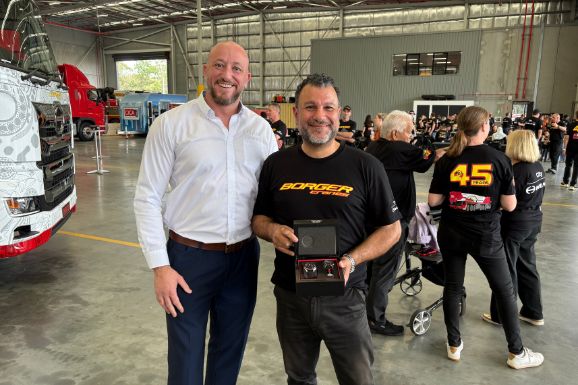
Selling 4,000 trucks is a remarkable achievement in the commercial vehicle industry, but for Christian Geadah from City Hino, the milestone represents more than 27 years of building relationships, understanding customers and finding the right truck for the job.
Christian Geadah has spent his entire truck sales career with City Hino, joining the dealership in February 1999. Over that time, he has sold 4,000 Hino trucks, an achievement recognised with a special award presented earlier this year.
It’s an impressive number, particularly considering the complexity of commercial vehicle sales, where customers are often purchasing a truck that needs to be specifically configured for their business.
Interestingly, Christian wasn’t keeping count himself.
“I had an idea because I deal with a few big customers, and I know how many they’ve got,” he explained when asked about reaching the milestone.
The exact number came as a surprise, but after almost three decades with the same manufacturer and dealership, Christian has accumulated plenty of experience and built relationships that have lasted for years.

It started at a kitchen table in Rooty Hill
Christian still remembers selling his first Hino truck in 1999. The customer was an Italian bricklayer living in Rooty Hill in western Sydney, and the vehicle was a small Hino Dutro with a steel tray and timber floor.
It was a very different sales environment from today. There were no smartphones, online vehicle configurators or instant email conversations. Meeting customers often meant travelling to their homes after they finished work.
Christian arranged to visit the bricklayer at his home and waited until he finished work at 5pm.
He remembers the drive to Rooty Hill feeling particularly long, before the motorway network that now connects much of western Sydney. The sale was completed at the family’s dinner table while Christian shared a pasta meal with his customer.
“We did the deal at his dinner table while I ate pasta with the family,” explained Christian. “That was how I was taught, and I’ve been doing that ever since.”
It was an introduction to a style of selling that has stayed with him throughout his career.
Relationships still matter
While technology has transformed the sales process, Christian believes personal relationships remain the foundation of successful commercial vehicle sales.
In 1999, quotations were still being prepared using typewriters, and much of the sales process involved visiting customers in person.
Today, email and mobile phones make communication easier, but Christian believes they cannot completely replace face-to-face contact.
“Going out, meeting the people. Not just talking over the phone. If it’s over the phone, you don’t get anywhere,” says Christian.
It’s a philosophy that has helped him develop relationships with businesses operating large fleets, where understanding the customer’s application can be just as important as knowing the truck’s specifications.
For Fleet Managers, the value of an experienced salesperson is often their ability to understand the operational requirements, identify potential problems and work with the manufacturer and bodybuilder to deliver a vehicle that is fit for purpose.
The Borger Cranes challenge
One of the more memorable examples from Christian’s career involves Borger Cranes, which recently celebrated the delivery of its 100th Hino truck.
The relationship began with a challenging order that required more than simply selecting a truck from the manufacturer’s range.
Christian recalled being given an order for 12 trucks, but with a significant condition.
“The Borger team gave me an order for 12 trucks, but said only build one. It had to work or I didn’t get the others.”
The first truck had to meet strict weight and payload requirements to transport counterweights for the company’s cranes. If it didn’t perform as required, the remaining 11 trucks would not proceed.
Christian worked with the bodybuilder to develop the specification, using computer drawings before the vehicle was constructed.
Once completed, the truck went through several rounds of adjustments and weighbridge checks to achieve the required carrying capacity.
“We had about six or seven goes at the weighbridge to weigh it, remove, add, change. Finally, got it right. And continued on with the next 11.”
That initial challenge became the foundation of a relationship that has now reached 100 Hino trucks.
Christian explained that the Borger Cranes fleet includes a wide variety of vehicle configurations, from smaller trucks to prime movers, machinery transporters and even a dedicated tyre service truck. Each vehicle has a specific purpose supporting the crane fleet.
The experience demonstrates how commercial vehicle sales can involve considerable technical knowledge, problem-solving and collaboration between the customer, dealership and bodybuilder.
From diesel mechanic to truck salesperson
Christian’s technical background has played an important role in his career. Before moving into sales, he trained as a diesel mechanic and already held a truck licence.
He credits his original manager, Bevin Joseph, with recognising that experience and helping him develop the skills needed to become a successful salesperson.
“You’ve got your truck license. You’ve got your mechanics knowledge. I’ve just got to help you learn how to sell.” Christian recalls with a smile.
Christian says Bevin encouraged him to build his product knowledge, providing the foundation for a career that has remained with the same brand and dealership for 27 years.
His mechanical background also gives him an understanding of how vehicles operate and the importance of selecting the correct specification for each application.
It’s particularly valuable when discussing complex body configurations, payload requirements and specialised equipment with customers.
Watching the trucks change
Over almost three decades, Christian has seen significant changes in the Hino product range and the requirements of commercial fleet customers.
He has worked through generations of trucks, with improvements in vehicle technology, comfort, safety and emissions performance.
The Hino 700 Series has become an important part of the range, with configurations suitable for a variety of applications.
Christian explained that the versatility of the product allows City Hino to support customers operating tippers, tipper and dog combinations, prime movers and specialised rigid trucks.
He also sees environmental requirements becoming a greater consideration for fleet buyers.
With newer Euro 6 diesel vehicles and hybrid technology becoming part of purchasing discussions, Christian says customers are increasingly considering emissions alongside their operational requirements.
However, he recognises that not every powertrain suits every application, reinforcing the importance of understanding what the customer actually needs.
The people behind 4,000 trucks
When asked who he wanted to thank for his achievement, Christian was quick to recognise the people and organisations that have supported his career.
He acknowledged Bevin Joseph for giving him the opportunity to move into sales and teaching him the importance of product knowledge.
He also thanked the Suttons family, which owns City Hino, and Hino for providing products he has been confident selling throughout his career.
“Thanks to the Hino brand because it’s easy to sell when you’ve got a good brand.”
For Christian, staying with the same dealership and manufacturer for 27 years reflects his confidence in the products, the organisation and the customers he works with.
His achievement also highlights something that can sometimes be overlooked in fleet procurement. While vehicle specifications, pricing and whole-of-life costs are essential to purchasing decisions, experienced people who understand the customer’s business can add considerable value to the process.
From selling his first Hino Dutro over pasta at a kitchen table in Rooty Hill to helping deliver complex fleet solutions for major customers, Christian has built a career around technical knowledge and personal relationships.
And after 4,000 trucks, the approach that helped him make his first sale remains just as relevant today.