

Australia’s road freight operators are facing one of the toughest economic environments in decades, with rising costs, uncertain freight volumes and pressure on margins forcing businesses to rethink their fleet investment strategies.
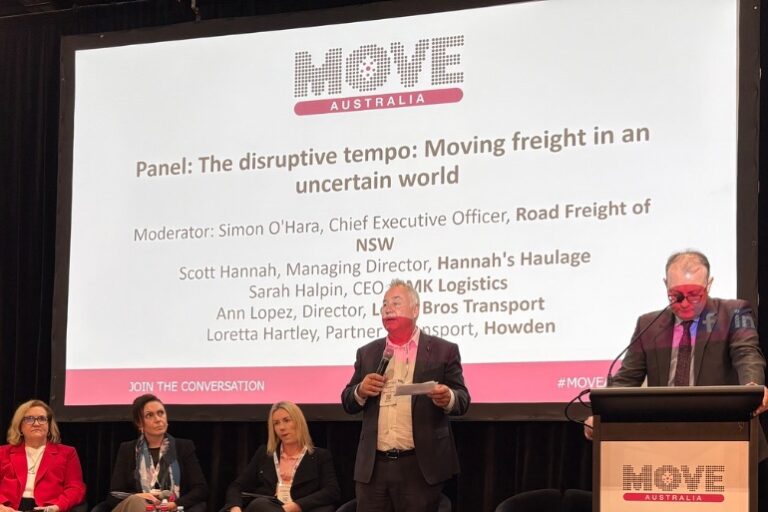
Speaking at MOVE Australia 2026 in Sydney, Scott Hannah, Managing Director of Hannah’s Haulage, warned that the next 12 to 18 months could be particularly challenging for transport operators.
“It’s the toughest time that I’ve ever known, actually,” Hannah told the audience during a panel discussion hosted by Simon O’Hara, CEO of Road Freight NSW.
Unlike floods, bushfires and other disruptions that can be relatively short-lived, Hannah believes the current economic pressures will require businesses to make difficult decisions over an extended period.
He compared the situation with the financial challenges experienced by transport operators during the late 1980s and early 1990s, when high interest rates placed enormous pressure on businesses.

Keep costs under control
Hannah’s advice to transport operators was straightforward: avoid overcommitting, review every expense and be cautious about investing in additional equipment.
“You’ve got to keep everything to a minimum,” he said.
“You’ve got to double check what it’s costing you and where you can save money because everyone’s going to do the same thing, and you’ll probably find that the volumes of your customers will drop.”
He cautioned operators against purchasing additional trucks simply because a new project or contract becomes available.
Instead, he suggested considering equipment rental or subcontractors to manage temporary increases in freight demand without committing to long-term capital expenditure.
This approach also helps maintain capacity across the broader transport industry by supporting smaller operators and subcontractors during difficult trading conditions.
Hannah encouraged businesses to maintain existing equipment where practical rather than automatically replacing trucks with new vehicles.
The message was particularly relevant for fleet managers developing replacement programs and capital budgets in an uncertain market.
Technology can deliver savings
While recommending caution on vehicle purchases, Hannah believes technology offers opportunities to improve business efficiency.
Administrative costs were identified as an area where operators should look for savings, particularly as artificial intelligence and other digital tools become more accessible.
“Have a look at your tech in your admin role. That can save you a lot of money,” he said.
Hannah also encouraged operators to review supplier costs, including fuel, tyres and vehicle servicing, rather than simply accepting invoices without questioning the value being delivered.
His message was that every part of the business needs attention when margins are under pressure.
Bigger trucks could improve productivity
Another opportunity Hannah identified was improving productivity through higher-capacity vehicle combinations.
Where routes and freight tasks permit, moving to larger combinations could reduce the number of trucks and drivers required to complete the same transport task.
“If we can run a B-double or a B-triple, this is what we’re going to look at. Then you’ve got one driver, one truck instead of two trucks and two drivers,” he explained.
However, Hannah emphasised that achieving these efficiencies requires collaboration with customers.
Transport operators need to explain how changes to freight movements, vehicle configurations and delivery arrangements can reduce costs across the supply chain while improving returns for the carrier.
A warning against overinvestment
Hannah also expressed concern about the potential for customers to reduce spending or delay projects as economic conditions tighten.
For transport businesses relying on major infrastructure and energy projects, this creates uncertainty about future workloads and the equipment required to service them.
His advice was to avoid building a fleet around projected work that may not eventuate.
The discussion highlighted an important fleet management principle: maintaining financial flexibility can be just as important as having the latest equipment.
For operators planning vehicle replacements or fleet expansion, the next 18 months may require a stronger focus on utilisation, maintenance, operating costs and return on investment.
Despite his concerns, Hannah finished with a positive message for the industry.
“Keep your chin up,” he told the audience.
For transport operators navigating uncertain economic conditions, the challenge will be balancing short-term financial discipline with the need to maintain safe, reliable fleets that are ready when freight demand improves.