


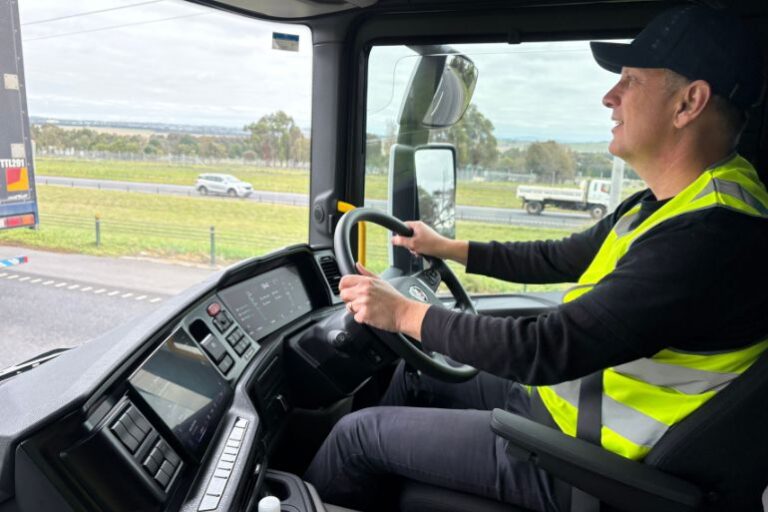
Issuing infringements to truck drivers may identify unsafe behaviour, but it doesn’t necessarily address the business decisions and operating conditions that created the risk in the first place.
That was one of the key messages from National Heavy Vehicle Regulator (NHVR) CEO Nicole Rosie during her presentation at MOVE Australia 2026 in Sydney, where she outlined a significant shift in how the regulator intends to improve heavy vehicle safety.
Rosie challenged the industry to consider whether traditional roadside enforcement was delivering lasting safety improvements, particularly when drivers have limited control over the circumstances that contribute to non-compliance.

Is the driver really the problem?
Using fatigue as an example, Rosie asked the audience whether issuing a fine to a driver would change the underlying causes of fatigue across the transport industry.
Her argument was that enforcement frequently targets the person exposed to the greatest risk rather than the business practices that contributed to the situation.
Drivers can find themselves under pressure from scheduling demands, delivery commitments and operational decisions made by others.
In some circumstances, Rosie explained, drivers may even lose their jobs after receiving an infringement for circumstances they had little power to change.
The challenge for regulators is to move beyond identifying individual breaches and understand why they occurred.
“So we need to change the system if we’re going to change the outcome,” Rosie told delegates.
Finding the risk before it reaches the road
Rosie explained that traditional enforcement often identifies problems after unsafe conditions have already developed.
By the time a truck is stopped with defective brakes, for example, it may have been operating in that condition for some time.
The same applies to drivers who have exceeded permitted driving hours.
Rather than relying primarily on roadside inspections to discover these problems, the NHVR wants to identify where risks originate and intervene earlier.
Rosie described this as moving towards a more risk-based approach to regulation, using data and intelligence to understand patterns of unsafe practices across the industry.
“We’ve agreed we’re going to move towards becoming more risk-based,” she said.
This means looking beyond the individual driver to examine maintenance systems, scheduling, management decisions and the effectiveness of safety controls.
What this means for fleet managers
For fleet managers, Rosie’s comments reinforce the importance of having a safety management system that works in practice, rather than simply maintaining policies and procedures to demonstrate compliance.
A driver exceeding their permitted hours may be the visible problem, but the underlying cause could involve unrealistic delivery schedules, poor workforce planning or inadequate management oversight.
Similarly, a vehicle defect identified during a roadside inspection may point to shortcomings in preventative maintenance, defect reporting or decisions about when vehicles are removed from service.
These are organisational risks that require management attention.
A mature fleet management approach means using operational information to identify recurring problems, understanding why they occur and putting effective controls in place before an incident or infringement.
A different approach to regulation
The NHVR is increasingly combining compliance records, accreditation information, incidents and other data to identify operators presenting higher levels of risk.
Rosie explained that this intelligence-led approach would allow the regulator to focus more attention on businesses and practices that contribute to unsafe outcomes, rather than relying on widespread roadside enforcement.
The intention is not to remove responsibility from drivers, but to recognise that improving safety requires accountability throughout the transport operation.
For fleet managers and transport executives, the message from MOVE Australia was clear.
Good safety management isn’t measured by how many infringements are issued or how many compliance boxes are ticked. It’s measured by whether the business understands its risks and has effective controls in place to prevent unsafe conditions from developing.