

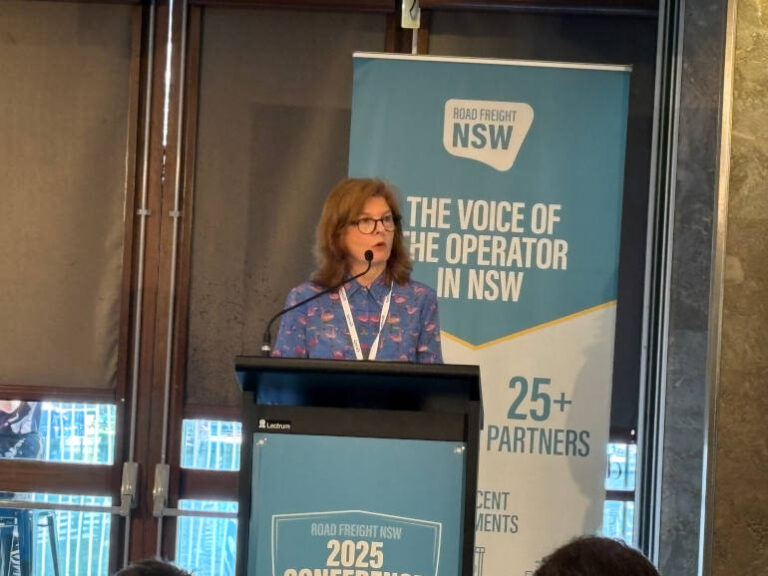
Last month, at the Road Freight NSW 2025 Conference and Awards, Sally Webb, Deputy Secretary of Safety, Policy, Environment and Regulation at Transport for NSW, delivered a wide-ranging address on the challenges and opportunities facing the road freight industry. Her focus was clear: building a safer, more sustainable, and more inclusive industry through strong collaboration between government and operators.
Safety as the First Priority
Webb emphasised that safety remains the central priority for Transport for NSW. Her team leads the state’s multi-modal safety and decarbonisation policy agenda, with road safety front and centre. “One of the most important things that my team works on is making sure that every journey—yours included—is as safe as it can be, whether it’s people or freight moving across our network,” she said.
She acknowledged the increasing pressure on drivers, noting fatigue, limited rest facilities, and unsafe behaviour by light-vehicle drivers as growing concerns. “Your drivers tell us the way light vehicle drivers behave creates risks and real stress, which they then carry for long hours,” she said.
Addressing Workforce Challenges
The freight industry is facing a critical driver shortage, with 28,000 heavy vehicle positions unfilled nationally. Webb highlighted the scale of the challenge: nearly half of drivers are aged over 55, while only 5.4% are under 25. Women remain significantly under-represented, making up just 3% of the heavy vehicle workforce.
To tackle this, Transport for NSW is supporting reforms to simplify driver entry pathways. “Entry pathways are unclear, inconsistent, and frustrating for applicants,” Webb admitted. She pointed to upcoming national reforms that will introduce experience-based progression, structured supervision, and competency-based training—piloted in 2025 and rolled out nationally from 2026.
Webb also called for cultural change within the industry. Clean, secure rest facilities, proper lighting, and a respectful workplace culture, she said, are essential to attracting new drivers, particularly women and younger workers.
Freight Reform and Future Initiatives
Looking beyond licensing, Webb outlined the NSW Freight Policy Reform Program. This includes:
- A new online hub with clear information on driver pathways, licence classes, and training options.
- A targeted workforce attraction program developed in partnership with industry.
- Investment in corridors, hubs, and network upgrades through the Freight Master Plan.
- A new heavy vehicle access policy to encourage safer, more productive vehicles on the network.
- Expanded rest stop facilities and support systems for drivers.
She also underlined the importance of aligning licensing and vocational training, stressing that while licensing ensures safe drivers, vocational training and employer support prepare them for the diversity of roles across the freight industry.
Partnership with Industry
Webb closed her presentation by highlighting the importance of collaboration. “Lasting change demands strong and open government and industry partnership,” she said. She acknowledged the success of initiatives like Transport Women Australia scholarships and NSW operators’ buddy systems for new drivers, noting they provide models for the kind of industry-led innovation that can drive progress.
“Together, we’ll attract new talent, retain experienced drivers, and secure a safer, more sustainable future,” Webb concluded.
- How Latin American Fleets Are Lifting Efficiency and Compliance
 For many fleet operators, route planning has traditionally been viewed as a back-office function — a daily exercise in allocating vehicles, assigning customers and setting estimated time windows. But leading transport operators in Latin America are reframing route planning as a frontline safety and efficiency strategy. Recent discussions at Geotab Connect 2026 with fleet leaders
 - How Latin American Fleets Are Using Cameras to Tackle Theft, Compliance and SecurityWhen fleet operators first consider in-vehicle video, the conversation usually centres on crash evidence and driver behaviour. But insights shared during the LATAM customer session at Geotab Connect 2026 revealed a broader and more strategic use of video technology across transport operations in Latin America. For these fleet leaders, video is no longer just a safety camera.
- Heavy Truck Digitalisation: The TCA Investment Is Starting to Pay OffAustralia’s heavy vehicle sector has long been complex — long distances, high productivity combinations, remote operations and increasingly stringent compliance requirements. But as regulatory settings evolve and technology matures, the digitalisation of heavy transport is accelerating. At Geotab Connect 2026, senior leaders pointed to a tipping point: years of investment in Transport Certification Australia (TCA)
- Latin American Driver Survey Reveals Safety Risks Driven by Stress and Productivity PressureFleet operators across Latin America are facing a complex safety challenge: drivers are under pressure to deliver productivity, often at the expense of safe driving behaviours. At a recent regional session at Geotab Connect 2026, results from a survey of approximately 500 drivers across Mexico, Central America and South America were shared, providing a clear
- Driver fatigue: The invisible risk costing fleets livesColin Hughes, APAC Senior Vice President, Optix Australia There are few calls a Fleet Manager fears more than the one reporting an incident. In seconds, it can shift from a routine day to injured drivers, damaged vehicles and disrupted operations — and in the most severe cases, irrevocable reputational damage or worse, a family waiting for