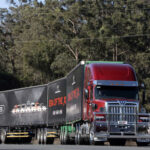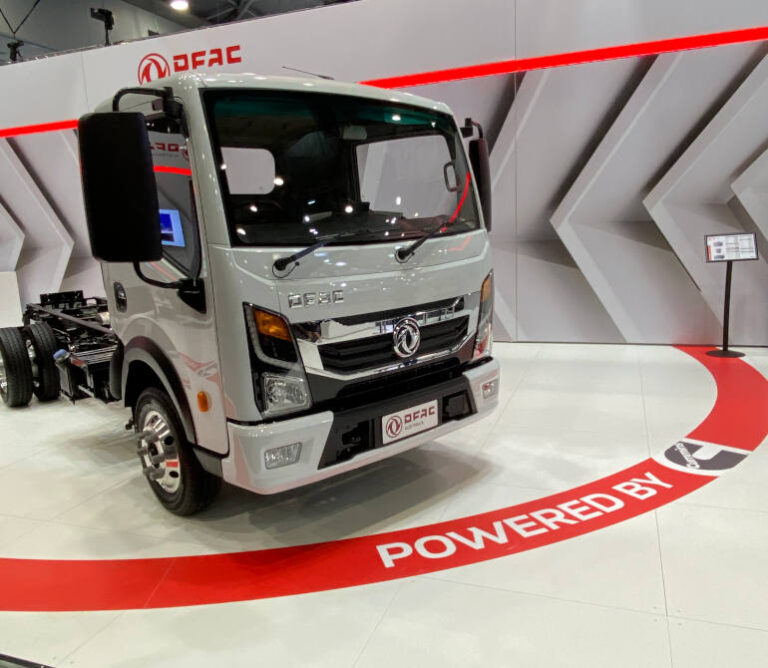
Chinese truck brands are becoming an increasingly visible force in the Australian truck market, adding a new layer of disruption at a time when operators are already dealing with cost pressure, supply constraints and changing emissions standards.
Over the past two years, a growing number of China-sourced heavy and medium-duty trucks have entered the market, often positioned on aggressive upfront pricing. For some operators, particularly those focused on capital cost, that has made them hard to ignore.
Price resets expectations — but not the full equation
The most immediate impact of Chinese brands has been on price perception. In segments such as eight-wheelers and selected heavy-duty applications, lower entry pricing has reset conversations between fleet buyers, dealers and established OEMs.
However, fleet decision-makers are weighing more than purchase price alone. Whole-of-life cost, parts availability, dealer coverage, resale value and uptime remain central to most fleet procurement frameworks — particularly for council, construction, waste and logistics operators.
This has created a clear divide in the market between buyers prepared to trial new entrants and those prioritising long-term asset certainty.
Established OEMs hold firm on value
Rather than chasing headline pricing, established brands have largely maintained their value-based positioning. The focus remains on safety systems, emissions compliance, service support and proven reliability, especially for fleets operating across multiple sites or jurisdictions.
This approach reflects a broader industry view that competing purely on price carries risk — particularly where vehicles are expected to remain in service for 10 to 15 years.
Where Chinese brands are gaining traction
Chinese trucks are finding traction in specific use cases:
- Price-sensitive applications with shorter replacement cycles
- Fleets with in-house maintenance capability
- Operators trialling vehicles for secondary or non-critical tasks
In these scenarios, the risk profile is different, and buyers are more willing to experiment.
At the same time, established brands continue to dominate higher-utilisation, safety-critical and compliance-driven fleets, where downtime carries a higher operational cost.
A more complex buying environment for fleets
For Fleet Managers and Procurement Managers, the arrival of more Chinese brands has made the buying environment more complex — but also more competitive.
It has sharpened scrutiny of specifications, service agreements and residual assumptions, while reinforcing the importance of application-fit rather than badge or price alone.
The disruption is real, but uneven. Chinese brands are changing conversations, not yet rewriting the entire market.
The takeaway
Chinese truck brands are adding pressure at the lower end of the price spectrum and challenging traditional assumptions around cost. But for most fleets, the decision still comes down to reliability, support and long-term value.
As the market moves through 2026, the presence of new entrants is likely to keep pricing tight — while reinforcing why fleet buyers continue to look beyond the sticker price when making critical asset decisions.
- Why Europe is moving faster on truck emissions and technology
 Europe is accelerating the transition to cleaner and safer commercial vehicles through legislation and policy support, while Australia is moving at a slower pace due to infrastructure gaps and different regulatory priorities. According to Glen Dyer, Managing Director at IVECO Australia, the European market has advanced more quickly in areas such as emissions reduction, alternative
 - How Latin American Fleets Are Lifting Efficiency and ComplianceFor many fleet operators, route planning has traditionally been viewed as a back-office function — a daily exercise in allocating vehicles, assigning customers and setting estimated time windows. But leading transport operators in Latin America are reframing route planning as a frontline safety and efficiency strategy. Recent discussions at Geotab Connect 2026 with fleet leaders
- Euro 6 and Multi-Combination Trucks: The Emissions Lever Hiding in Plain SightAs debate continues around battery electric and hydrogen trucks, Craig Lee, Executive General Manager – On-Highway at Penske Australia & New Zealand, believes Australia may be overlooking a far more immediate emissions opportunity. “If you actually want to make the single biggest emission reduction that you can in Australia,” Lee said, “provide significant incentives to
- Breaking Barriers and Raising Standards in the WorkshopTransit Systems Victoria has appointed Ellearn Savvidis as Workshop Assets Manager at its Footscray depot, highlighting both her career progression and the growing diversity within Australia’s mechanical and public transport sectors. The appointment reflects a broader shift across the industry, where technical expertise, data capability and leadership skills are increasingly combined to manage modern fleets.
- Lift off for new Scania Air-OIs it a bird? Is it a Ute? No, it’s the new Scania Air-O Scania Australia today introduces a new diesel-free, zero-emission last-mile delivery solution that will drive forward the shift to a sustainable transport system and reshape the local logistics industry. Motivated by the sky-high rises in the price of diesel, Scania will begin