The Australian transport industry is heading into 2026 with a mix of caution and underlying confidence, as operators, fleets and suppliers adjust to softer market conditions following several years of intense activity.
Speaking at a media briefing late in 2025, Richard Emery, President and CEO of Hino Motor Sales Australia, outlined why the current slowdown should be viewed as a pause rather than a downturn — and how truck sales, fleet investment and the broader economy are expected to evolve over the next 12–18 months.
A market taking a breather
After the post-COVID surge in truck demand across 2021–2024, Emery said the industry is now experiencing what he described as a “breather”.
“It’s as if we’ve been running since COVID and everyone’s just having a breather,” he said, noting that decision-making has slowed rather than stopped.
This pause is being felt across new truck purchases, maintenance spend and refurbishment decisions. Workshops are seeing customers prioritise essential servicing only, with discretionary reconditioning work increasingly deferred into future years.
Importantly, this slowdown is not isolated to one segment. While prime movers and long-haul operations are under the most pressure, the effect is being felt right through the supply chain.
Why renewal pressure is building
One of the structural drivers pointing to renewed activity beyond 2026 is the age of the national truck fleet.
Emery said much of the growth seen during the boom years was driven by the need for additional vehicles, not replacement.
“We didn’t do a lot of replacing old trucks. We did a lot of ‘we need extra trucks’,” he said.
With the average truck now sitting at around 14 years of age, renewal pressure is building — particularly as emissions standards tighten and safety technology expectations rise.
“There’s got to be some renewal,” Emery said, pointing to Euro 6 emissions, safety systems and operational efficiency as unavoidable drivers of future replacement cycles.
Economic signals heading into 2026
Looking more broadly at the Australian economy, Emery suggested confidence should begin to stabilise through late 2026, supported by:
- Large-scale government infrastructure projects already in the pipeline
- A gradual recovery in consumer and business confidence
- Ongoing investment in mining, construction and logistics, particularly in Queensland and Western Australia
While growth is not expected to return to the double-digit levels seen during the COVID period, Emery expects a more sustainable expansion phase to emerge from late 2026 into 2027.
“We think the market will return to a normal growth stage going into 2027,” he said, forecasting more modest annual growth of around five to six per cent.
Truck sales outlook for 2026
From a truck sales perspective, 2026 is shaping up as a transitional year.
Ongoing supply constraints linked to the industry-wide move from Euro 5 to Euro 6 emissions standards will continue to affect model availability across several brands. This is expected to keep overall volumes below recent peaks, even as underlying demand remains intact.
The combination of delayed replacement cycles, emissions compliance and rising operating costs suggests demand has not disappeared — it has simply been deferred.
Key focus areas for Hino Motor Sales Australia
Against this backdrop, Emery outlined several clear focus areas for Hino as it navigates 2026.
1. Hybrid electric momentum
Hino’s 300 Series Hybrid has gained renewed interest from fleets reassessing full battery-electric timelines.
“The market is certainly rethinking low-to-zero emissions,” Emery said, noting increased order intake during the second half of 2025 as customers seek practical, near-term emissions reductions.
2. Expanding the 700 Series footprint
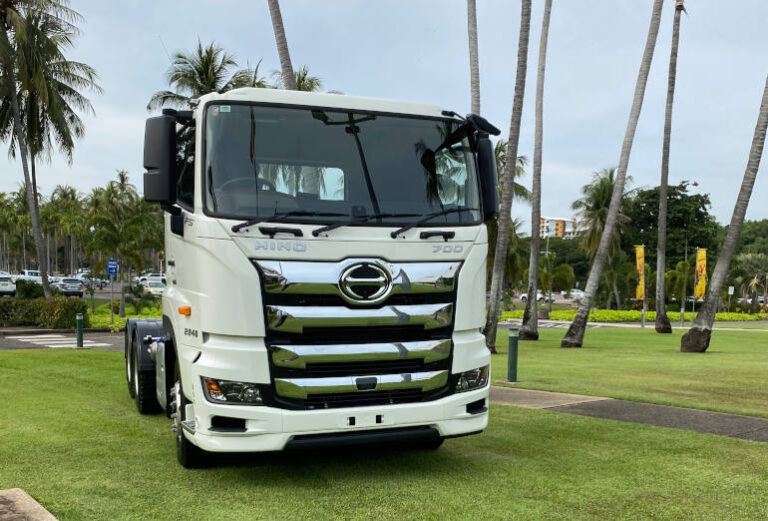
Hino is placing increased emphasis on the 700 Series, particularly in heavy rigid and single-trailer applications.
“We’re clearly highlighting ourselves as the heavy-duty rigid and single-trailer champion,” Emery said, identifying this segment as a core opportunity as fleets replace ageing assets.
3. Navigating Euro 6 transition
Managing production gaps during the Euro 5 to Euro 6 transition remains a key operational challenge for 2026, particularly in the medium-duty segment. Maintaining supply continuity where possible is a priority.
4. Preparing for the next growth phase
Hino’s longer-term “Horizon 30” strategy is focused on ensuring the business is structurally ready when growth returns — from dealer capacity and parts supply through to logistics efficiency and brand positioning.
“We want to be ready to take advantage of all of the positive things that are planned,” Emery said, referencing the expected benefits of global collaboration and scale over time.
What fleets should plan for in 2026
For Fleet Managers and Procurement Managers, 2026 is shaping up as a year to plan rather than rush.
Key considerations include:
- Assessing replacement backlogs created over the past four years
- Aligning replacement timing with Euro 6 availability
- Reviewing hybrid and alternative powertrains as interim solutions
- Factoring longer lead times into procurement strategies
While conditions remain challenging in parts of the market, the fundamentals of freight demand, asset renewal and infrastructure investment remain intact.
As Emery summed up, predictability — rather than explosive growth — is what the industry should expect next.
“I think 2027 will be a little bit more predictable,” he said. And for fleets that prepare during 2026, that predictability may prove to be the real opportunity.
- MOTUM Puts Heavy Vehicle Drivers to the Test
 Australian simulation technology company MOTUM has completed a heavy vehicle driver training platform that allows operators to practise challenging manoeuvres and hazardous situations in a controlled virtual environment. The platform supports vehicle configurations ranging from rigid trucks and semi-trailers to B-doubles, livestock combinations and oversized vehicles. It also captures performance data, giving instructors a consistent
 - Borger Hits a Century with HinoBorger Cranes has taken delivery of its 100th Hino truck, adding a distinctive Indigenous-liveried Hino 700 Series SS 2848 prime mover to its national fleet. The truck will transport auxiliary crane equipment, including counterweights, supporting a business that employs more than 1,100 people and operates 320 cranes and over 270 vehicles. For the Indigenous-owned family
- ATA Celebrates Excellence and ServiceDenis Robertson, a founding member and former Chair of the Australian Trucking Association, has been made a life member of the ATA’s Industry Technical Council in recognition of his long and distinguished service to the council. The honour was announced at the ATA’s 2026 Technology and Maintenance Conference in Melbourne, placing industry service alongside achievements
- Downer’s Hino Choice Starts with the DriverDowner Group has added another Hino 700 Series to its fleet, selecting an FY 3248 8×4 chassis for a specialised Bergkamp feeder unit used in road preservation and microsurfacing. The purchase followed an extensive evaluation of different truck manufacturers, with Downer assessing how each chassis would meet the demands of the application. Driver comfort, low
- Hino 500 Series Means BusinessHino is putting Australian operating experience at the centre of its 2027 medium-duty 500 Series, highlighting an established driveline alongside standard safety technology and connected fleet support. Since the platform’s introduction in 2019, the 500 Series has worked across applications ranging from freight and construction to council services and towing. For fleet managers assessing replacement