

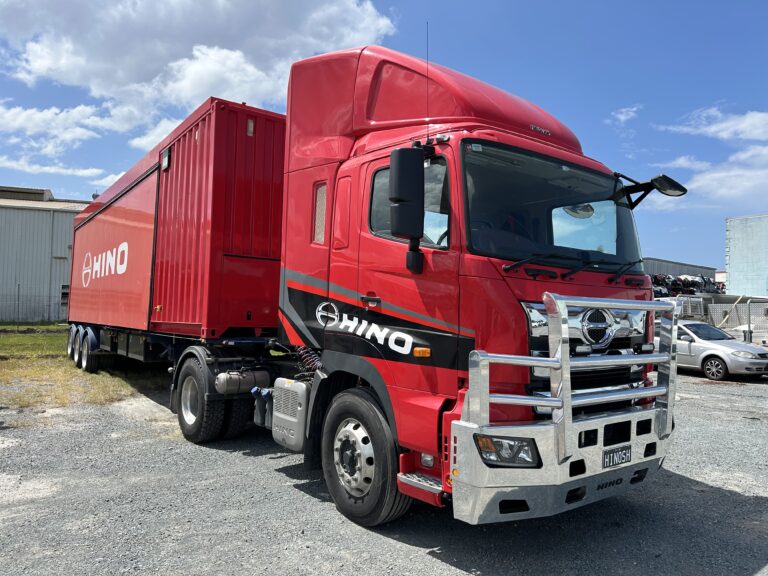
Hino Australia says an expanded 700 Series range has helped deliver a significant lift in heavy-duty orders as the company works to convince traditional light and medium-duty customers to consider Hino for more demanding applications.
Hino Australia President and CEO Richard Emery acknowledged that the 700 Series had not previously achieved the market penetration the company believed was possible.
For many customers, Hino had historically been strongly associated with light and medium-duty trucks.
“A lot of customers saw us as a light duty and medium duty truck brand,” Emery said.
That meant an operator might run Hino trucks in the lighter parts of its fleet while buying heavy-duty vehicles from another manufacturer.
Over the past several years Hino has been working to change that perception by expanding the number of 700 Series variants and applications available.
The strategy appears to be producing results.
“We’re talking about a tripling of our order intake over the last six months,” Emery said.
More applications create more opportunities
The expanded range is important in the truck market because many fleet operators require significantly different specifications across their operations.
A single fleet might require vehicles for metropolitan delivery, waste operations, construction, regional transport and trailer work.
Emery said providing more configurations gives Hino the opportunity to compete for a larger proportion of those requirements.
He said seeing Hino as a “one stop shop” rather than having to source particular applications elsewhere had contributed to the growth.
The changes have also become more important following the cessation of the 500 Series wide cab.
Hino has been encouraging some customers that previously used the 500 Series wide cab to consider stepping into the 700 Series, where the larger truck can provide additional performance, newer safety technology and a broader range of configurations.
Waste, street sweeping and vacuum truck applications were among the examples discussed during the drive.
Moving beyond traditional urban work
The broader range is also allowing Hino to target applications outside the urban work traditionally associated with the brand.
Engine and transmission combinations now allow the 700 Series to cover more regional operations, while Emery identified rigid trucks as remaining an important part of Hino’s heavy-duty focus.
He also pointed to tipper and dog combinations and some urban or shorter regional trailer applications as potential uses for higher-output variants.
For fleet buyers, this highlights the importance of specifying the truck for the task rather than simply selecting the highest power output available.
The appropriate engine and transmission combination changes according to payload, terrain, operating radius and whether the truck spends most of its life in metropolitan stop-start conditions or travelling further from base.
Broader range brings a supply challenge
Expanding a truck range also makes inventory planning more difficult.
Unlike a passenger vehicle range with a relatively small number of model grades, heavy trucks can require a large number of combinations to suit different bodies and applications.
“It absolutely complicates it,” Emery said.
The challenge for Hino has been predicting which new combinations customers will order most heavily. In some cases, demand has moved more quickly than expected.
“We’ve got some examples of the new models that we’re already sold out of for the next four or five months,” Emery said.
Other configurations have remained available for much faster delivery, requiring Hino to adjust its future production mix as ordering patterns become clearer.
A heavy-duty reset
The 700 Series was launched locally in 2021, during a period when COVID restrictions made traditional product launches, demonstrations and customer events difficult.
Five years later, Hino is effectively reintroducing the range to parts of the market through new variants and greater dealer activity.
Emery said there had been a “real momentum shift” since the expanded line-up was introduced. But he was also careful not to suggest the work was finished.
“There’s still more for us to do though. We think we can still do more.”
For fleets, increased competition in the heavy-duty segment provides another set of specifications to consider when replacing vehicles.
Whether the recent order growth translates into a sustained change in Hino’s position in the heavy-duty market will depend on how the expanded range performs across those new applications.