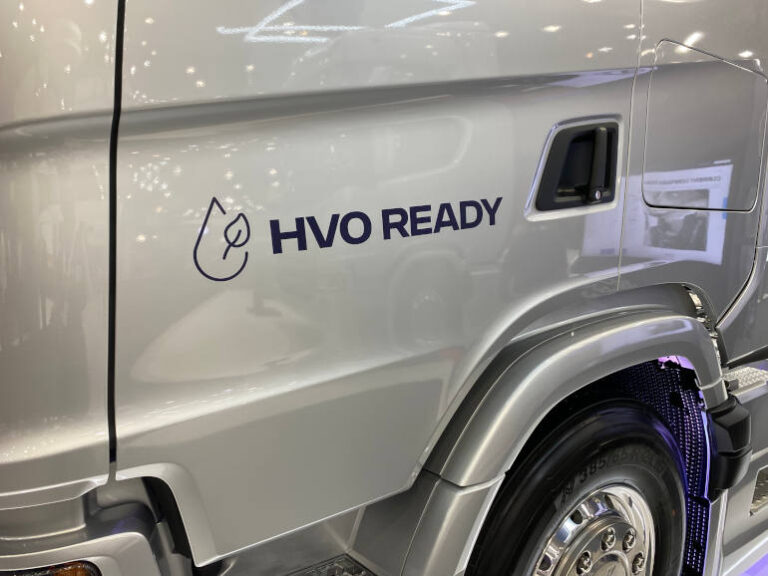
For fleet operators looking for practical, low-risk ways to reduce emissions in heavy vehicles, Cleanaway’s 2024 trials of HVO100 renewable diesel and hydrogen trucks offer one of the clearest case studies yet. It’s real-world data from real trucks under real workloads — the kind of evidence every fleet team is asking for.
Cleanaway ran both technologies side-by-side in 2024 across its Perry Road depot in Dandenong South, Victoria, demonstrating what “transition-ready” fuels look like today, and what future zero-emission operations may require.
HVO100: A Drop-In Fuel That Actually Works
The headline finding from Cleanaway’s demonstration is simple: HVO100 performs the same as mineral diesel in heavy vehicles — without modification — and delivers immediate Scope 1 emissions reductions.
In the first six months of the demonstration, Cleanaway used 32kL of HVO100 and avoided 87 tonnes of CO₂-e. Across the full eight-month program, consumption reached 46kL, delivering 124 tonnes CO₂-e avoided. All calculations were based on the Australian Government’s 2023 National Greenhouse Account Factors.
Why it matters for fleets
HVO100 is chemically near-identical to mineral diesel, so it’s a true drop-in solution. No new engines. No new tanks. No retraining drivers. No changes to maintenance regimes.
For fleets chasing decarbonisation without the downtime or capital investment of electrification, the operational simplicity is a major win.
Operational Performance: No Surprises (and That’s the Point)
Cleanaway monitored two Volvo collection trucks over three months prior to the trial (baseline on fossil diesel) and throughout the HVO100 demonstration.
The trucks had different duties — a high-stop sidelifter for the City of Casey and a long-running frontlifter servicing Coles — making them ideal for comparison.
The results were consistent:
- Equivalent fuel consumption to diesel across both trucks.
- Driver feedback confirmed no change in power delivery or refuelling frequency for the frontlift unit.
- The sidelift driver actually reported longer gaps between refuelling, aligning with Cleanaway’s data showing slightly lower consumption in that vehicle.
This kind of like-for-like validation is exactly what fleet teams need when considering new fuels. No loss of power, no loss of route performance, and no operational disruption.
Maintenance Findings: Cleaner Fuel Filters
One of the more interesting insights came from the workshop floor.
Cleanaway’s fleet maintenance team inspected fuel filters during scheduled servicing and found that filters from the HVO100 truck were noticeably cleaner than those from the identical mineral-diesel truck — even accounting for lower kilometres travelled.
For fleets operating high-hour trucks with tight service windows, anything that reduces contamination or wear is a bonus. It also suggests potential long-term improvements in injector life and engine health, although Cleanaway’s trial didn’t run long enough to quantify that.
Hydrogen Trucks: Preparing for the Next Frontier
Alongside HVO100, Cleanaway also welcomed two hydrogen trucks through its partnership with Viva Energy and the Viva Energy Hydrogen Mobility Project.
The hydrogen refuelling hub in Geelong opened earlier in 2025. Prior to opening, Cleanaway focussed on:
- driver and operations training
- identifying suitable routes
- assessing payload impacts
- preparing to track uptime, terrain performance and running costs
A realistic picture of hydrogen adoption
The hydrogen trucks have already faced hurdles, including Hyzon — the vehicle manufacturing partner — entering administration late in the build process. Cleanaway highlights this as evidence of how vulnerable hydrogen’s emerging supply chain still is in Australia.
Despite this, the Viva Energy Hub received substantial backing:
- $34 million from ARENA
- $1 million from the Victorian Government
For Fleet Managers, this shows hydrogen is coming — but it isn’t “plug and play”. Infrastructure, supply chain maturity, and operating models still need to evolve before heavy vehicle hydrogen becomes a mainstream option.
Customer and Industry Response
Cleanaway’s demonstration wasn’t just technical — it had strong customer engagement.
- Coles reported 189 services per week powered by HVO100.
- City of Casey promoted the trial as part of its commitment to net-zero corporate emissions by 2030.
Meanwhile, Bioenergy Australia noted that Cleanaway’s real-world data has helped shift government policy and industry thinking on renewable diesel — especially as Canberra develops standards and certification schemes for low-carbon liquid fuels.
What Fleet Managers Can Learn
1. Emissions cuts are available today — without new trucks
HVO100 offers an immediate Scope 1 reduction pathway for fleets that can’t electrify in the short term.
2. Operational performance remains unchanged
No loss of power, no drop in uptime, and no changes in maintenance schedules make it an easy transition.
3. Hydrogen is promising, but not plug-and-play
It represents a true zero-emissions solution but still requires infrastructure, supplier stability, and careful planning.
4. Demonstrations matter
Real-world evidence from fleets like Cleanaway helps build confidence, shape policy, and encourage suppliers to bring alternatives to market.
Where This Leaves Heavy Vehicle Decarbonisation
Cleanaway operates around 3,500 diesel trucks, each with a decade-long lifecycle. Electrifying all of them isn’t realistic in the near term, and hydrogen will take years to mature.
That’s where HVO100 fits — decarbonising the existing fleet while zero-emission technologies scale up.
Hydrogen, meanwhile, is the longer-term play. Cleanaway’s willingness to test both fuels shows a pragmatic, multi-pathway strategy — something many fleets are now adopting.
If your fleet is planning its 2026–2030 emissions roadmap, Cleanaway’s 2024 trials are a valuable reminder: transition isn’t a single technology — it’s a portfolio.