
Tom Connell, Associate Director of Business Development & Transactions at the Australian Renewable Energy Agency (ARENA), used his All Energy 2025 presentation to deliver one of the clearest updates yet on Australia’s path to electrifying heavy vehicles — and the scale of the challenge ahead.
Speaking to a packed session, Connell reminded attendees that the transition to zero-emission transport is not just a technical and commercial shift; it is a transformation happening on Aboriginal land across vast distances, complex freight corridors, and a dispersed vehicle fleet. His message: we’ve made progress — but the job has barely begun.
ARENA’s Decade of Investment — and Why Transport Now Matters Most
Established in 2012, ARENA exists to improve the supply and competitiveness of renewable energy technologies. Connell highlighted that in just over a decade, ARENA has invested more than $3 billion across 800+ projects, unlocking $3.50 of private funding for every $1 of Commonwealth money.
Transport has become a major focus.
Since 2017, ARENA has allocated over $300 million to transport-related projects, including:
- Smart charging
- Fleet electrification
- Heavy vehicle trials
- Sustainable aviation fuel
- Public and depot charging
- Vehicle-to-grid (V2G) technology
Importantly, ARENA’s support has evolved from early public charging initiatives to targeted fleet projects, and now to large-scale heavy-vehicle demonstrations.
The Problem: Transport Emissions Are Rising, Not Falling
Connell didn’t shy away from the hard numbers. Transport now represents 22% of national emissions, overtaking electricity as the second-largest emitting sector and on track to become number one by 2030.
Passenger EV sales are rising, but the heavy vehicle sector — rigid trucks, articulated trucks and domestic aviation — isn’t moving in the right direction.
Connell emphasised just how early we are in the transition: Australia has only around 100 battery-electric prime movers on the road out of a national fleet of more than 120,000.
“We haven’t even scratched the surface,” he said.
What Fleets Are Telling ARENA: Barriers Are Real — But Solvable
Over the past six months, ARENA has spoken extensively with freight operators, property groups, charging suppliers, customers, landlords and financiers. The barriers they reported will be familiar to most fleet managers:
- Concerns about operational capability and range
- Lack of depot and en-route charging
- Site space constraints
- High upfront costs
- Customers unwilling to pay any “green premium”
- Perceived risks around fire safety and technology pathways
- Competing investment priorities
Connell stressed that many of these issues have already been solved overseas — especially in China, Europe and New Zealand — and Australia should learn from those examples rather than start from scratch.
What ARENA Has Learned from Its Flagship Truck Trials
Connell shared insights from three ARENA-funded heavy-vehicle projects, each covering a different part of the “port to home” supply chain.
Patrick Terminals – Fremantle
- Nine electric terminal tractors
- 24/7 operations with rotation-based charging
- 60% reduction in energy costs
- Performance and battery degradation consistent with modelling
- Change-management success was the standout achievement
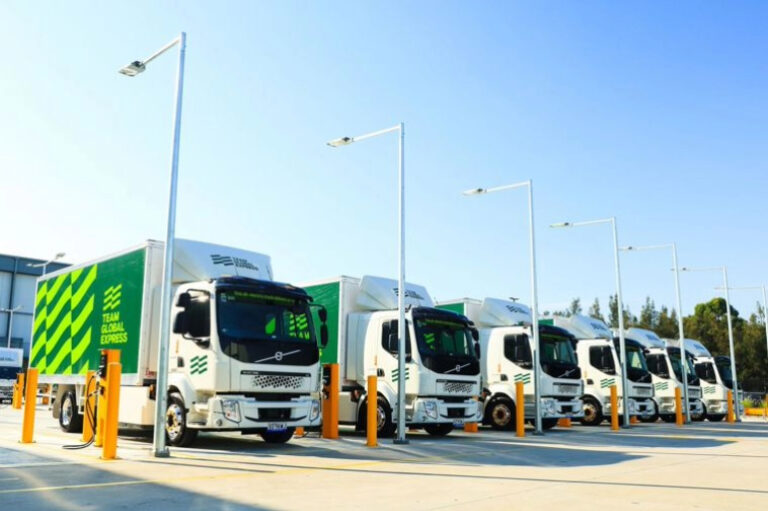
Team Global Express – Bungarribee, Sydney
- 60 electric trucks plus a mix of AC/DC chargers and an on-site battery
- Early engagement with engineers, power retailers and suppliers was critical
- Driver confidence grew after a demo truck was brought in before fleet rollout
- Three years of lessons are now available publicly through ARENA
- Some unexpected site-compliance and construction hurdles slowed progress
ANC Deliveries – Last-mile urban delivery
- 112 cab-chassis BEVs and 112 chargers
- Drivers report strong confidence in the vehicles
- But AC charging was sometimes insufficient overnight
- DC charging didn’t always meet the expected 100kW
- Range could be reduced by tail-lifts, HVAC use and stop-start driving
- Commercial viability remains challenging due to upfront cost and infrastructure expense
Across all three projects, four common insights emerged:
- Daily driving distances are typically well within BEV truck capability.
- Energy use matched or was slightly higher than manufacturer specs.
- Off-site charging will be necessary to extend range and flexibility.
- Idle time (overnight and weekends) creates major V2G potential.
The Next Phase: Scaling Heavy Vehicle Electrification
Connell outlined ARENA’s refreshed Driving the Nation funding program, which now includes three focus areas:
- Heavy Battery-Electric Vehicle Deployment – ARENA will continue co-funding trucks and associated charging, but now with a stronger emphasis on total cost of ownership and commercial replicability.
- Charging Solutions for Heavy Vehicles – Including public charging hubs, mid-journey locations and multi-fleet depots — all critical gaps in Australia’s current charging landscape.
- Vehicle-to-Grid (V2G) and Innovation – A new, explicit focus area calling for trials, standards development, new commercial models, and projects that can accelerate grid-integrated fleets.
Connell summarised ARENA’s investment theme for next year in one word: scale.
ARENA wants to support:
- Larger fleet deployments
- Longer routes and heavier loads
- Aggregators who can bring solutions to small operators
- Charging hubs at ports, logistics precincts and freight corridors
- Megawatt charging and next-generation charging architecture
- High-impact innovation that meaningfully reduces emissions
“If you’ve got an idea or concept, and you think it can unlock barriers, come and talk to us,” Connell urged.
Why V2G Could Become a Heavy Vehicle Game Changer
While V2G is often discussed in the context of household EVs, Connell believes the biggest opportunity lies with trucks.
The reasons are compelling:
- Trucks have larger battery capacities
- Depots often have larger grid connections
- Routes and schedules are predictable
- Weekends and nights offer long idle periods
Connell showed weekend charging data from a current project where trucks sit fully connected but doing nothing.
“This is a massive opportunity,” he said. Unlocking V2G revenue could help close the TCO gap and make the transition commercially viable for many operators.
A Powerful Call to Action for Fleet Operators
Connell closed with an invitation — and a warning. Australia is significantly behind global leaders in heavy vehicle electrification. But the barriers are now well understood, the early lessons have been documented, and the pathways are becoming clearer.
His message to fleet operators:
- Start now.
- Read the knowledge-sharing reports.
- Learn from the early adopters.
- Talk to ARENA if you’re ready to pilot or scale.
The heavy-vehicle transition won’t be easy, but with ARENA’s backing — and the experience of global markets — it’s no longer uncharted territory.