

Hydrogen is beginning to shift from pilot projects to early commercial deployment in New Zealand’s heavy transport market, supported by infrastructure investment, government backing and growing operator interest.
Rodger Spillane, Manager – Hydrogen Programme at Toyota New Zealand, says the country’s hydrogen journey has accelerated over the past few years through coordinated industry and government action.
“Toyota New Zealand have had active hydrogen projects since around 2021,” Spillane said, noting that the ecosystem began to take shape following “a 2018 Memorandum of cooperation between New Zealand and Japan.”
Infrastructure and trucks moving together
A defining feature of New Zealand’s approach has been linking infrastructure investment directly with vehicle deployment.
Through support from the Energy Efficiency and Conservation Authority (EECA), four hydrogen refuelling stations have been established in the North Island — in Auckland, Tauranga, Hamilton and Palmerston North.
Spillane said the funding model recognises the interdependence between supply and demand.
“You can’t have the trucks without the infrastructure, but you can’t build the infrastructure if you don’t know that you’ve got customers lined up to make use of them,” he said.
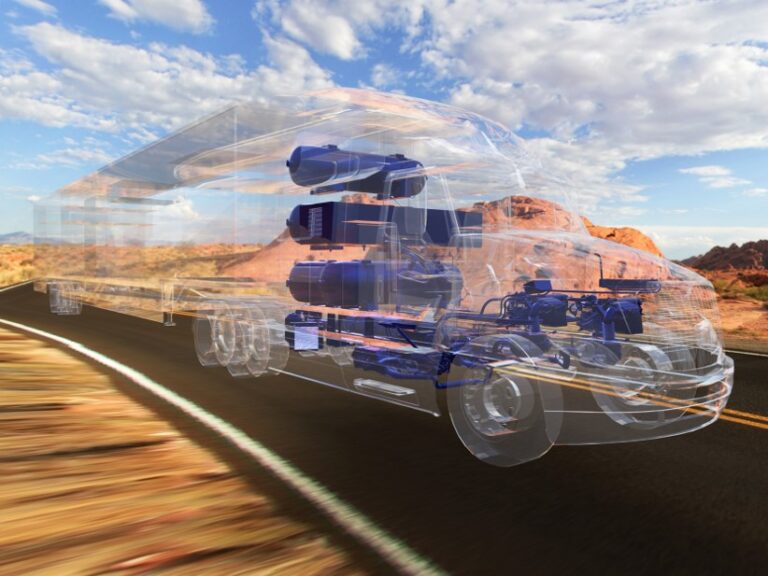
On the vehicle side, converted 50-tonne hydrogen fuel cell trucks are entering service, backed by TR Group and hydrogen producer Hiringa Energy, with integration support from GBV Technology.
“GBV are delivering 12 of those which are powered by the Toyota fuel cell,” Spillane said. “So the same fuel cell that you’ve got in Mirai… that’s enough motive power for a 50-ton GVM truck.”
For heavy freight operators, this marks a transition from concept vehicles to operational assets.
Policy settings shaping the business case
Alongside infrastructure and product, policy is influencing the economics of hydrogen.
Spillane pointed to staged increases in diesel costs under New Zealand’s Emissions Trading Scheme (ETS), including a 12 cent per litre increase in 2027 followed by ongoing annual increments.
“We can see and understand very clearly where diesel is going to be, say by 2030,” he said.
That visibility allows operators to model future operating costs. According to Spillane, parity between diesel and hydrogen is expected toward the end of the decade.
“You’ve got a view on where diesel and hydrogen parity from an operating cost will be… which is seen to be something towards 2030,” he said.
For larger freight operators, particularly those operating trans-Tasman, emissions reduction is already on the agenda.
Ministry of Transport research in 2024 found that 51 per cent of freight operators were actively exploring ways to reduce emissions.
“Certainly the larger operator businesses in New Zealand, which are often trans-Tasman, are definitely looking to do that,” Spillane said.
Green hydrogen advantage
New Zealand’s high renewable electricity mix is also playing a role in positioning hydrogen as a decarbonisation pathway.
“You’ve got a very high proportion of renewable energy generating electricity… up to 85 per cent,” Spillane said.
“That means that the hydrogen that we’re using to refuel the Mirai or the trucks is green hydrogen,” he added. “The use of green hydrogen is really important to us, and we know to our customers as well.”
For freight operators with Scope 1 emissions targets, the availability of green hydrogen strengthens the environmental case compared with grey hydrogen produced from fossil fuels.
Heavy freight leading adoption
While Toyota globally continues to develop hydrogen passenger vehicles, Spillane acknowledged that New Zealand’s immediate opportunity lies in heavy transport.
“Our opportunity in New Zealand is skewed towards that heavy freight,” he said, reflecting current infrastructure capability and customer demand.
The strategy, he explained, is not to position hydrogen as a single solution, but as part of a broader powertrain mix.
“We’d expect to see a range of powertrains serving the market,” Spillane said, including hybrid, plug-in hybrid, battery electric and hydrogen fuel cell vehicles.
For now, however, heavy vehicles are at the forefront of hydrogen’s commercial rollout.
With refuelling infrastructure established, early trucks entering service and diesel costs forecast to rise, hydrogen is moving from discussion to deployment in New Zealand’s freight sector. For fleet decision-makers, the next few years will determine how quickly those early projects translate into broader adoption.