
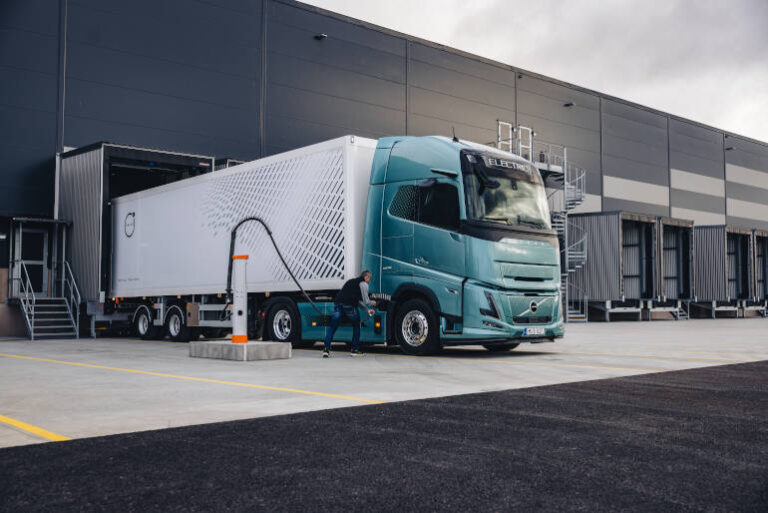
If you’re catching up on reading over the holidays and wondering why everyone suddenly keeps talking about “megawatt charging”, here’s a relaxed explainer to get you ready for the year ahead.
Put simply: megawatt charging is the technology that makes electric trucks truly viable for mainstream fleet operations.
Suppliers have confirmed it will land in Australia in 2026. So here’s what that actually means — without the jargon.
What Is Megawatt Charging?
Normally, EVs charge at:
- AC charging: 7–22 kW
- Fast DC: 50–150 kW
- Ultra-fast DC: 200–350 kW
Megawatt charging jumps to over 1,000 kW (one megawatt).
That’s enough power to:
- add hundreds of kilometres of range during a driver’s rest break
- charge a rigid truck in under an hour
- charge a long-haul tractor in roughly the time it takes to refuel a diesel prime mover and complete logbook requirements
It’s the missing piece in the electric truck puzzle.
Why Is It Suddenly Important?
Because the industry has solved almost everything except fast turnaround.
Electric trucks:
- can pull real loads
- have batteries big enough for proper duty cycles
- meet Australian compliance rules
- are becoming cost-competitive with diesel
But without megawatt charging, they were stuck spending hours at chargers.
How Does It Work?
Think of it like plugging into an ultra-high-pressure water main — but safely, of course. Megawatt systems use:
- heavy-duty cables and liquid cooling
- high-voltage architecture
- specialised connectors
- smart energy controls
- battery-buffered power if the grid can’t deliver peak load
All of this is automated. From a driver’s perspective, it’s just another plug-in and walk-away moment.
Do Depots Need Massive Grid Upgrades?
Surprisingly, no. This is the biggest misconception.
Most megawatt sites will use large battery storage to buffer power. The storage charges slowly from the grid (or solar) and then discharges quickly into trucks.
It smooths everything out:
- avoids peak demand
- reduces upgrade costs
- lets fleets start electrifying earlier
- keeps energy bills predictable
If you have space for a shipping container, you have space for depot energy storage.
Will Every Truck Need Megawatt Charging?
No — and that’s good news. A simple summer summary:
- Urban PUD trucks → 100–350 kW is fine
- Regional delivery → 350–500 kW ideal
- Linehaul trucks → megawatt charging is essential
- Waste, council, emergency fleets → depends on duty cycle
So megawatt charging isn’t replacing other systems. It just fills the gap for your most demanding routes.
What Should Fleet Managers Do in 2026?
Here’s your easy holiday checklist — no spreadsheets required:
- Start learning the basics of high-power charging
- Map where trucks stop for breaks today
- Think about which routes need fast turnaround
- Look at depots like a future “energy site”, not just a parking yard
- Begin conversations with OEMs and charging providers early
- Stay across local energy storage incentives
That’s it. Small steps, big payoff.
A Holiday-Friendly Conclusion
Megawatt charging is not the scary, grid-breaking monster people imagine. It’s just the next logical step in electrifying heavy transport. And by this time next year, it’s likely to be operating in Australia.
So while you’re enjoying summer downtime, take a moment to picture your depot in 2026. A couple of shiny electric trucks plugging in, a compact battery storage unit humming quietly nearby, and drivers heading off for a coffee break while their vehicles charge faster than ever before.
It’s closer than it looks. And it’s going to redefine how fleets operate.