

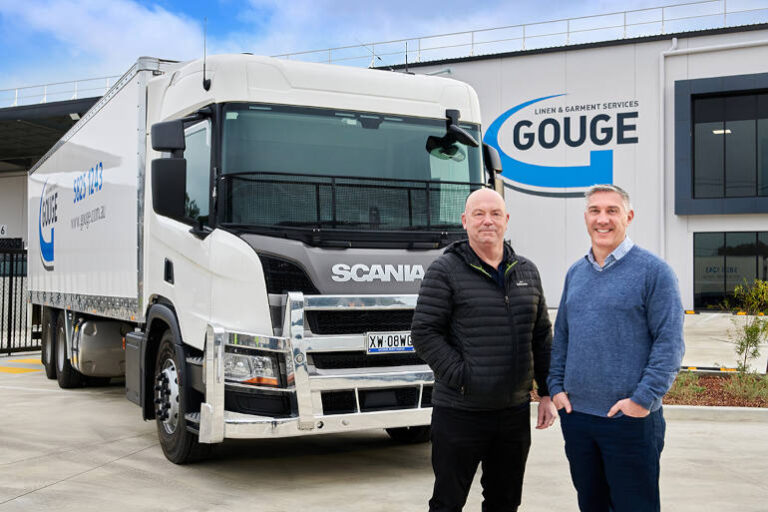
Regional Victorian operator Gouge Linen and Garment Services is underpinning its next phase of growth with a fleet strategy focused on fuel efficiency, safety and reliability, following the introduction of 10 Scania trucks.
Founded in the 1940s as a dry-cleaning business in Shepparton and owned by the Priestly family since the 1980s, Gouge Linen has evolved into a large-scale commercial laundry servicing accommodation, healthcare and industrial customers across Victoria and southern New South Wales. The business now services around 1,300 customers and launders approximately 55,000 uniforms each week.
Its transport task is significant. The company’s fleet travels the equivalent of 15 laps of Australia every month, with some vehicles covering up to 1,300 kilometres per day across two shifts, often running fully loaded in both directions.
Growth has recently been reinforced by the construction of a new purpose-built laundry facility in Geelong, which is twice the size of the Mooroopna site near Shepparton and designed to eventually deliver almost double its output.
Chief Executive Officer John Calleja said transport efficiency plays a critical role in supporting the company’s expansion.
“We pretty much go to every town in Victoria, so we have an extensive range and footprint,” Calleja said. “We’ve got an unwavering focus on three key areas; the quality of the linen and uniforms we provide, our customers receive what they order every time, complemented with great customer service.”
The fleet comprises 52 trucks in total, including 10 Scanias — two prime movers and eight rigids — operating alongside a mixed fleet to meet varying access and delivery requirements.
General Manager of Logistics Damian Marston said the move to Scania followed a competitive tender process, with fuel efficiency, safety and support all weighing heavily in the decision.
“When we went out to tender, the Scanias had a higher level of safety spec, which also helps attract drivers,” Marston said. “They’re living in the truck most of the day, and they like the in-dash driver support system that scores their driving style.”
Calleja said fuel performance was a key proof point.
“I still remember when Damian told me the fuel efficiency the Scanias would be getting, and I said that would be awesome but prove it,” he said. “Scania loaned us a truck for a demonstration, and they delivered what they promised.”
Beyond fuel savings, environmental outcomes were also part of the equation, particularly given the distances covered.
“The distances we cover being a regional business makes electric trucks a challenge. That technology’s not right for us, yet,” Calleja said. “So, having Scanias that are really fuel efficient is an important thing for us.”
Safety and driver support were further factors, with advanced visibility, camera systems and access to Scania driver training contributing to what the business sees as a well-rounded fleet package.
Looking ahead, Gouge Linen expects its fleet to continue growing in line with operational demand, with Scania likely to remain part of the mix where vehicle size and access allow.
“If the numbers stack up and I’ve got a truck that’s better for our drivers and safer for our drivers, then that’s a great outcome,” Calleja said.