

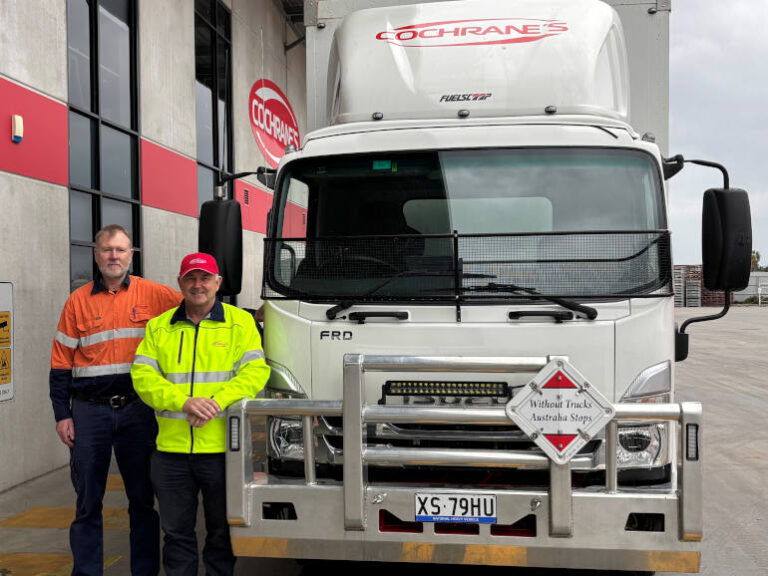
South Australian freight operator Cochrane’s Transport has found the winning formula for fleet reliability — and it starts with going fully automatic.
Almost a decade since the business began fitting Allison 2500 Series™ transmissions across its Japanese truck fleet, the results speak for themselves: minimal downtime, smooth performance, and strong resale value.
“Since introducing Allisons into our fleet, any transmission issues have been negligible,” said Mike Lean, CEO of Cochrane’s Transport. “That’s saved us considerable time and money, and earned invaluable trust with our customers.”
Operating around 100 trucks — 90% of which run Allison automatics — the fleet covers roughly 3.4 million kilometres a year, delivering time-sensitive freight including daily newspapers and fresh bread across regional South Australia.
Reliability built into the schedule
Cochrane’s runs a disciplined servicing program that exceeds OEM requirements, with internal checks every 10,000 km, engine services at 20,000 km, and driveline services every 100,000 km. Trucks are typically retired after five years, having clocked close to one million kilometres.
“It doesn’t matter whether it’s a Fuso, Hino or Isuzu — we’ll always opt for an Allison,” Lean said. “They’re easier to service, and you avoid the clutch wear you’d see with manuals or even AMTs. For us, it’s one of the best fleet management decisions we’ve ever made.”
Performance that pays back
The torque converter in the Allison automatic ensures continuous power delivery and smoother acceleration, reducing driver fatigue and mechanical wear. Many of Cochrane’s trucks are retired without needing any major transmission repairs — and still return around $20,000 at auction.
“They’re the hardest working trucks in our fleet,” Lean explained. “Some travel almost non-stop between Adelaide, Mt Gambier and regional towns like Ceduna and Roxby Downs. The fact they can go that distance without a transmission rebuild is remarkable.”
A broader benefit for fleets
According to Robert Cavagnino, Australian Sales Manager at Allison Transmission, the benefits go beyond uptime.
“Automatics make fleets more inclusive by broadening the talent pool — not every driver is comfortable with a manual,” Cavagnino said. “They also protect the drivetrain, reduce fatigue and provide smoother performance for both the driver and the cargo.”