
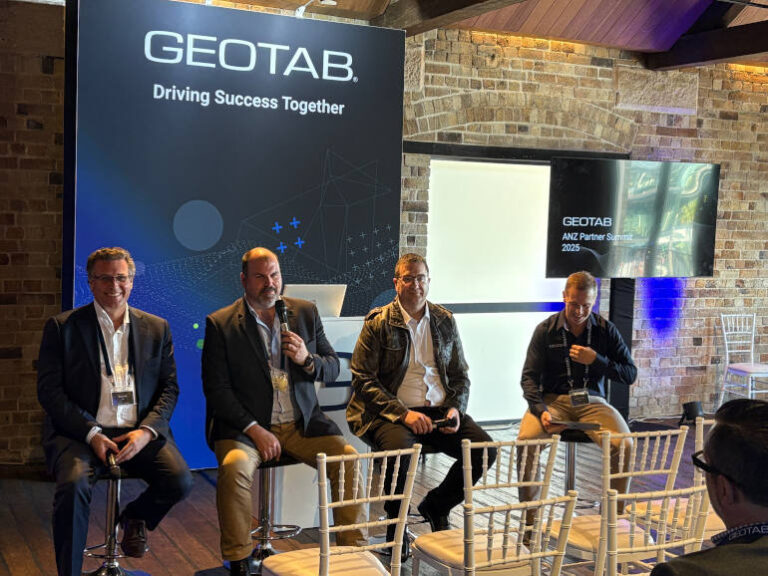
At the Geotab Partner Day in Sydney, a powerhouse panel explored the intersection of regulation, technology, and productivity shaping Australia’s heavy vehicle industry. Moderated by Geotab’s Andrew Hintz (Associate Vice President – Heavy Transport, APAC), the discussion brought together Todd Hacking (CEO, Heavy Vehicle Industry Australia), Gavin Hill (General Manager, Austroads), and Stewart Flecknoe-Brown (Director, Logmaster) — each representing a critical part of the transport ecosystem: policy, data, and compliance.
Reform Fatigue: The Law That’s Failing to Keep Up
Todd Hacking opened with a blunt assessment of the Heavy Vehicle National Law (HVNL) — a framework conceived through inter-state compromise and now showing its age, describing a system where “states still hold too much power” and innovation is often stifled by unelected officials resistant to change.
“It was horse-traded to the lowest common denominator.”
Todd Hacking, CEO at HVIA
The long-promised HVNL reform has again fallen short, Hacking said, delivering “minor tweaks” instead of the root-and-branch overhaul the industry was promised. The result is a patchwork of regulation that continues to frustrate operators and deter investment in new technology.
The Big Three Challenges: Productivity, Safety and Decarbonisation
Austroads’ Gavin Hill framed the discussion around three intertwined challenges:
- Maintaining productivity in a supply chain under pressure;
- Improving road safety; and
- Achieving decarbonisation targets.
“These three things don’t always sit comfortably together — they pull in different directions,” he said.
Hill explained that Austroads and Transport Certification Australia (TCA) are focusing on how telematics and data governance can help balance these priorities while giving policymakers confidence in road-network management and investment planning.
Data, Governance and the Power of Telematics
The panel agreed that data is the key to unlocking smarter, safer and more productive transport systems — but only if it’s trusted and used responsibly.
Hill highlighted the growing role of certified telematics, where systems approved under the Telematics Monitoring Application (TMA) and Smart On-Board Mass (OBM) frameworks feed de-identified, aggregated data to road agencies.
“These systems help agencies understand how their networks are being used — not to track individuals, but to inform maintenance, investment, and access decisions,” he said.
Hacking added that this evidence base is critical for shifting outdated assumptions — such as the belief that “heavier trucks mean more pavement damage.”
“Public servants don’t get paid to take risks,” he said. “But data can prove that productivity and safety gains don’t have to come at the cost of infrastructure.”
Technology That Builds Trust
Logmaster’s Stewart Flecknoe-Brown brought the discussion to the operational front line, where drivers and managers grapple with compliance daily.
“Paper diaries made compliance almost impossible,” he said. “With digital tools, everyone’s on the same page — the driver and the office see the same data in real time.”
By integrating Logmaster’s electronic work diaries (EWDs) with Geotab’s telematics, fleets can cross-reference vehicle data and human records to ensure accuracy and transparency.
“The result isn’t just compliance,” he said, “it’s a better relationship between drivers and managers.”
He shared stories from fleets that saw fatigue-related non-compliances plummet within a month of switching to digital diaries. “Drivers now see where they’re at in the day — they’re not doing mental arithmetic at 100 km/h trying to calculate hours of rest.”
From Fear to Opportunity: The EWD Debate
Despite these gains, uptake of EWDs remains slow.
“It’s the number one complaint I hear — operators hate logbooks, but still don’t invest in EWDs,” Hacking said.
He believes some still fear “Big Brother,” or worry that real-time data will expose breaches. “We don’t need a mandate yet, but at some point, someone will lose something — and then regulation will come.”
Flecknoe-Brown agreed, noting that most concerns disappear once companies understand how data is handled. “Once they get to the specification, they see the protection built in — it’s not surveillance, it’s support.”
Using Data to Build a Safer, Smarter Network
Hacking pushed for stronger collaboration between police, regulators, and industry, arguing that nationally shared data could transform road safety.
“How good would it be if first responders could report crashes in real time, feeding back to fleets for trend analysis?” he said. “Truck drivers could log potholes and feed them to local councils in 30 seconds — we’ve got the tech, but not the coordination.”
Hill agreed that the best ideas often come from industry itself.
“The good ideas don’t come from government,” he said. “They come from people like you who have your ear to the ground. We just need to capture and scale them.”
Building the Case for Investment and Net Zero
Looking ahead, Hill said governments are finally using telematics data to build business cases for infrastructure funding.
“In Victoria, Freight Victoria is presenting data-driven proposals to Treasury — that’s a major breakthrough,” he said. “Quality data helps us compete for funding across portfolios like health and education.”
The conversation turned to decarbonisation, with Hacking describing the government’s recent transport emissions plan as “a 36-page document without a single action.”
He warned that while transport is forecast to become Australia’s largest-emitting sector by 2030, “not a single dollar” has been allocated to help operators transition to cleaner trucks.
Instead, he urged fleets to focus on practical decarbonisation now.
“Optimise your routes, invest in aerodynamics, reduce idling, use telematics, and make sure your return trips aren’t empty. It’s not about perfection — it’s about progress.”
Todd Hacking, CEO at HVIA
The Road Ahead
The panel closed on a note of collaboration — recognising that technology, trust and transparency will define the next era of heavy-vehicle management.
As Hill summed up, “Certified telematics is no longer just for regulators — the ATO and EPA are starting to recognise its value too. Quality data gives everyone assurance.”
For Geotab and its partners, that assurance means more than compliance — it’s the foundation for safer drivers, smarter fleets, and a more sustainable transport future.
- ATA Celebrates Excellence and Service
 Denis Robertson, a founding member and former Chair of the Australian Trucking Association, has been made a life member of the ATA’s Industry Technical Council in recognition of his long and distinguished service to the council. The honour was announced at the ATA’s 2026 Technology and Maintenance Conference in Melbourne, placing industry service alongside achievements
 - Geotab Joins ATA to Invest in the FutureThe Australian Trucking Association (ATA) has relaunched its award-winning Future Leaders’ Forum (FLF), unveiling a refreshed professional development program designed to prepare the next generation of leaders for Australia’s transport industry. Now supported by new major sponsor Geotab, the Future Leaders’ Forum is targeted at trucking professionals aged between 21 and 40 and provides participants
- ATA Honours Trucking’s Best at 2026 National Industry AwardsThe Australian Trucking Association (ATA) has recognised some of the industry’s most respected leaders, operators and businesses at the 2026 National Trucking Industry Awards, announced during the ATA Foundation Sponsors Gala Awards Dinner on Hamilton Island. Held as part of Trucking Australia 2026, the awards celebrate excellence across the trucking sector, recognising individuals and organisations
- Government fuel relief plan welcomed as industry warns of mounting pressureAustralia’s peak trucking bodies have welcomed the Federal Government’s decision to fast-track changes to allow fuel costs to be passed through the supply chain, but warn that more immediate support is needed to prevent business failures across the transport sector. The move follows a dramatic surge in diesel prices, which industry leaders say has placed
- Freight Costs Set to Rise as Diesel Prices SurgeAustralian trucking operators are warning customers to prepare for higher freight costs as diesel prices surge, according to the Australian Trucking Association (ATA). Australian Trucking Association CEO Mathew Munro said the rapid increase in global diesel prices is already flowing through to Australian retail fuel prices and will inevitably affect transport costs across the economy. The