

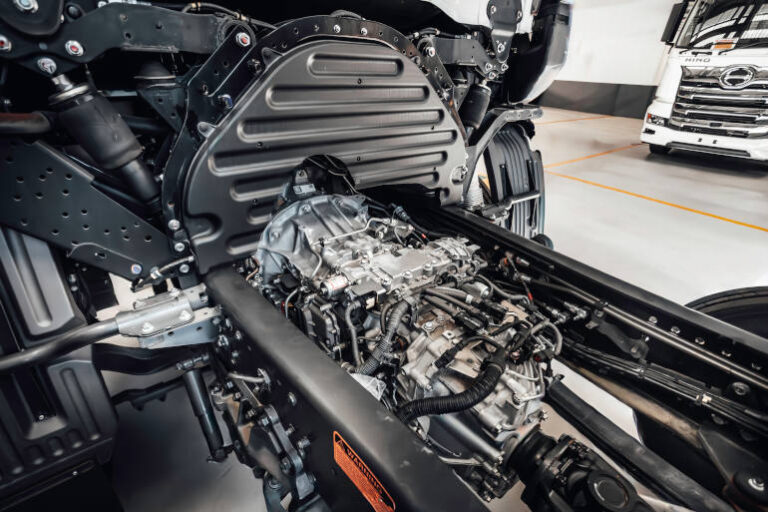
At a recent media briefing, Hino Australia’s Manager of Product Strategy, Daniel Petrovski, provided detailed insights into the transmission options available across the Hino truck range. Drawing on real-world operational needs and Hino’s engineering roadmap, Petrovski outlined how different transmissions—manual, automatic, and automated manual (AMT)—fit into various transport applications. Here’s a technical breakdown of each option, based on Hino’s lineup and development direction.
Automatic Transmissions – Smooth, Proven, but Application-Specific
Hino has long offered Allison full automatic transmissions in its 9-litre 700 Series models. These are torque converter automatics that provide smooth, gear-free operation and are well-regarded for urban use, frequent stop-start conditions, and ease of training.
Pros:
- Smooth acceleration and deceleration with torque converter
- Best for stop-start applications, such as urban deliveries and waste collection
- Proven durability in Australian operating conditions
- Lower driver fatigue and minimal training required
Cons:
- Lower efficiency at highway speeds or under constant load
- Higher initial cost
- Limited availability in configurations requiring higher GCM ratings
“The 9-litre in leaf sprung suspension was paired with the Allison automatic… but we didn’t have an airbag suspended 8×4 for council use,” Petrovski noted, pointing out a key limitation of the older configuration.
Manual Transmissions – Reliable and Affordable, But Driver-Dependent
Traditional synchromesh manual transmissions, such as Hino’s MZ12, have been part of the brand’s DNA for years. These transmissions offer direct control and mechanical simplicity, which some operators prefer in rural or heavy-load applications.
Pros:
- Lower acquisition cost
- Excellent engine control in variable conditions
- Familiarity for long-time drivers
- Low maintenance costs in certain use cases
Cons:
- Driver skill-dependent – hard to achieve consistent fuel economy
- Increased fatigue in stop-start traffic
- Less suitable for younger or less experienced drivers
- No longer available in newer model lineups like the 2025 700 Series
Hino has moved away from offering manuals in newer models, favouring automated options for safety, efficiency, and operational consistency.
“We go from 19 models now to 31 models… every model now is two-pedal,” Petrovski confirmed. [DP1]
Automated Manual Transmissions (AMT) – A Hybrid Approach with Big Benefits
The headline development in 2025 is the introduction of Hino’s in-house 12-speed AMT (Automated Manual Transmission). This unit blends the efficiency of a manual with the ease of an automatic by automating clutch engagement and gear selection using an ECU and countershaft brake.
It is based on Hino’s long-running MZ12 synchromesh manual but re-engineered into a constant mesh gearbox for faster, more durable shifts.
Pros:
- Faster gear shifts with countershaft brake
- Greater fuel efficiency than full automatics
- Driver-friendly two-pedal layout
- Superior engine brake operation for safer descents
- Allows entry into new segments like 8×4 with air suspension
- Supports applications like tippers, tankers, hooklifts, and vacuum trucks
“This was the 9-litre, leaf sprung, Allison automatic… but now we’ve got a 360hp, 12-speed AMT with Hendrickson airbag suspension,” Petrovski explained. “We’re able to get into more applications, especially for council fleets.”
Cons:
- May require driver education for using manual override or engine braking features
- More complex electronics than traditional manual
- Less refined than torque converters in ultra-low-speed manoeuvring (though Hino includes a “slow mode” for docking)
- Usability and Control Features
The new AMT setup also includes smart driver interface tools:
- Stalk-mounted gear selector on the left-hand side of the steering wheel
- Manual override for up/down gear changes
- Three-stage engine brake control, with downshift assist on higher settings
“You press the top of the stalk—it flicks you to manual—and you can select gears up and down. It’s very intuitive,” said Petrovski. “The engine brake wand is separate, with automatic shift-down available for extra control.”
This design allows AMT to offer a high level of operational safety and versatility—especially critical for local government fleets operating in urban and mixed environments.
Summary Table: Transmission Comparison in Hino Trucks
| Feature / Type | Manual | Automatic (Allison) | AMT (Hino 12-speed) |
| Gear Changes | Driver-controlled | Fully automatic | Electronically controlled |
| Driver Fatigue | Higher | Lowest | Low |
| Fuel Efficiency | Variable (driver-dependent) | Moderate | High |
| Upfront Cost | Lowest | Highest | Moderate |
| Suitable for | Experienced drivers, rural | Urban deliveries | Mixed use, councils |
| Transmission Type | Synchromesh | Torque Converter | Constant Mesh w/ ECU |
| New Model Availability | Discontinued | Limited to specific GVMs | Across full range |
Hino’s transmission evolution reflects the changing needs of commercial fleets. While manual gearboxes once dominated, safety, driver availability, and fuel cost pressures are driving uptake of smarter, automated systems. The introduction of Hino’s 12-speed AMT, backed by years of global reliability and enhanced for local use, marks a new chapter.
For local government, construction, and last-mile operators seeking performance without complexity, the Hino 700 Series with the new AMT presents a balanced, future-proof solution. As Petrovski put it: “This combination will be able to go into applications we couldn’t touch before.”