

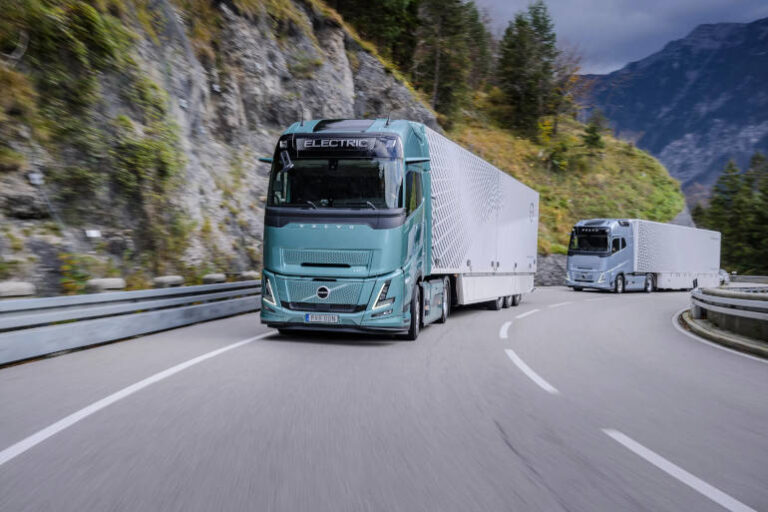
Volvo Trucks has finished 2025 as Europe’s leading heavy-duty truck brand for the second year running, strengthening its position in a highly competitive market.
The manufacturer secured an overall market share of 19.0 per cent in the European heavy truck segment (16 tonnes and above), up from 17.9 per cent in 2024. The result confirms Volvo Trucks as the market leader across Europe, with its strongest registration volumes recorded in the UK, France, Poland, Germany, Lithuania and Spain.
The performance reflects steady demand across Volvo’s heavy-duty range, particularly in long-haul applications where efficiency, uptime and driver comfort remain key purchasing criteria for large fleet operators and owner-drivers alike.
FH Aero drives long-haul demand
A major contributor to Volvo’s 2025 result was the FH Aero, the company’s latest evolution of its flagship long-distance truck. Introduced with a strong focus on aerodynamic optimisation, the FH Aero features design changes and technologies aimed at reducing fuel consumption and emissions without compromising payload or performance.
According to Volvo Trucks, the FH Aero can deliver up to seven per cent better fuel efficiency compared with the regular Volvo FH it replaced. This improvement is attributed to enhanced aerodynamics and the adoption of digital camera mirrors, which replace traditional side mirrors and help reduce drag.
Customer uptake has been strong, with nearly 33,000 FH Aero trucks ordered across Europe during 2025. Volvo Trucks says the model has resonated with hauliers operating in long-distance and linehaul roles, where even small efficiency gains can translate into meaningful cost savings over the life of the vehicle.
Roger Alm, President of Volvo Trucks, said the market-leading result reflects customer confidence in the brand and its product direction.
“We are very proud to be market leader in Europe for the second consecutive year. Our goal is to be our customers’ best business partner and being market leader is strong proof of the confidence our customers put in us,” Alm said.
“It makes us very proud, and I wish to extend a big thank you to our customers and our employees for this great achievement.”
Alm said feedback from operators using the FH Aero had been particularly positive.
“We have a first-class product range with trucks that offer superior uptime, fuel efficiency and safety. The FH Aero is our shining star for longer distances. I hear from customers that they experience amazing performance and fuel savings with the Aero.”
Strong global footprint
Beyond Europe, Volvo Trucks continues to hold a strong position in key global markets. In 2025, the brand was either the market leader or the second-largest heavy truck manufacturer in 30 countries worldwide, highlighting the scale of its international footprint.
This global reach allows Volvo Trucks to spread development costs across multiple markets while tailoring specifications and technologies to suit regional operating conditions, regulatory requirements and customer expectations.
Multi-path approach to decarbonisation
Alongside its commercial performance, Volvo Trucks continues to position itself as a major player in the transition to lower- and zero-emission transport.
The company has committed to reaching net-zero emissions by 2040 and is pursuing this goal through what it describes as a three-path technology strategy. Rather than relying on a single solution, Volvo Trucks is developing and offering a mix of battery electric trucks, fuel cell electric vehicles, and combustion engines capable of running on renewable fuels.
These renewable fuels include green hydrogen, biogas, biodiesel and hydrotreated vegetable oil (HVO), allowing operators to reduce emissions using existing vehicle platforms and refuelling infrastructure in markets where zero-emission options are not yet practical.
Alm said maintaining flexibility was critical as different markets and applications move at different speeds.
“We will continue to innovate and introduce new trucks that contribute not only to our customers’ businesses, but also to the decarbonisation of our industry,” he said.
“By investing in multiple technologies we can offer transport solutions that fit a variety of customer needs and markets.”
Looking ahead
With tightening emissions regulations across Europe and continued pressure on operating costs, fuel efficiency and technology adoption are expected to remain central to heavy-duty purchasing decisions.
Volvo Trucks’ 2025 result suggests its strategy of incremental efficiency improvements, combined with parallel investment in zero- and low-emission technologies, is resonating with European operators. Whether that momentum can be maintained as the market shifts further towards alternative powertrains will be a key question in the years ahead—but for now, Volvo Trucks has once again set the benchmark in Europe’s heavy-duty segment.