
For Fleet Managers and Procurement Managers, securing a new truck today is no longer just about when a chassis rolls off the production line. Delivery timelines are increasingly shaped by what happens after the chassis is built — particularly the time it takes to complete body builds and final fit-out.
At a media briefing late in 2025, Richard Emery, President and CEO of Hino Motor Sales Australia, provided rare clarity on where the current bottlenecks sit and why trucks with confirmed orders are still missing year-end delivery targets.
The misconception: chassis supply equals delivery
One of the most common assumptions in fleet procurement is that once a truck chassis is available, delivery is imminent. Emery challenged that thinking.
He explained that there are already enough trucks in the market with customer names on them, but many are not being delivered within the expected timeframe.
“There’s enough trucks in the market with customers’ names on them… I just don’t think they’re going to get delivered by the end of the year,” Emery said.
The issue, he stressed, is not always production volume — it’s what happens next.
Where the delay really sits: body build and fit-out
Once a cab-chassis leaves the factory, it typically enters a second, often lengthy, phase of the delivery process: body building.
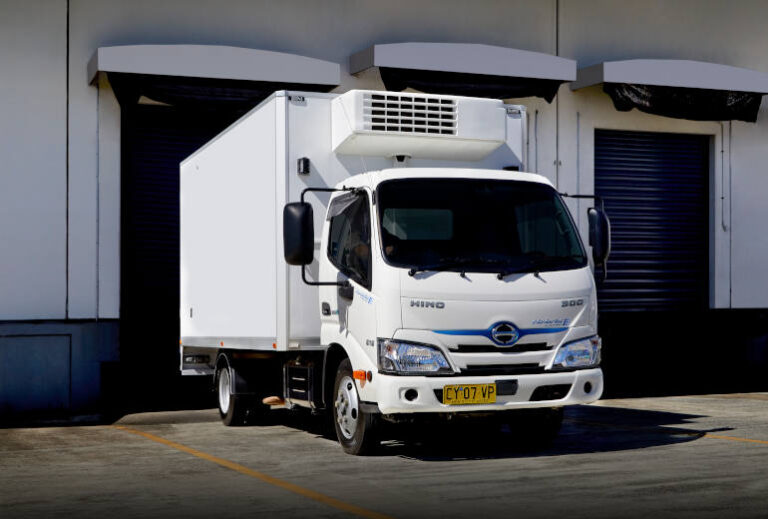
Fleet vehicles rarely arrive as complete, off-the-shelf units. Trays, tippers, cranes, waste bodies, refrigerated units, service bodies and specialist equipment all add time and complexity.
Emery was clear that this stage is now a major constraint.
“Vehicles are still slow to move through delivery channels,” he said, linking that directly to body building and fit-out timelines.
In some cases, trucks built in one calendar year are not delivered until the next — not because production stopped, but because they are waiting on bodies.
Why some ‘sold’ trucks slip into the next year
This dynamic also explains why sales figures and delivery numbers can diverge.
Emery noted that some Euro 5 trucks will still be delivered into 2026 only because they are delayed in body build, despite production having effectively ended.
“So we will deliver a few [trucks] into next year because they’re waiting on body builds,” he said.
For fleets, this can create confusion around replacement timing, registration forecasts and budget planning — particularly when projects are aligned to financial years.
A compounding effect for fleets
Longer body build timelines have a knock-on effect across fleet operations:
- Replacement cycles stretch, forcing fleets to keep older vehicles on the road longer
- Maintenance costs increase as life-expired assets are retained
- Operational planning becomes harder, especially for contract-based work
- Capital expenditure timing drifts, complicating budget approvals
While none of these pressures are new, Emery’s comments confirm they are now systemic rather than exceptional.
Not brand-specific — an industry reality
Importantly, Emery did not position this as a Hino-specific issue. The comments reflect a broader industry challenge affecting multiple OEMs and body builders as demand normalises after several intense years.
The shift to Euro 6 emissions standards, combined with bespoke fleet specifications and a backlog of deferred replacements, means delivery timelines remain extended even as chassis availability improves.
What fleet buyers should do differently
Based on the realities outlined in the briefing, fleet buyers should consider adjusting their planning assumptions:
- Separate chassis availability from delivery timing — they are no longer the same milestone
- Engage body builders earlier in the procurement process
- Build longer lead times into replacement schedules, particularly for specialised bodies
- Avoid end-of-year assumptions around delivery without confirmed body build slots
As Emery’s comments highlight, delivery timelines are now defined by the slowest part of the chain — and increasingly, that is not the factory.
The takeaway for 2026
Fleet delivery timelines are unlikely to snap back quickly in 2026. While production supply is stabilising, downstream constraints remain a critical factor.
For fleets that recognise this early and plan accordingly, the risk of disruption can be reduced. For those that assume a return to pre-COVID delivery norms, delays may come as an unwelcome surprise.
The message from the industry is clear: a truck isn’t delivered when it’s built — it’s delivered when the body is finished. And right now, that distinction matters more than ever.
- Breaking Barriers and Raising Standards in the Workshop
 Transit Systems Victoria has appointed Ellearn Savvidis as Workshop Assets Manager at its Footscray depot, highlighting both her career progression and the growing diversity within Australia’s mechanical and public transport sectors. The appointment reflects a broader shift across the industry, where technical expertise, data capability and leadership skills are increasingly combined to manage modern fleets.
 - Lift off for new Scania Air-OIs it a bird? Is it a Ute? No, it’s the new Scania Air-O Scania Australia today introduces a new diesel-free, zero-emission last-mile delivery solution that will drive forward the shift to a sustainable transport system and reshape the local logistics industry. Motivated by the sky-high rises in the price of diesel, Scania will begin
- MAN to invest €300 million in European service networkMAN Truck & Bus has announced plans to invest around €300 million in the expansion and modernisation of its European service network by 2030, marking the largest service-network investment in the company’s history. The investment will focus on expanding workshop capacity, improving regional coverage, and preparing the network to support the growing number of electric
- NewVolt breaks ground on Melbourne fast-charging network for electric trucksConstruction has commenced on a new fast-charging network designed specifically for heavy vehicles, marking a significant step in the development of Australia’s electric truck infrastructure. Energy and infrastructure company NewVolt confirmed it is building Stage 1 of the NewVolt Network — a three-hub, open-access fast-charging network located across Melbourne’s major freight precincts. The announcement coincides
- What Are Scope 1, 2 and 3 Emissions — and Why Fleet Managers Need to Understand ThemSustainability reporting is moving quickly from a corporate talking point to an operational requirement. For fleet managers, understanding Scope 1, 2 and 3 emissions is becoming as important as tracking fuel consumption, maintenance costs or utilisation. These emissions categories form the backbone of modern carbon reporting frameworks and are increasingly linked to customer expectations, contract