
Australia’s heavy vehicle sector has broadly welcomed the Productivity Commission’s final report into heavy vehicle reform, with major industry bodies pointing to improved road access, reduced permit requirements, higher-productivity combinations and better conditions for zero-emission trucks as priorities.
While each organisation approached the report from a different part of the industry, the response was remarkably consistent: Australia has the technology to move freight more efficiently, but regulation, road access and inconsistent rules between jurisdictions are limiting its use.
The Federal Government has announced a $400 million heavy vehicle productivity reform package following the report, with the reforms forecast to deliver economic benefits of up to $4.4 billion annually.

ATA says productivity reform can reduce freight costs
The Australian Trucking Association focused heavily on the potential for productivity improvements to reduce transport costs for households and exporters.
ATA Chair Mark Parry said the reforms recognised the broader economic role of truck productivity.
“The Government’s announcement recognises that increasing productivity is the key to reducing the cost of living for families and reducing transport costs for Australia’s exporters,” Parry said.
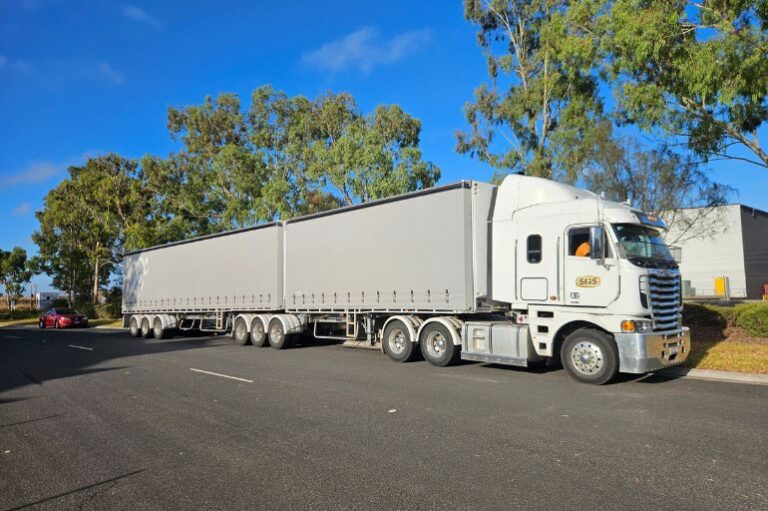
The ATA highlighted access for higher-productivity combinations as one of the major opportunities.
“We know, for example, that businesses who switch from conventional semitrailers to what are called A-doubles can move the same amount of freight in half the number of trips while using 72 per cent of the fuel,” Parry said.
However, access remains restricted to approved networks or permits. According to the ATA, the National Heavy Vehicle Regulator receives about 197,000 permit applications each year.
The ATA therefore welcomed moves to accelerate the National Automated Access System, which is intended to reduce the number of individual permits required by operators.
It also supported reforms covering electric truck mass limits, road access, charging and delivery curfews.
“The plan will encourage state governments to expand the road network that can be used by electric trucks. Electric trucks are heavier than conventional trucks. They can’t carry the same freight unless their gross mass is allowed to be higher,” Parry said.
The ATA also singled out proposed driver licensing reform, arguing that licence progression should place greater weight on demonstrated driving experience rather than simply the time a person has held a particular licence class.
HVIA wants policy converted into practical outcomes
Heavy Vehicle Industry Australia described the reform package as a significant opportunity to improve freight efficiency, economic productivity and supply chain resilience.
HVIA Chief Executive Officer Todd Hacking said the issue extended beyond the transport sector.
“Freight productivity is not just a transport issue. It is a cost-of-living and economic competitiveness issue,” Hacking said.
HVIA has been calling for streamlined access approvals, greater consistency between jurisdictions, faster deployment of Performance Based Standards vehicles and practical measures to support zero-emission heavy vehicles.
Hacking said improved productivity could mean fewer truck movements for the same freight task.
“When road freight becomes more productive, the benefits flow through the entire economy. It can mean fewer trips to move the same amount of freight, less road congestion, stronger supply chains and lower pressure on costs before goods ever reach consumers,” he said.
HVIA also welcomed the proposed acceleration of the National Automated Access System and removal of unnecessary regulatory barriers.
Its emphasis, however, was on implementation.
“The opportunity now is to move quickly from policy announcements to practical outcomes that operators, manufacturers, suppliers and the broader community can experience,” Hacking said.
“We have world-class vehicle technology available today, but too often it is constrained by outdated processes, inconsistent access decisions and unnecessary delays. These reforms have the potential to address those challenges.”
Construction materials sector pushes for greater PBS access
Cement Concrete & Aggregates Australia welcomed recommendations dealing specifically with Performance Based Standards vehicles, local road assessments and automated access.
CCAA Chief Executive Officer Michael Kilgariff said investment by industry in safer and more productive equipment had moved faster than the road access system.
“The Commission has recognised a fundamental problem – industry has invested in safer and more productive trucks, but the road access system has not kept pace,” Kilgariff said.
The Productivity Commission recommended greater as-of-right access for eligible PBS vehicles, including allowing them onto existing gazetted networks without requiring additional notices.
It also backed further Commonwealth funding for local government road and bridge assessments and network-based automated access through NAAS.
The Commission estimates that implementation of NAAS alone could increase GDP by around $600 million to $1.3 billion.
“Greater as-of-right PBS access, better local road asset data and an effective National Automated Access System can reduce unnecessary permits, cut truck movements and improve productivity across housing and infrastructure supply chains,” Kilgariff said.
CCAA also welcomed support for nationally consistent additional mass allowances for electric heavy vehicles, streamlined charging infrastructure planning and exemptions for heavy zero-emission vehicles from time-based delivery curfews.
But it warned that better access rules will only work if road managers have reliable information about their assets.
“Nationally consistent access, better road and bridge asset data, stronger assessment capability for local road managers and effective network-based automated access remain critical if Australia is to realise the full productivity benefits of safer, higher-performing heavy vehicles,” Kilgariff said.
EVC sees reform as a breakthrough for electric freight
The Electric Vehicle Council focused on the barriers that have slowed adoption of battery-electric heavy vehicles.
Electric trucks currently account for less than one per cent of Australian heavy vehicle sales, according to the EVC, which argues that road access restrictions, battery-related weight penalties, delivery curfews and limited charging infrastructure have all contributed to slow uptake.
EVC CEO Julie Delvecchio said the reforms recognised the connection between electrification, productivity and fuel security.
“We’ve long been saying electric trucks deliver productivity and fuel security for the nation. Every electric truck on the road is one less truck relying on imported diesel. Today’s decision shows governments at every level are listening to industry, with real money behind the reform,” Delvecchio said.
The EVC particularly welcomed moves to address rules that were originally designed around diesel trucks.
“The EVC has been clear: electric trucks are caught up in rules that shouldn’t apply to them – curfews built for diesel engines are just one example. Now there’s investment behind fixing that,” she said.
EVC Heavy Vehicle Lead Cameron Rimington said payload remained central to the commercial case.
“Red tape has been one of the biggest handbrakes on electric trucks in Australia. A truck that can’t carry a full load isn’t commercially viable, no matter how much cheaper it is to run. Today’s commitment to increase road access for heavy EVs, improve charging infrastructure and lift noise restrictions is exactly the kind of practical reform operators have been asking for.”
Different sectors, similar message
The four industry bodies are looking at the Productivity Commission’s recommendations through different lenses.
For the ATA, the priority is giving trucking operators access to more productive combinations while reducing permits and reforming licensing. HVIA is focused on nationally consistent access and turning reforms into practical outcomes for manufacturers and operators. CCAA sees PBS access, better road and bridge data and automated approvals as critical to improving construction material supply chains. The EVC wants regulatory settings to recognise the different characteristics of electric trucks.
What connects all four responses is the argument that vehicle capability has moved ahead of the regulatory system.
The next test will be implementation by state and territory governments.
If the proposed funding delivers more consistent road access, fewer permit delays, better use of PBS combinations and practical pathways for zero-emission trucks, the Productivity Commission report could become a significant turning point for the way Australia regulates and moves road freight.