

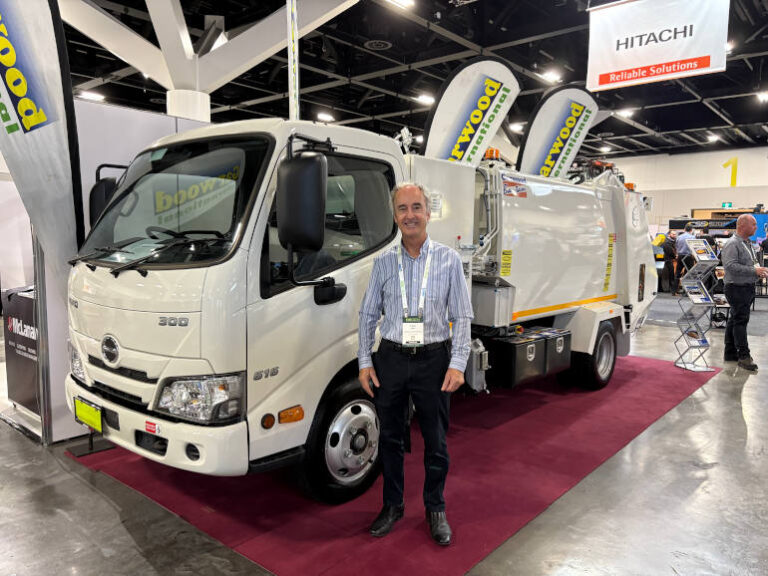
Garwood International put its innovation on display at ReGen Expo 2025 with a compact waste solution that’s already proving popular with local councils and contractors. Tony Miller, Sales Manager for NSW and WA, showcased the Garwood Bantam—a four-cubic-metre rear-loading compactor mounted on a Hino 616 chassis—designed specifically for tight urban spaces and high-density residential areas.
“It’s a lower profile, narrower unit,” said Miller. “It’s specifically built for parks and gardens, for litter bins, and also Corso-type areas. High street, tight access—this is where it really works well.”
Meeting Modern Urban Waste Needs
The Garwood Bantam is a response to a growing trend in urban development. As more councils grapple with the logistics of waste collection in tight and often underground spaces, compact vehicles like the Bantam have become essential.
“We’re constantly having inquiries for little trucks that can actually go underneath buildings,” Miller explained. “With new apartments and office developments, we build low-entry trucks to suit those environments.”
Garwood has already delivered significant volumes into the Victorian market—“we’ve sold 150 mainly to contractors,” Miller noted—proving the demand for compact, purpose-built solutions is growing.
Flexibility Across the Range
Garwood’s capabilities go far beyond the Bantam. “We go from this four-cube up to a 28-cube,” Miller said. “We work with all major chassis—Volvo, Scania, you name it.”
The smaller models, like the one shown at ReGen, often require a Hino 616 due to strict height requirements. “You have to be under 2.1 metres, and this setup with the 616 and our body gets you there,” said Miller.
Interest in Electric and Hybrid Options
Garwood has seen an increase in interest for low-emission options, particularly from local governments. “We’ve actually fitted our bodies to the Hino hybrid—several of those for local government departments,” Miller said. “They work really well.”
Yet despite hybrids being cost-competitive with diesels, Miller noted that many councils still prefer traditional engines—for now. “For whatever reason, they still prefer to stick with diesel. But there has been a lot more inquiries for full electric EV trucks.”
Tenders are now frequently calling for both diesel and electric options. “It’s about comparing the pricing,” he said. “But the chassis pricing for full electric is virtually more than double.”
The bigger concern is performance. “Councils ask if it can do an eight-hour service,” said Miller. “They worry that the compactor will draw too much power and reduce the vehicle’s range.”
Custom Builds and Sales Approach
Garwood provides both standalone waste bodies and full truck builds, depending on the tender setup. “If we’re the primary tenderer, we’ll supply the complete unit,” said Miller. “If the dealer’s the lead, we just supply the body.”
This flexible sales model ensures Garwood can support both direct government contracts and commercial fleet customers via dealership networks.
Trusted by Councils and Contractors
From inner-city bin collection to hard waste recovery, Garwood’s vehicles are found across local government and contractor fleets. “Inner West Council have 30 of our reloaders,” said Miller.
He explained that while most councils contract out their kerbside services, they still operate their own fleets for tasks like litter bin collection and hard waste. “Pretty much every council is going to have a need for a compactor—whether it’s two or 30,” he said.
Built Local, Built to Last
Garwood International is a proudly Australian-owned and operated family business based at Wetherill Park, NSW. “We’ve been supplying waste compactor trucks for over 45 years,” said Miller.
Founder Les McHugh remains actively involved, with day-to-day operations now led by his son, Daniel McHugh. “It’s rare these days to find a fully owned and operated family business. All the manufacturing is done in Wetherill Park,” Miller added.
Only the hydraulic cylinders are imported—from Italy—while the rest is locally sourced and built.
Simplicity Over Complexity
A key selling point of Garwood’s products is their simplicity. “We’ve cut out a lot of the problems you might get with units that have full-blown CAN bus systems and complex electrics,” said Miller.
Instead, Garwood sticks to a “hard-wired, simplistic system with a printed circuit board,” which appeals to operators in remote areas. “We sell a lot into Alice Springs, the Northern Territory, and far northern Queensland,” he said. “It’s more analog—and that’s a big selling point for reliability.”
The Bottom Line
As cities grow upwards and waste operations become more complex, Garwood International continues to evolve with the market. Whether it’s building low-entry vehicles for underground carparks or integrating bodies with hybrid or electric drivetrains, Garwood’s focus remains the same—fit-for-purpose design, local manufacturing, and long-term reliability.
For fleet buyers and councils seeking compact waste solutions that are ready for today’s urban challenges, the Garwood Bantam delivers more than just capacity—it brings capability, service, and Australian-made confidence.