




Asbestos remains a major challenge across the Australian building landscape, with one in three homes estimated to contain the hazardous material. Despite bans on its manufacture and use, legacy asbestos continues to pose health risks during renovations, demolitions, and natural disasters. For Northern Rivers Demolition & Asbestos, tackling this issue safely and efficiently is the core of their business—and Isuzu Trucks is playing a key role in that mission.
A Growing Business Born from Community Need
Founded in Ballina in 2016 by Managing Director Samuel Northfield, Northern Rivers Demolition & Asbestos began as a modest operation focused on safe asbestos removal. Over the years, the company has expanded into full-scale demolition services, a recycling centre in Lismore, and a skip bin operation for transporting asbestos securely to disposal facilities.
“We specialise in asbestos removal, demolition, and recycling in both residential and commercial situations,” said Samuel. “Whether it’s an asbestos removal job or a large-scale demolition project, my role is to keep the cogs turning in all the different aspects of the business.”
The 15-person team is fully trained and equipped with high-grade PPE, respirators, and HEPA H-Class vacuums. They follow a rigorous process that includes site assessments, removal, decontamination, and final clearance inspections. Jobs like the demolition of Cedar Park caravan park in Ballina and the Sedgers Reef Hotel in Iluka highlight their reach and reputation in the Northern Rivers region.
The Right Truck for a Dangerous Job
A major hurdle in asbestos removal is finding licenced disposal sites. With limited facilities in the Northern Rivers area, the company needed a reliable heavy-duty truck to transport waste across the border to Queensland.
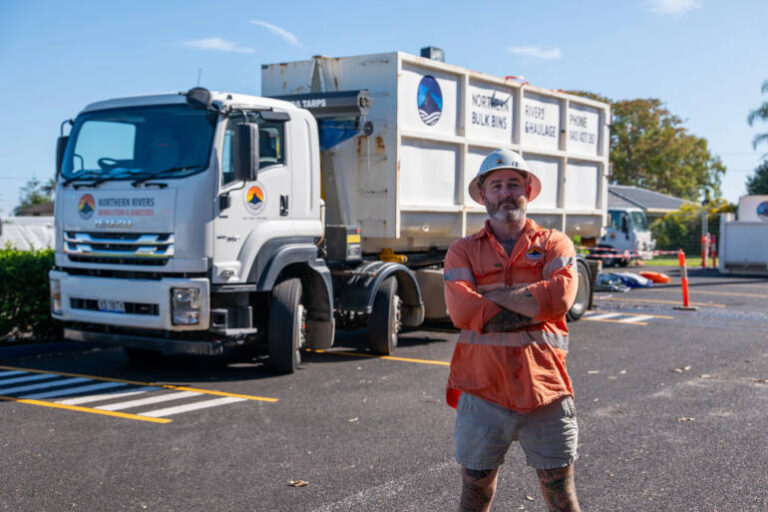
Their solution: the Isuzu FYJ 300-350 8×4 Auto. Featuring a 30,000 kg GVM and equipped with a Palfinger crane hook lift, the truck manages 30-cubic-metre skip bins used for sealed asbestos loads.
Thanks to its high-torque 6UZ1-TCC engine (257 kW @ 2,000 rpm and 1,422 Nm @ 1,400 rpm), twin-steer axles, and load-sharing suspension, the FYJ is perfectly suited for the long hauls to Ipswich, Yatala, and Staplyton.
“We can load up the skip bin over several days, sealing it each afternoon and continuing the next day,” explained Samuel. “Once it’s full, we can head straight to Queensland for disposal. Access to affordable, licenced disposal facilities is a major issue in our industry at the moment, so the Isuzu FYJ is our solution to this problem.”
Isuzu Reliability Backed by Local Support
The FYJ is the latest in a growing fleet of four Isuzu trucks that includes an NMR 60/45-150 Tipper, an NPR 45/55-155 Tipper, and an NLR 45-150 Traypack. Samuel was so committed to getting the right truck that he flew to South Australia to collect the FYJ and drove it nearly 3,000 km back to Ballina.
He’s been impressed with the comfort and drivability of the FYJ, likening the cab feel to the smaller Isuzu models in his fleet. The truck’s Allison 4430 automatic transmission has proven ideal for reducing fatigue on the 200 km-plus journeys into Southeast Queensland.
“Business owners have already got enough to juggle, so Isuzu’s reputation for reliability gives us peace of mind, letting us get on with the job at hand,” said Samuel.
A Future-Focused Business
Ongoing support from Northern Rivers Isuzu has been a key enabler of the company’s continued growth. Samuel praised Sales Manager Jake Everett for quick turnaround on parts and servicing: “Jake always makes sure to minimise downtime, which can really impact us.”
As the company scales up, new initiatives like Northern Rivers Recycled Building Materials are helping divert reusable materials—like hardwood timber—from landfill. The newly launched Northern Rivers Bulk Bins & Haulage is also enabling asbestos transportation services for other businesses.
To support this expansion, another heavy-duty Isuzu may soon join the fleet.
With safety, service, and sustainability at its core, Northern Rivers Demolition & Asbestos is proving that the right equipment—backed by the right people—can transform one of Australia’s toughest jobs into one of its most essential services.