




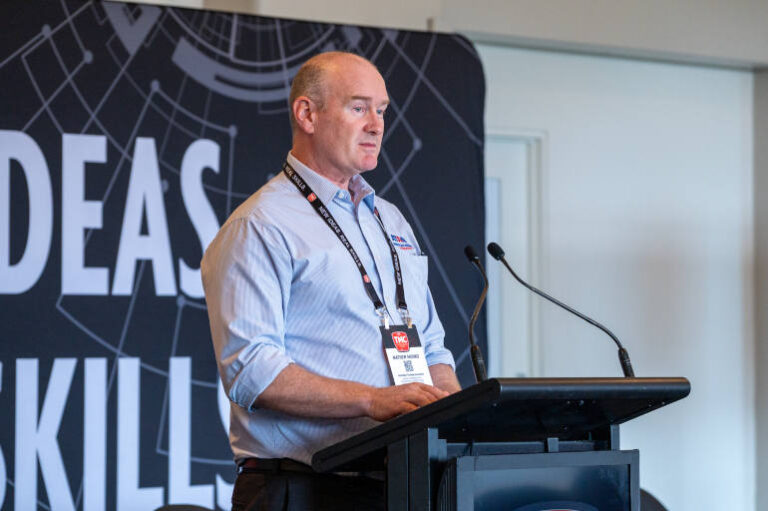
At the Australian Trucking Association’s (ATA) Technology and Maintenance Conference (TMC) 2025, Australian Trucking Association CEO, Matthew Munro, outlined why hydrogen remains a critical piece of Australia’s heavy transport decarbonisation puzzle — particularly for long-haul freight where battery-electric options remain constrained by range, weight, and infrastructure challenges.
Munro said the ATA’s latest modelling confirms that renewable diesel, battery-electric and hydrogen will each play complementary roles in decarbonising heavy vehicles, but adoption will take time given the industry’s slow fleet turnover and complex operating environments.
“Hydrogen — whether through fuel cells or combustion — may be a simple solution for heavier, long-distance transport,” Munro explained. “But upfront cost, operating cost, and investment uncertainties still need more attention.”
Transition will take time
Munro reminded delegates that the transition to low-carbon fuels is fundamental and cannot happen overnight. “Technologies will continue to innovate and mature. Fuel supply capacity must be increased, supporting infrastructure must be built, and regulatory issues must be resolved,” he said.
With Australia’s trucking fleet averaging 14.8 years of age, the vehicles ordered today will still be on the road in 2040. That reality, Munro said, highlights the urgency for governments and industry to act now to create viable pathways for adoption.
“Let’s not kid ourselves. There is massive pressure to act,” he said. “The Australian Government has committed to reduce greenhouse gas emissions 43% below 2005 levels by 2030, 62–70% by 2035, and to achieve net zero by 2050.”
ATA’s roadmap for low-emission fuels
Munro said the ATA’s proposals—supported by modelling from Curtin University and Deloitte Access Economics—include a suite of supply and demand measures designed to accelerate industry adoption of cleaner technologies.
On the supply side, the ATA supports incentives to produce renewable diesel and hydrogen domestically, including the federal government’s $1.1 billion, 10-year commitment to low-carbon fuel production. Munro said this investment could help create a $36 billion industry by 2050, generating jobs across the supply chain.
However, he argued that demand-side incentives are equally essential. The ATA has called for a low-carbon fuel standard modelled on California’s approach, where fuel suppliers are required to reduce lifecycle emissions intensity against declining benchmarks. They can meet these targets by selling renewable fuels, building hydrogen refuelling stations, or installing EV charging infrastructure.
“This model allows suppliers to decide how best to adjust their product mix to meet emissions targets and the needs of their customers,” Munro said.
Hydrogen-ready vehicles need support
The ATA has also proposed a voucher scheme to offset the higher upfront cost of zero- and low-emission trucks. The scheme would allow buyers of hydrogen, battery-electric, hybrid or e-axle trucks to claim a voucher from the dealer covering up to half the price difference compared with a conventional diesel model.
Modelled on California’s “CalStart” program, Munro said the scheme would remove one of the biggest financial barriers to adoption. The ATA’s analysis found that this incentive could see electric trucks make up 92% of the rigid fleet by 2044, cutting emissions by 14.9 million tonnes over 25 years.
Policy alignment and productivity gains
Beyond fuels, Munro said improving access for high-productivity and low-emission vehicles could deliver significant emissions and cost reductions. “Switching from a conventional semi-trailer to a B-double carrying the same load uses only 72% of the fuel and halves the number of trips,” he noted.
ATA modelling shows such productivity improvements could reduce emissions by 33 million tonnes by 2050, save the industry $13.6 billion in operating costs, and cut household expenses by $400 a year through lower freight costs.
Munro said it was encouraging that the government’s Transport and Infrastructure Net Zero Roadmap, released in 2025, reflected many ATA proposals — including recognition of high-productivity vehicles as a key emissions-reduction pathway.
“The government is getting serious about its productivity agenda,” he said. “We’re pleased that our message is getting through.”
A pragmatic view on hydrogen
Munro’s comments set the stage for technical insights from hydrogen specialists at BOC, who discussed storage, refuelling and infrastructure projects underway in Australia. Together, their presentations reinforced that hydrogen is not in competition with battery-electric vehicles, but part of a broader mix needed to decarbonise freight.
“The change ahead is fundamental,” Munro concluded. “But if we align policy, infrastructure and industry investment, hydrogen can help ensure Australia’s heavy vehicle fleet meets its emissions goals without compromising productivity.”
- Penske Crowns 2026 Master Technicians
 Penske Australia & New Zealand has named Luke Andrew and Luke Reid as its 2026 Penske Guild Master Technicians, recognising technical excellence across the company’s on-highway and off-highway operations. Andrew, a leading hand at Penske’s Perth branch, claimed the on-highway title, while Darwin-based Reid took out the off-highway category. The biennial Penske Guild competition brings
 - WABCO Air Dryer Range Targets Heavy Vehicle UptimeZF Aftermarket has highlighted its WABCO air dryer cartridge range for Australian commercial vehicle operators, with the products designed to protect compressed-air systems from moisture, oil and other contaminants. The range was showcased at the recent Australasia Bus & Coach Expo, where ZF demonstrated the role air treatment can play in maintaining the reliability of
- Five-year warranty becomes part of Hino’s aftersales retention strategyHino Australia is positioning its five-year warranty as part of a broader aftersales package designed to give fleet buyers more certainty over vehicle ownership costs. At the company’s recent business briefing, Hino Australia President and CEO Richard Emery said the warranty extension was one element of a wider focus on the customer lifecycle after delivery.
- Why trailers are the missing link in linehaul fuel efficiencyWhen linehaul fleets look for fuel savings, attention often turns first to the prime mover. Engine specification, cruise control settings, driver behaviour, aerodynamic packages and route planning all matter. But a TruckShowX case study has highlighted another area that can quietly undermine efficiency: the trailer. Speaking during a practical TruckShowX session, Lachlan Van de Haar,
- Truck alignment is a driver fatigue and retention issue, not just a tyre issueTruck wheel alignment is often viewed as a workshop task: correct uneven tyre wear, protect the steering components and reduce fuel use. Presented at TruckShowX, the case study from Big Wheels Truck Alignment and Impact HQ Australia showed that wheel alignment can influence more than tyre life and fuel consumption. It can also affect driver