

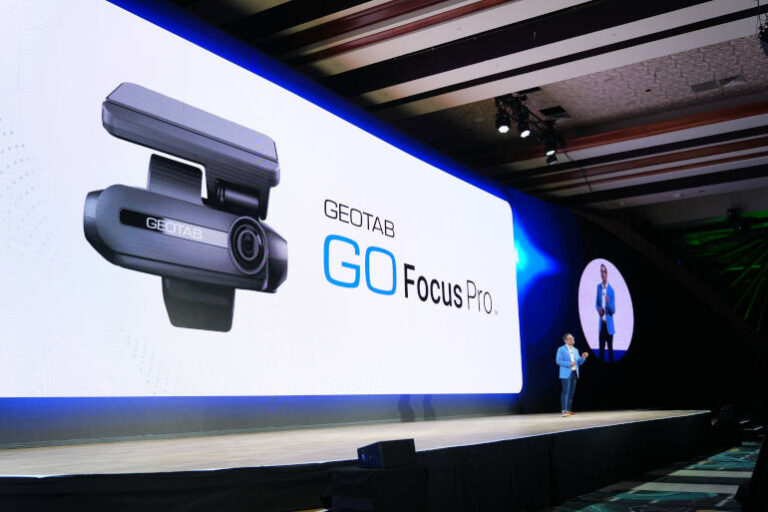
Video telematics was one of the dominant themes at Geotab Connect 2026. Not simply as a hardware discussion, but as a maturity conversation.
Australian fleets have largely embraced GPS tracking and data reporting. The next question is more complex: are they ready for inward-facing cameras, AI-driven event detection and predictive safety analytics?
From Recording to Risk Intelligence
According to Alkan Ciftci, Business Development Manager at Geotab, video telematics has moved beyond simple recording.
“There’s two bits of AI that are working here,” Ciftci said. “There’s one in the camera that’s noticing that your eyes are down… it might actually see your mobile phone. That’s the AI picking up the actual event. The second part of AI is in the reporting that you see, which is then collating the events and looking through the events to show those high magnitude offenders.”
In other words, video is no longer just evidence after the fact. It is becoming a behavioural analytics tool.
The software now “surfaces repeat and high magnitude offenders,” Ciftci explained, rather than simply listing total events. That shift changes how fleets coach drivers and prioritise risk.
The Privacy Question
Despite the technical capability, adoption ultimately hinges on culture.
“There will be resistance, and there will be questions — valid questions around that,” Ciftci acknowledged.
He argues that flexibility in configuration is critical to gaining driver acceptance. Cameras can be set up to operate as sensors rather than continuous recorders.
“You can program the camera to work as a sensor and not a recorder,” he said. “It will notify the defence generator where there’s distraction… but it won’t actually send the video through.”
That means fleets can agree on what behaviours are important to monitor — mobile phone use, seatbelt compliance or fatigue — while disabling other triggers.
“It’s about interacting with, ‘Hey, pick up and show us these events and don’t show us those,’” Ciftci said.
For low-risk drivers, inward-facing recording may not be necessary. “If you’re not generating events, tell me a sensor maybe we record the forward-facing in case of incidents,” he said. “But the inward-facing can be modified.”
The aim is to strike what Ciftci described as “that happy middle ground where drivers can be exonerated when they’re doing the right thing.”
The Australian Readiness Test
So where do Australian fleets sit on the maturity curve?
“I think there is a level of maturity that we can sit around the table,” Ciftci said. “The technology has been around… especially the heavier vehicles and commercial vehicles may already have some form of video in there.”
But readiness goes beyond hardware.
“It requires good policy. It requires good leadership,” he noted. “Doing a good trial where driver feedback is involved.”
This aligns with broader industry observations that fleet safety maturity is defined not just by tools, but by documented policies, coaching frameworks and executive alignment.
Carrot or Stick?
One of the shifts highlighted at Connect was the move away from purely punitive approaches. Ciftci pointed to reward-based programs as a way to accelerate acceptance.
“It’s the ultimate carrot for the driver to earn extra reward points that turn into dollars,” he said. “Shift that whole conversation around from punitive measures into drive rewards, safer environment, less incidents.”
The concept is straightforward: instead of cameras being seen as surveillance, they become part of a system that recognises and rewards professional driving. This approach reflects a higher level of organisational maturity — where behaviour management is embedded into structured programs rather than reactive discipline.
The Inevitable Convergence
For Sean Killen, Senior Vice President at Geotab, the broader trend is unmistakable.
“Global telematics is going to consolidate into about three or four players,” Killen said. “It’s all video driven. And all in one.”
He believes the Australian market will follow global patterns.
“I will be shocked if you ever see in like three or four years a last-mile delivery guy without a camera,” Killen said. “If there’s liability risk? Yes.”
He pointed to industries already operating with in-cab cameras as precedent. “If you want to drive a cab, you have a camera in your face,” he said.
For organisations managing safety risk, civil liability and reputational exposure, video becomes difficult to ignore.
“Chief legal officers kept telematics alive,” Killen added. “Because of the legal liability and the ability to recreate an accident and say this was not your fault.”
Data + Context
Will Batty, Associate Vice President Business Development – APAC at Geotab, framed the evolution as a natural progression.
“Data’s always going to have a very important role,” Batty said. “But I think the video context enables you to understand what’s happened in an event.”
He described video as the missing layer that allows fleets to either exonerate drivers or coach more effectively.
“Are we going to exonerate our drivers because they’ve taken the right corrective action? Or is there something we could see that we could coach?” he said.
That context moves fleets beyond event counts into meaningful intervention.
The Maturity Gap
The central issue is not whether video technology works. It does. The real question is whether fleets have the governance, communication and change management capability to implement it effectively.
Ciftci was clear that the technology alone is not enough. “It’s bringing everyone together to say, ‘Hey, these are the critical outcomes.’”
Video telematics is not a plug-and-play safety solution. It is a test of organisational maturity. For fleets that have progressed beyond basic tracking — with documented policies, executive support and structured coaching — video becomes a powerful enabler.
For those still relying on informal management and reactive reporting, the transition may be more confronting.
The industry momentum suggests video will become increasingly common. The differentiator will be how professionally fleets introduce it. In that sense, the question is less about technology readiness — and more about leadership readiness.