
As Australia debates the future of heavy vehicle decarbonisation, Craig Lee, Executive General Manager – On-Highway at Penske Australia & New Zealand, believes the most practical emissions lever may not be hydrogen or battery electric trucks — but renewable diesel.
“It’s unsexy, because an engine still has a tailpipe,” Lee said. “But as far as actually reducing emissions, renewable diesel through conventional distribution methods works.”
While battery electric trucks and hydrogen fuel cell technology continue to attract attention, Lee argues the barriers to deploying those technologies at scale in Australia remain significant.
“The Australian market is unbelievably difficult in heavy transport to implement non-liquefied fuel technology,” he said. “The infrastructure required is absolutely prohibitive on scale.”
In contrast, renewable diesel — often referred to as HVO (hydrotreated vegetable oil) — can utilise existing internal combustion engines and the established fuel supply chain. Refineries know how to produce it, fuel companies know how to distribute it, governments know how to tax it, and operators know how to use it.
“All of that is in place today at a sunk cost,” Lee said.
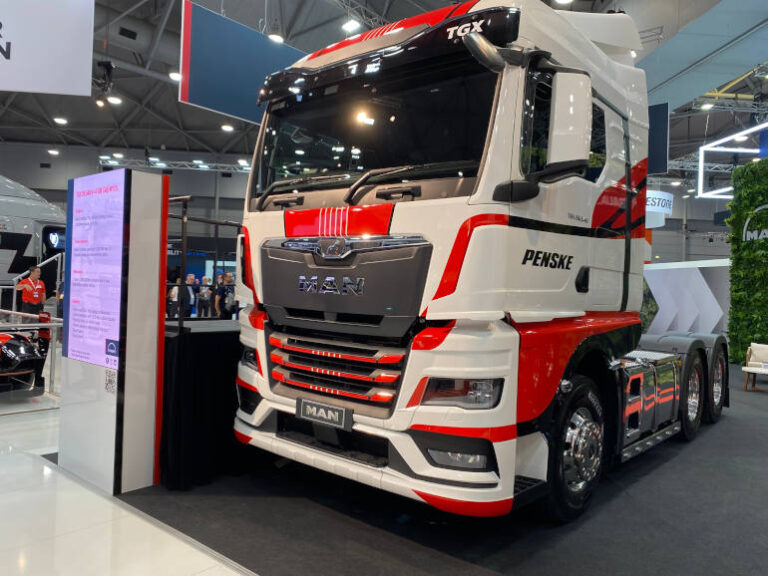
Both of Penske’s prime mover platforms can operate on 100 per cent HVO, providing immediate emissions reductions without requiring new vehicle technology or large-scale infrastructure investment.
The blending capability is another practical advantage. Renewable diesel can be mixed with conventional diesel at varying percentages, gradually lowering the carbon intensity of the overall fuel supply.
“You can run a renewable at 20 per cent or 50 per cent, like we do today with ethanol,” Lee explained. “You rise the tide of the entire market.”
This approach allows fleets to reduce emissions across existing assets rather than relying solely on new vehicle replacement cycles. For operators managing tight capital budgets, that flexibility matters.
Lee acknowledges that renewable diesel is not without debate, particularly around feedstock sourcing and the balance between food and fuel production. However, from an operational perspective, it avoids many of the technical and logistical constraints facing alternative powertrains.
“Emergency services know what to do when the thing’s lying on the side of the road upside down,” he said, pointing to the familiarity and established safety frameworks around liquid fuels.
Government support is also emerging. Lee referenced recent federal announcements supporting investment in renewable diesel production, signalling that policy settings may begin to align with this transitional pathway.
Importantly, Lee does not dismiss battery electric or hydrogen technologies outright. He sees viable use cases in urban delivery and city bus applications. But for long-haul heavy transport operating across Australia’s vast geography, he remains cautious about the pace of transition.
“I’ve not seen an operator who has successfully gone to alternative technologies on any form of scale,” he said.
For fleets facing growing Scope 1 and Scope 2 reporting obligations, renewable diesel offers a commercially realistic step forward — one that can be implemented progressively without waiting for new infrastructure networks to mature.
In a sector where decarbonisation ambitions must coexist with freight reliability and cost control, renewable diesel may represent the bridge between aspiration and operational reality.
It may lack the headline appeal of zero-emission trucks, but as Lee suggests, the most effective transitional solutions are often the ones already within reach.
- Waste truck deaths demand a closer look at council transport safety
 Waste collection is one of local government’s most visible services. It also brings heavy vehicles into residential streets, close to pedestrians, driveways and people putting out their bins. Three fatal incidents reported in 2026 highlight the potential consequences when something goes wrong. For council leaders, waste managers and fleet teams, they should prompt a fresh
 - FRNSW Bolsters Disaster ResponseFire and Rescue NSW (FRNSW) is strengthening its heavy vehicle emergency response capability with three new Bulk Water Transfer units, part of a $3.89 million investment in specialist pumping systems and transport vehicles. The Hytrans systems are being based at Bangalow in the Northern Rivers, Molong in the Central West and Albury on the NSW–Victoria
- MOTUM Puts Heavy Vehicle Drivers to the TestAustralian simulation technology company MOTUM has completed a heavy vehicle driver training platform that allows operators to practise challenging manoeuvres and hazardous situations in a controlled virtual environment. The platform supports vehicle configurations ranging from rigid trucks and semi-trailers to B-doubles, livestock combinations and oversized vehicles. It also captures performance data, giving instructors a consistent
- Borger Hits a Century with HinoBorger Cranes has taken delivery of its 100th Hino truck, adding a distinctive Indigenous-liveried Hino 700 Series SS 2848 prime mover to its national fleet. The truck will transport auxiliary crane equipment, including counterweights, supporting a business that employs more than 1,100 people and operates 320 cranes and over 270 vehicles. For the Indigenous-owned family
- ATA Celebrates Excellence and ServiceDenis Robertson, a founding member and former Chair of the Australian Trucking Association, has been made a life member of the ATA’s Industry Technical Council in recognition of his long and distinguished service to the council. The honour was announced at the ATA’s 2026 Technology and Maintenance Conference in Melbourne, placing industry service alongside achievements