





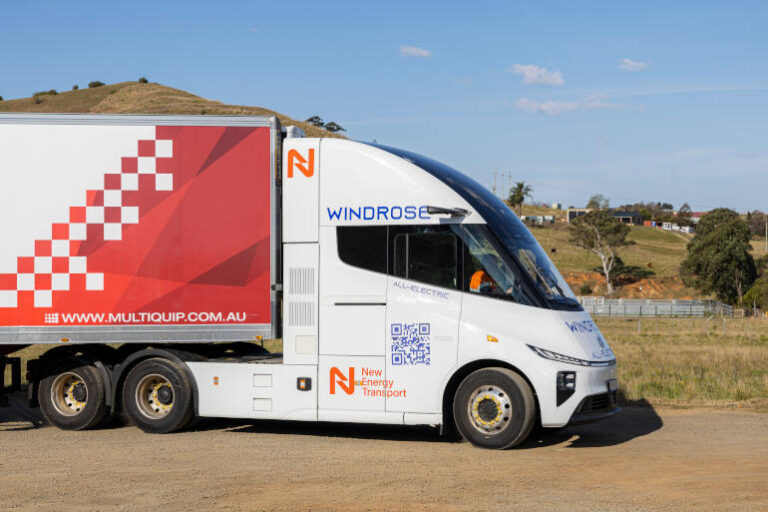
The transition to electric heavy vehicles is often framed as a technology shift. New trucks, new drivetrains, new infrastructure. But listening to Daniel Bleakley, Co-founder and Co-CEO at New Energy Transport, at the Smart Energy Conference in Sydney, it becomes clear that the real disruption is happening somewhere deeper.
It’s the business model.
For more than a century, road transport has operated on a relatively simple structure. A transport buyer contracts a carrier. That carrier buys fuel from a retailer, who sources it from a global petroleum supply chain. Each part of that system has evolved around diesel, and each part is optimised for it.

Bleakley’s view is that electrification breaks that structure completely.
“We have an electricity sector and a road freight sector that have been completely separated or isolated for 100 years or so,” he said. “And with the electrification of heavy road freight, we’re now seeing those two sectors converging. How they converge, and where they converge, and how energy flows between transport and the electricity sector… is going to be incredibly fascinating to see how that plays out, because there are huge efficiency gains to be made on both sides.”
That convergence is not a minor adjustment. It forces a rethink of where value sits in the supply chain, and who captures it.
Why the traditional model doesn’t translate
One of the early assumptions in the market has been that electrification simply replaces diesel with electricity. Service stations become charging hubs, and the rest of the system stays intact.
Bleakley doesn’t believe that works in practice.
“We’ve seen some models popping up where you have a transport buyer, then a trucking company, then a charging company simply replacing the service station one to one,” he said. “But we see challenges with that model… if you’re a charging company, you’re then tasked with selling electricity to trucking companies who don’t have electric trucks, and you also have to deal with a lot of variables.”
Those variables are operational, not theoretical. Different trucks charge at different speeds. Dwell times vary. Utilisation of expensive infrastructure becomes unpredictable.
“You might have one trucking company’s trucks charging at 100 kilowatts and another at 400 kilowatts,” Bleakley explained. “One is going to sit in your charging bay for four times the amount of time… and then there’s all these other variables.”
For fleet operators, that introduces a level of uncertainty that doesn’t exist in the diesel world.
Starting with the customer, not the truck
New Energy Transport has taken a different approach—one that starts at the demand end of the market.
“What we decided to do is go straight to the transport buyer,” Bleakley said. “That’s where the demand for zero emission road freight is coming from. And then we vertically integrate everything on our own site, and we’re able to leverage those efficiency gains.”
That vertical integration includes energy sourcing, charging infrastructure and fleet operations. It’s a model that looks less like traditional trucking and more like an integrated energy and logistics platform.
“And through that, we believe that we can reduce the overall cost of heavy road freight by over 20%,” he said.
That number matters. Not because it’s incremental—but because it changes competitive positioning. If one operator can structurally reduce costs, the rest of the market is forced to respond.
From fuel cost to energy strategy
The economics behind that shift are already familiar to most fleet operators, even if the implications are not fully understood yet.
In the diesel model, the cost structure is heavily weighted toward operating expenditure.
“You buy a truck for around $250,000, you run it up and down the Hume Highway doing 200,000 kilometres a year… and over 10 years you’ll spend around $2 million in diesel,” Bleakley said.
Electric systems flip that equation. Higher capital investment, lower running costs. But more importantly, they introduce a new dimension—energy timing and control. Bleakley framed it in practical terms.
“Imagine what it would be like if the price of diesel dropped by 80% for four hours every day, consistently,” he said. “You’d probably buy big tanks and stick them on your depot, and you would buy as much diesel as you can in those few hours, and then fill your trucks throughout the rest of the day. That’s really the opportunity that we have with the electric wholesale market.”
This is where the model starts to diverge sharply from what the industry is used to. Energy is no longer just consumed—it’s managed, stored and optimised.
Trucks as energy assets
The scale of that opportunity becomes clearer when looking at fleet-level energy capacity.
“These trucks have 700 kilowatt hour batteries,” Bleakley said. “So if you have 100 of these trucks, you have 70 megawatt hours of battery capacity at your disposal… effectively half a South Australian big battery.”
That comparison shifts the conversation. Fleets are no longer just transport assets—they are potential participants in the energy system.
“With megawatt charging… we’ll also see bidirectional capability,” he said. “You’ll be able to use the trucks themselves as batteries in future as well.”
For operators, this introduces new revenue streams and new operational considerations. Charging is no longer just a cost—it can be part of an energy strategy.
A fragmented industry facing structural change
The challenge, however, is that the Australian freight industry is not structured for this kind of transition.
“It’s a highly fragmented industry,” Bleakley said. “Less than 2% of trucking companies have more than 20 employees… 45% have one to two employees, and the rest are owner operators.”
That fragmentation has always shaped how fleets operate—lean, decentralised, and capital constrained.
“It’s incredibly challenging for the current industry to electrify,” he said. “These companies don’t have the capital to build charging hubs, and they don’t have the capital to invest in new electric prime movers, even though those things enable a much lower operating cost.”
This is where the traditional model starts to break down. The infrastructure required for electrification doesn’t align with the financial structure of most operators.
Thinking beyond the individual truck
Bleakley repeatedly returned to the idea that this transition requires a different mindset.
“It’s not individual truck driver thinking,” he said. “It’s thinking at a system level—10 trucks, 100 trucks—how does that system work?”
That system-level thinking changes everything from asset utilisation to driver scheduling and energy procurement.
It also changes who leads the decision-making process. Transport is no longer isolated from energy, and fleet decisions increasingly intersect with broader organisational strategy.
The end of a familiar model
For decades, the freight industry has operated on a stable foundation. Buy fuel, move goods, manage costs.
That model is now being challenged—not gradually, but structurally.
Electrification doesn’t just replace diesel. It connects transport to the energy system, shifts cost structures, and creates new sources of value.
For fleet operators, the implication is straightforward, even if the execution is not.
The competitive advantage in the next phase of road transport won’t come from running the same model more efficiently.
It will come from adopting a different one altogether.