




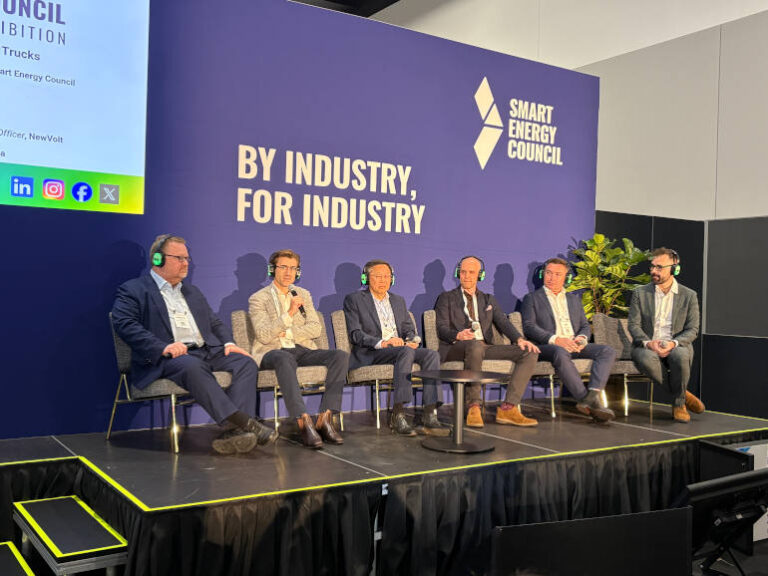
Australia’s heavy transport industry is starting to view truck electrification through a very different lens. At the Smart Energy Conference and Exhibition in Sydney, the conversation shifted beyond emissions reduction and sustainability targets to something far more immediate — fuel security, operational resilience, and the long-term viability of freight businesses reliant on imported diesel.

During a panel discussion featuring leaders from the electric truck, charging infrastructure, and energy sectors, speakers argued that Australia is entering a period where electrification is no longer simply an environmental initiative. Instead, it is becoming a strategic response to rising fuel costs, supply chain vulnerabilities, and growing pressure on freight operators already struggling with operating expenses.
Andrew Dickson, Director & Senior Advisor at Smart Energy Council, said Australia is approaching a critical turning point where truck electrification must be viewed as a national priority tied directly to energy security.
“The context for today is that a month ago, the Smart Energy Council Energy Futures Foundation hosted a really formative event at Parliament House called Freight Forward, and essentially it’s focusing on electrification of our road freight network,” said Dickson.
“Electrifying trucks is something that’s been unloved in the energy transition, but it’s an urgent priority given the fuel disruptions that are about to hit us.”
Dickson described Australia as being in “the calm before the storm”, warning that the country’s dependence on imported diesel creates growing risks for freight operators and the broader economy.
The discussion repeatedly returned to the issue of diesel supply vulnerability and the increasing pressure this is placing on transport businesses already operating on tight margins.
Ben Hutt, CEO at Janus Electric, said the economics of truck electrification are rapidly changing as diesel prices continue to rise.
“By the middle of next year, heavy transport will be the single biggest emitter of carbon in this country,” said Hutt. “Governments around the world are starting to focus on this.”
Hutt said conversations with fleet operators have shifted from curiosity about electric trucks to immediate operational concerns about fuel costs and profitability.
“In meeting with our customers in South Australia last week, they basically told me that the only trucks making any money in their fleets at the moment are the electric trucks,” he said.
“They’re making upwards of $1,000 a day profit on the electric trucks, and the diesel trucks are costing them $500 or more dollars a day to run.”
“I think the fuel price will be where it is until the end of the year, and no one really realises that yet. So this is not temporary. This is permanent.”
Hutt also linked truck electrification directly to Australia’s national resilience, arguing that the country’s dependence on imported fuel presents a serious long-term vulnerability.
“I remember sitting in a government room five years ago and having it unpeeled that actually we probably only have four days of diesel on nation,” said Hutt.
“I remember how horrifying that was to me, because we depend more on diesel freight in this country, and we spend more per capita, per person on diesel than anywhere else in the world because we’re such a big land mass.”
“To think that you wouldn’t be investing in insulating that from a war or the Straits of Hormuz or whatever it is, just seems crazy.”
Bruce Hardy, Executive Director at Energy Futures Foundation, said the freight sector now needs to think beyond traditional vehicle replacement economics and focus on long-term operational resilience.
“When companies are now thinking about electric freight, it’s not just about ‘have the numbers tipped for this particular duty cycle?’,” said Hardy.
“It’s also us coming to grips with the fact that Australia is at the end of these very long supply chains in the world, including for all the fuel that we bring here.”
“And 98 per cent of the diesel that is consumed in our freights is coming from overseas.”
Hardy said Australia faces a major strategic decision about whether future investment should continue supporting imported fuel dependency or accelerate electrification infrastructure.
“We have a choice where we are thinking about, do we invest very, very large sums of money to get after extended, deep fuel reserves and to reopen refineries, or do we take an approach where we electrify?” he said.

The panel also highlighted how quickly electric truck adoption is accelerating internationally, particularly in China, where government policy, infrastructure investment, and manufacturing scale have dramatically reduced costs and increased uptake.
Richard Zee, CEO and Founder at Solarh2e, said Australia needs to stop debating whether electrification will happen and instead focus on deploying trucks and charging infrastructure as quickly as possible.
“The question is really this — are we going electric?” said Zee. “And the answer is yes. So if you’re going electric, it’s a no brainer.”
Zee said charging infrastructure remains the critical enabler for widespread truck adoption.
“We need to get the charging infrastructure in place. Without the infrastructure, you won’t have electric trucks full stop,” he said. “We need to build a backbone that connects every major city.”
He also argued Australia should rapidly increase the number of electric truck models available locally to improve accessibility for operators.
“We need more trucks, different models here, and we need more charging,” said Zee.
The discussion also explored the policy settings needed to accelerate adoption and avoid Australia falling further behind international markets.
Rainer Knobloch, Co-Founder and Chief Strategy and Operating Officer at NewVolt, warned that without a coordinated national strategy, Australia risks slowing momentum while other technologies fill the gap.
“We need to have a collective view and a simple vision and a simple target at a federal level,” said Knobloch. “And no matter who’s in government, we stay on.”
Knobloch said many transport operators are not resisting electrification but are currently overwhelmed by operating pressures and uncertainty.
“They’re out there worried about paying the next fuel bill,” he said. “They’re not anti-electric truck. They just can’t hear that message right now.”
Gareth Ridge, Director at Zenobe Energy Australia, said the commercial case for electric trucks is already becoming clear, but the industry still needs to support operators through the transition.
“Even before the energy crisis, there was a need to electrify trucks, and we were seeing that the tipping point for trucks was already there,” said Ridge. “But since then, with the fuel crisis coming, we’ve actually seen that the commercial decision to electrify is an absolute no brainer.”
Ridge said the next challenge is helping operators understand how electrification works in practice for their businesses.
“The industry isn’t moving yet,” he said. “But now we know that the commercial decision actually is right there, ready for the taking.”
As the session concluded, the panel shared a common message — Australia’s truck electrification challenge is no longer about waiting for technology to mature. The technology already exists. The real challenge is how quickly industry, government, infrastructure providers, and fleet operators can work together to deploy it at scale.