

The road transport industry has always been shaped by change, but the current period feels different for operators trying to manage cost, compliance, technology and workforce pressures at the same time.
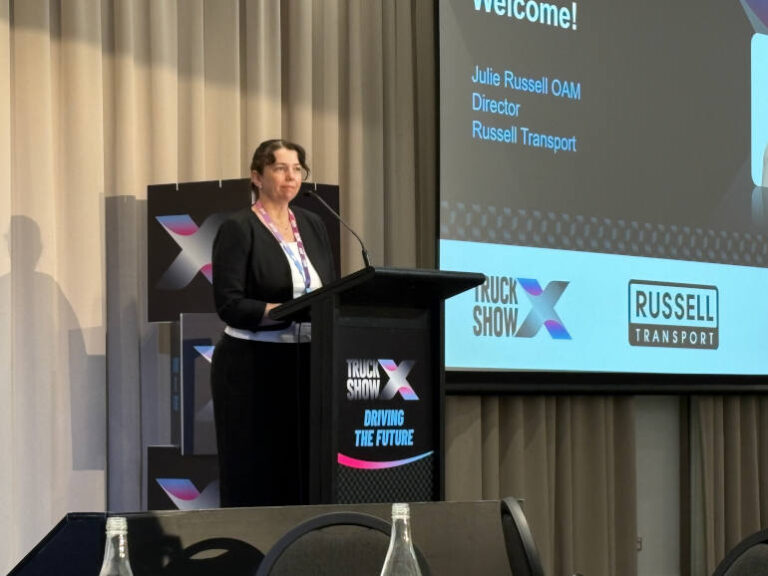
That was the message from Julie Russell OAM, Director at Russell Transport, during her presentation at TruckShowX, where she used the history of her family business to place today’s transport challenges in a longer context. Russell Transport is a Queensland-based operator with more than 100 years of history, giving Russell a rare perspective on how the industry has adapted across generations.
“When I reflect back across my time within industry, I see a pace of change that appears to be getting faster and disruptions that are both unpredictable and often occurring at the same time,” Russell said.

For Russell, change is not new. Her grandfather’s early business decision was whether to adopt the emerging vehicle technology of the day or stay with the horse and cart. That decision set the direction for a company that has since had to adjust to changing vehicle sizes, equipment types, freight tasks, employment structures and regulatory expectations.
But the difference today is the number of pressures arriving together.
Russell said the industry is dealing with shifts across the “societal, cultural, political, regulatory, and technological landscape,” while geopolitical events are also affecting supply chains and business costs.
She pointed to workforce change as one of the major issues affecting operators. More frequent job changes across the labour market mean businesses are often managing teams with less depth of task-specific knowledge. In transport, that can affect safety, compliance, utilisation and operating efficiency.
“With changing societal norms, we now see people changing jobs more frequently, and as a result, skill sets and experience in specific job tasks often lack real depth of knowledge,” Russell said.
She said this increases “the risk of unsafe and non-compliant events” while also contributing to underutilisation of equipment and technology. At the same time, labour costs across drivers, technicians and operations have continued to rise.
The freight task is also growing, but Russell warned that more work does not automatically mean stronger margins. Operators continue to face cost pressures, capacity constraints and access issues, particularly when access permissions change after businesses have already committed capital to equipment.
“Limiting and continually changing access permissions puts significant operational pressures on carriers, particularly when large capital investments have been made up front,” she said.
Fuel was another live concern. Russell said the war in Iran had added pressure to fuel prices and cash flow, with some operators facing delays before fuel adjustment mechanisms in contracts could take effect. She also pointed to the planned reintroduction of the road user charge from July as another short-term cash flow issue for operators.
The looming changes to the Heavy Vehicle National Law were also raised, particularly around accreditation schemes. Russell said businesses seeking to maintain additional mass or working hours arrangements may face extra IT costs.
Technology was a central theme of the presentation. Russell said transport technology is no longer just “the computer on a desk”. Modern operators now need systems that can manage scheduling, allocations, compliance, vehicle monitoring, data flows and reporting.
“Tomorrow’s transport company is looking more like a systems owner than a fleet owner,” Russell said.
That shift creates opportunity, but also risk. Operators need systems that suit their fleet makeup, customer needs and compliance requirements. They also need technology that can scale across mixed fleets while ideally providing a single interface to access and interpret information.
“Making the wrong decision on this is going to be very costly, but making no decision will have its own detrimental effect,” Russell said.
The challenge is not only the software itself. Many transport businesses lack the internal IT capability to assess systems, integrate data and close the knowledge gap between fleet operations and digital platforms.
Russell also flagged ESG reporting as an emerging pressure for operators of all sizes. Even businesses not directly captured by mandatory reporting may still need to provide emissions data to larger customers reporting on Scope 3 emissions.
“Regardless of our size, you’ll need to understand and have in place a system and process to capture the data, either a scope one or three emissions over the next few years,” she said.
While electric vehicles and other low-emission technologies are entering the market, Russell said each operator would need to consider what works for its own freight task and cost base. The transition will not look the same across the industry.
Her closing reflection returned to the historical comparison that opened the presentation. For new entrants, the opportunity may be to start with modern systems and technology from day one. For established operators, the task is more complex.
“I have the horse and cart, and I, like many, am having to navigate a number of changes the way we operate, including our fleet, our people, and the system,” Russell said.
The message for TruckShowX delegates was clear: the transport industry has always adapted, but the next phase will require operators to make decisions across vehicles, people, compliance, data and emissions at the same time.