
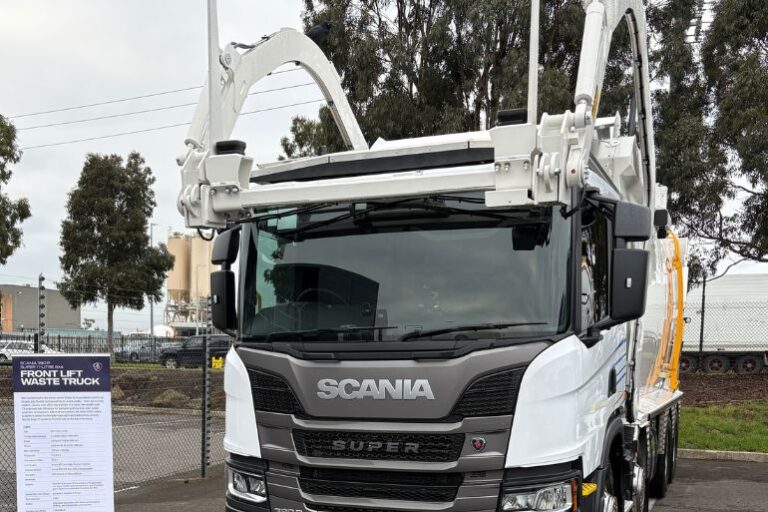
Scania Australia is using the launch of its new Super 11-litre engine to strengthen its position in the waste sector, with a new 390 P 8×4 front-lift waste truck fitted with a Superior Pak Pegasus FL Series VI body.
The truck was displayed as part of Scania’s Australian launch program for the Super 11 engine family, which has been developed for regional haulage, construction, distribution and vocational applications where fuel efficiency, payload, safety and uptime are central to the business case.

For waste operators, these factors are becoming more important as fleets face rising fuel costs, safety expectations, driver attraction challenges and the need to maximise productivity across dense urban routes.
Ben Nye, Sales Director – Trucks at Scania Australia, said waste is now a serious growth area for the brand.
“We are growing in the waste segment,” Nye said at the launch. “To be successful in waste, it is safety, it is entry and egress, it is tare weight, it is forward vision, and it is fuel consumption. They are the main drivers for any waste company right now.”
A new engine for a demanding sector
The 390 P front-lift waste truck is powered by Scania’s DC11 101 Euro 6e engine, a 10.62-litre five-cylinder inline diesel producing 390 hp, or 287 kW, at 1,800 rpm.
The engine delivers 2,000 Nm of torque from 950 rpm to 1,360 rpm, giving the truck strong low-rev performance for stop-start waste operations, urban running and heavy front-lift work.
The Super 11 engine has been positioned between Scania’s 9-litre and 13-litre engine families. It is 85 kg lighter than the Super 13-litre six-cylinder engine, shares 85 per cent parts commonality with the larger Super engine, and delivers up to seven per cent improved fuel efficiency compared with Scania’s 9-litre five-cylinder engine.
Those performance benefits are particularly relevant in waste, where trucks can spend long days operating in low-speed, high-idle environments and where small improvements in fuel use can have a major impact across large fleets.
At the launch of the 11 litre engine, Nye said some waste customers are now paying much closer attention to fuel bills.
“One big waste company said for the first time my board of directors asked me to look at our fuel bill, and they’d never looked at it before,” Nye said. “The Scania stood out very clearly on the spreadsheet, and for a good reason.”
Front-lift body with up to 10.6-tonne payload
The vehicle displayed at launch was fitted with a Superior Pak 31 m³ Pegasus FL Series VI front-lift waste body, with up to 10.6-tonne payload and the option of full ejection or tipping body configuration.
The combination gives Scania a stronger offer in a segment where payload, body integration and route productivity are critical purchasing factors.
The truck uses a CP17 low-roof cab with electronic cab tilt system and was finished in Phantom White with Glossy Steel Grey grille inserts.
The 8×4 configuration is supported by air suspension front and rear, a load transfer system, and extra stiff anti-roll bars front and rear. The truck rides on 22.5 x 8.25 Alcoa DuraBright alloy rims with Continental 295/80 R22.5 tyres on steer and drive axles.
G25 Opticruise for waste work
The 390 P front-lift waste truck is fitted with Scania’s G25CM1 Opticruise gearbox.
The transmission provides 14 forward gears, made up of 12 standard gears plus one super-crawler and one overdrive. It also offers up to eight reverse gears, Opticruise automated shifting and Eco-Roll.
Scania Opticruise drive modes include Economy, Standard and Power.
At the launch, Nye said Scania had developed the G25 gearbox specifically for the 11-litre engine and had created dedicated programs for waste and concrete applications.
“We have developed programs for this G25 for waste and for concrete, which changes shift mapping, clutch actuations, and a few other things,” he said.
Scania will also continue to offer alternative transmission options for waste customers that prefer traditional automatic gearboxes.
“We’re going into the waste market, so you’ve got to give everyone options,” Nye said.
Safety at the centre of the package
Waste trucks operate in complex urban environments, often around pedestrians, parked vehicles, cyclists, narrow streets and reversing movements. Scania has given the 390 P front-lift a broad safety specification.
Standard safety and driver assistance features include Electronic Stability System, Traction Control, Adaptive Cruise Control, Hill Hold, Differential Lock, Advanced Emergency Braking and an electropneumatic parking brake.
The ADAS package includes Lane Departure Warning with Active Steering, Lane Keep Assist, Lane Change Collision Prevention, Blind Spot Warning, and Vulnerable Road User Collision Warning using front and left-side radar.
The truck also includes driver and passenger seat belt pretensioners, driver airbag, and driver and passenger side curtain airbags.
Cab equipment includes LED headlamps, tail-lights and daytime running lights, DAB audio, Bluetooth, CB radio, USB charging and climate control air conditioning.
For drivers spending long shifts in urban waste collection, Scania has specified Medium-style driver and passenger seats with woven upholstery and an air-suspended driver’s seat.
Lower emissions pathway
The Super 11-litre engine family is HVO compatible across all variants, while B100 compatibility applies to the 390 hp and 430 hp versions.
That means the 390 P front-lift waste truck can run on HVO and is also part of the Super 11 range that supports B100 biodiesel, giving fleets more options to reduce emissions where renewable fuels are available.
For many waste operators, this may provide a practical transition pathway while they continue to assess battery electric technology, charging infrastructure and operational range requirements.
Nye said Scania remains committed to electrification, but internal combustion still has an important role in applications where electrification is not yet viable.
“As we all know, electrification is not viable for every application, so in true Scania fashion, we have continued to develop internal combustion,” he said.
Full truck specification
Model: Scania 390 P Super 11-litre 8×4 Front Lift Waste Truck
Vehicle status: Vehicle as displayed
Engine: DC11 101 Euro 6e
Configuration: 5-cylinder inline, 10.62 litres
Power: 390 hp / 287 kW at 1,800 rpm
Torque: 2,000 Nm at 950–1,360 rpm
Bore and stroke: 130 mm x 160 mm
Firing order: 1-2-4-5-3
Compression ratio: 23.0:1
Fuel system: Scania XPI Extra High-Pressure Injection
Emission system: Scania SCR, DPF, twin AdBlue dosing system
Fuel tank: 355 litres
AdBlue tank: 47 litres
Gearbox: G25CM1 Opticruise
Forward gears: 14, including 12 gears, one super-crawler and one overdrive
Reverse gears: Up to eight
Shift system: Opticruise automated changing
Fuel-saving function: Eco-Roll
Opticruise modes: Economy, Standard and Power
Rear axle ratio: 3.08:1
Brakes: ABS/EBS9 disc brakes with Advanced Emergency Braking
Parking brake: Electropneumatic
Engine brake: Variable Valve Brake, 234/344 kW
Axle distance: 5,150 mm
Bogie distance: 1,350 mm
Suspension: Air suspension front and rear, load transfer system, extra stiff anti-roll bars front and rear
Wheels: 22.5 x 8.25 Alcoa DuraBright alloy rims
Tyres: Continental 295/80 R22.5 steer and drive
Cab: CP17 low roof with electronic cab tilt system
Body: Superior Pak 31 m³ Pegasus FL Series VI front-lift waste truck
Payload: Up to 10.6 tonnes
Body type: Full ejection or tipping body
Key standard features include Scania Communicator C400, Electronic Stability System, Traction Control, Adaptive Cruise Control, Hill Hold, Differential Lock, LED lighting, DAB audio, Bluetooth, CB radio, USB charging, climate control air conditioning, driver and passenger seat belt pretensioners, driver airbag, and driver and passenger side curtain airbags.
Scania pushes further into waste
The 390 P front-lift waste truck shows how Scania plans to use the Super 11 engine to move further into specialist vocational markets.
The combination of 390 hp, 2,000 Nm of torque, lighter engine weight, fuel efficiency, strong safety specification and a dedicated waste body gives the company a stronger platform in a segment where operating costs and safety are under greater scrutiny.
For waste fleets, the pitch is straightforward: lower fuel use, practical payload, factory-backed uptime, advanced safety and a drivetrain developed specifically for the application.
For Scania, it is another step into what Nye described as “uncharted territory” as the brand looks beyond its traditional long-haul and fire truck reputation and into a wider range of Australian fleet applications.