





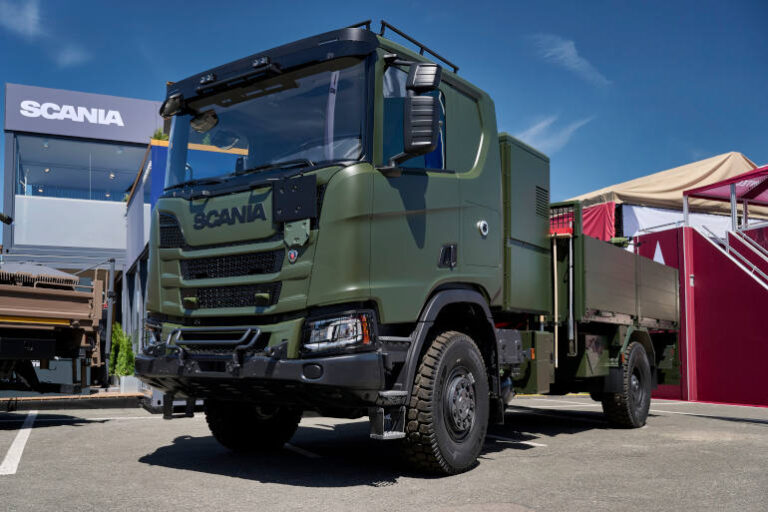
Scania has handed over the first of three plug-in hybrid trucks to the Swedish Defence Materiel Administration (FMV), beginning a joint development project that will test how electrified heavy vehicles can support future military operations.
The first vehicle was presented at Eurosatory in Paris and will be evaluated by the Swedish Armed Forces across its service branches. The project brings together Scania, FMV and the end user to assess the operational role of hybrid technology in demanding defence applications.
While fuel efficiency remains an important benefit, the project is focused on the broader capability a hybrid truck can bring in the field. This includes short-distance silent driving, instant electric torque at low speeds and the ability to provide onboard electricity for equipment such as command posts, communications systems, sensors and temporary camps.
A truck that can also supply power
The Scania hybrid is designed to act as a mobile energy platform as well as a transport vehicle.
Its 208kWh battery can provide around four hours of continuous AC power supply, depending on demand and the operating profile. The truck can supply both 400V and 230V AC electricity through vehicle-mounted outlets, creating an alternative to conventional diesel generators for some field-based applications.
This could be particularly valuable where vehicles need to support communications, surveillance or command equipment without creating the noise associated with a running generator.
The battery can also be recharged by the combustion engine, with Scania stating a full charge from zero can be achieved in approximately 45 to 60 minutes while idling.
Silent movement adds another capability
The plug-in parallel hybrid system allows the combustion engine and electric motor to operate separately or together, depending on the mission and operating environment.
In electric mode, the truck has an estimated range of around 70 to 80 kilometres, depending on payload, terrain, use and conditions. The electric motor delivers up to 290kW for short periods and a maximum torque output of 2,800Nm.
For defence users, the attraction is not simply emissions reduction. Electric propulsion allows limited periods of quiet movement, while battery-powered external energy can reduce a vehicle’s acoustic signature when stationary.
The system also supports power take-off operation during charging, when stationary, during manoeuvring and while driving. Scania says the current configuration can provide up to 60kW of electric PTO power and up to 220kW of mechanical power.
From trial project to modular solution
Scania is now examining how the hybrid truck technology could be industrialised and incorporated into its modular production system.
That approach would allow the platform to be adapted for different vehicle configurations, military missions and customer requirements, rather than being limited to a one-off development model.
Scania Commercial Head Stefano Fedel said the project reflects changing defence requirements, where mobility, energy supply and operational flexibility are becoming increasingly important.
The three-truck program will give FMV and the Swedish Armed Forces the opportunity to test the technology under operational conditions, while providing Scania with real-world insight to guide the development of future hybrid defence vehicles.
For heavy vehicle manufacturers, the project also demonstrates how electrification may first gain traction in specialised applications where the value lies not only in propulsion, but in the ability to deliver power where it is needed.