

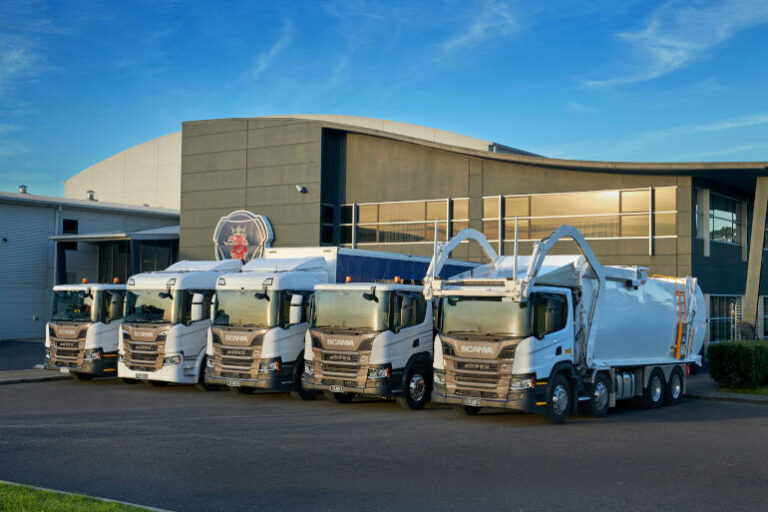
Scania Australia has launched its new Super 11-litre five-cylinder engine, a powertrain the company expects will help it expand beyond its traditional strongholds and compete more aggressively in waste, construction, distribution, concrete agitators and other vocational applications.
The new engine sits between Scania’s established 9-litre five-cylinder and 13-litre six-cylinder engines, giving operators a lighter, more efficient option without stepping away from the performance and durability associated with the Scania brand.

Available in 350 hp, 390 hp and 430 hp variants, the Euro 6e-compliant Super 11 delivers up to 2,200 Nm of torque and is aimed at operators looking for more payload, lower fuel consumption and improved uptime. Scania says the engine offers up to seven per cent lower fuel consumption compared with its existing 9-litre engine and is 85 kg lighter than the Super 13.
For Scania Australia, the launch is about more than a new engine. It is part of a broader push into applications where tare weight, safety, fuel efficiency and bodybuilder flexibility are becoming more important buying criteria.
A new chapter for Scania in Australia
Speaking at the Australian launch, Ben Nye, Sales Director – Trucks at Scania Australia, said the Super 11 gives the brand a stronger platform to compete in segments where it has historically had less presence.
“Scania has always been known as the long-haulage, highway line-haul truck, as well as the fire truck, but we need to survive, and we need to evolve,” Nye said. “For us to evolve, we need to go into uncharted territory, and uncharted territory means new applications.”
Those applications include hooklift, front-lift waste, eight-wheel distribution, six-by-two prime movers and concrete agitators. Scania also sees opportunities in fuel delivery, car transport, flatbed and crane combinations, recovery vehicles, emergency vehicles and high-volume bulk transport.
Built for efficiency and payload
The Super 11 shares 85 per cent of its engine architecture with Scania’s Super 13, which has already been operating in Australia since 2023. The 10.6-litre five-cylinder engine has been designed to deliver high torque at low revs, with maximum torque available from 950 rpm.
The three outputs are:
- 350 hp with 1,800 Nm of torque
- 390 hp with 2,000 Nm of torque
- 430 hp with 2,200 Nm of torque
The engine is compatible with HVO across all variants, while B100 biodiesel compatibility applies to the 390 hp and 430 hp versions. This gives operators a pathway to lower emissions where renewable fuels are available, without requiring the same infrastructure step-change as battery electric trucks.
Nye said Scania remains committed to electrification, but he also acknowledged that diesel will remain necessary in many Australian applications.
“As we all know, electrification is not viable for every application, so in true Scania fashion, we have continued to develop internal combustion, because that is what’s going to get us through,” he said.
The Super 11 also introduces technology that Scania says will improve efficiency, performance and driveability. This includes cam phaser technology for variable valve timing, turbo dosing for more efficient AdBlue use, balance shafts to reduce vibration and a Variable Valve Brake producing up to 344 kW of engine braking power.
Targeting waste and concrete
Waste is one of the key markets where Scania believes the Super 11 will strengthen its offer. Nye said Scania has already been growing in the segment, with major operators recognising the importance of fuel consumption, tare weight, safety and forward vision.
“To be successful in waste, it is safety, it is entry and egress, it is tare weight, it is forward vision, and it is fuel consumption,” Nye said. “They are the main drivers for any waste company right now.”
At the launch, Scania displayed a 390 hp Super 11 front-lift waste truck and provided media with the opportunity to drive a 350 hp six-by-four hooklift. The company has also developed specific G25 gearbox programs for waste and concrete applications, adjusting shift mapping and clutch actuation to suit the operating environment.
Scania will also offer Allison automatic transmissions where operators prefer that option.
Concrete agitators are another important target. Nye said the market was looking for another option, particularly as some existing products have not evolved quickly enough.
“The market is demanding another option,” he said. “We decided we wanted to take that spot, so we’ve developed as light as possible an eight-by-four 350 horsepower agitator.”
According to Nye, the Scania agitator package has been designed around safety, stability and driver comfort. He pointed to rollover risk, entry and egress, noise and vibration as key issues in concrete operations, and said Scania had worked to address them through chassis design, suspension stiffness, safety systems and cab comfort.
“We have made sure that this is the safest concrete truck on the market,” he said. “It’s also the quietest concrete truck on the market, and the smoothest concrete truck on the market, and it performs.”
Distribution gets a rethink
Scania is also using the Super 11 launch to revisit distribution applications, including eight-by-two rigid trucks and six-by-two prime movers.
Nye said the eight-by-two rigid curtain-sider setup solves practical fleet problems in distribution because it is less sensitive to how the vehicle is unloaded. With two axles at the front and two at the rear, but only one driven rear axle, Scania says the configuration can deliver fuel savings while maintaining stability and safety.
The six-by-two prime mover is aimed at supermarket and distribution work where two driven axles may not be required.
“Why do we need a six-by-four for doing distribution supermarket drop-off?” Nye said. “Why do we need two axles driven?”
Scania’s six-by-two system includes load transfer technology designed to keep 60 per cent of the load on the drive axle to reduce wheel slip. The system also allows the driver to transfer air from the tag axle to the drive axle in low-speed situations such as steep driveways or spoon drains.
“The biggest change is fuel,” Nye said. “Not running a power divider, not running a second tailshaft, not running a second diff, it makes so much sense.”
Uptime included in the package
Scania is also backing the Super 11 launch with inclusive maintenance packages. Nye said waste and concrete trucks will be offered with three years or 6,000 hours of maintenance, while the rigid and prime mover applications will include five years or 500,000 km.
“All Super 11 trucks will come with inclusive maintenance as part of what we sell the truck with,” Nye said.
He said this was supported by Scania’s factory-owned service network across major Australian markets, with additional service outlets in remote areas.
“Keeping it on the road, uptime, maintaining performance is obviously quite important,” he said.
The Super 11 engine itself has maintenance intervals up to 30 per cent longer than Scania’s 9-litre engines when using LDF-5 engine oil. Scania says the engine has also been designed for a 25 per cent longer working life, with an expected life of up to two million kilometres depending on application.
A broader product strategy
The Super 11 is not simply a replacement for an existing engine. It gives Scania Australia a new tool to compete in applications where the balance between weight, power, safety and operating cost is changing.
For some operators, the Super 11 may provide a lower-cost step up from the 9-litre engine. For others, it may offer a lighter and more fuel-efficient alternative to the 13-litre engine where maximum output is not required.
“The new Scania Super 11 five-cylinder engine range will give our customers more power, more efficiency and more flexibility,” Nye said.
“It opens new opportunities for energy-efficient and cost-effective transport. It’s lighter, leaner and more flexible, yet it still carries the strength and reliability for which Scania is known.”
As fleet operators place greater scrutiny on fuel, safety, emissions and uptime, Scania believes the Super 11 will help it win business in parts of the market where the brand has not traditionally been the default choice.
“Current market conditions have pushed operating costs to be absolute front-of-mind for all truck users,” Nye said. “Everyone is seeking greater efficiency, greater uptime and greater productivity from their vehicles. This is where the Super 11 five-cylinder engine range will excel.”