

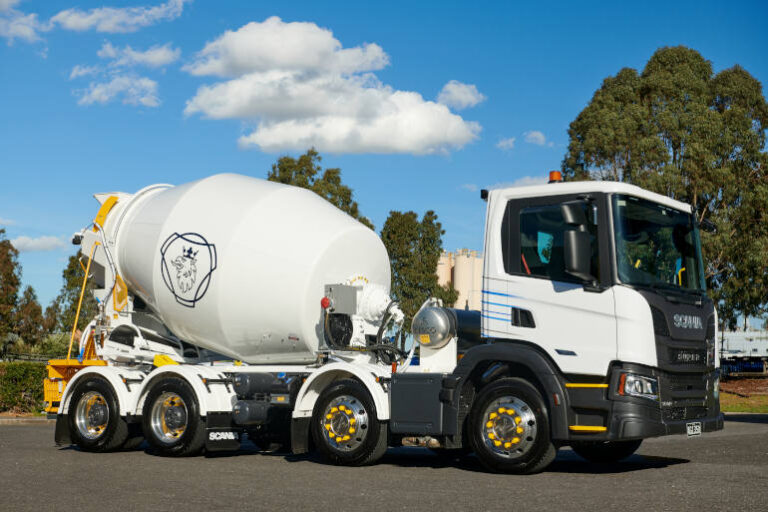
Scania Australia is taking aim at the concrete agitator market with a new 350 P 8×4 agitator powered by the company’s latest Super 11-litre engine.
The truck was shown as part of Scania’s Australian launch program for the new Super 11 engine family, which has been developed for regional haulage, construction and distribution applications where uptime, fuel efficiency, safety and payload all matter.
For Scania, the agitator is more than a new body application. It signals a broader push into vocational markets where the brand has not always been the first choice, particularly in areas dominated by traditional heavy-duty suppliers.
Ben Nye, Sales Director – Trucks at Scania Australia, said the market was looking for another option in concrete.
“The market is demanding another option,” Nye said at the launch. “We decided we wanted to take that spot, so we’ve developed as light as possible an eight-by-four 350 horsepower agitator.”

Built around the Super 11
At the centre of the new agitator is Scania’s DC11 100 Euro 6e engine, a 10.62-litre five-cylinder inline diesel producing 350 hp, or 257 kW, at 1,800 rpm.
The engine produces 1,800 Nm of torque between 950 rpm and 1,360 rpm, giving the agitator strong low-speed pulling power for urban and construction site work.
The Super 11 engine has been introduced to sit between Scania’s 9-litre and 13-litre engine families. It is 85 kg lighter than the Super 13-litre six-cylinder engine, shares 85 per cent parts commonality with the larger Super engine, and delivers up to seven per cent improved fuel efficiency compared with Scania’s 9-litre five-cylinder engine.
For agitator operators, those numbers matter. Lower tare weight can support payload productivity, while fuel savings can quickly become a major operating cost advantage in stop-start, high-idle urban work.
Nye said fuel efficiency has become a much bigger focus for vocational operators.
“Current market conditions have pushed operating costs to be absolute front-of-mind for all truck users,” he said. “Everyone is seeking greater efficiency, greater uptime and greater productivity from their vehicles.”
Safety and stability as selling points
The agitator segment has specific safety challenges, including rollovers, driver access, visibility, noise and vibration. Nye said Scania had worked to address these issues in the new truck.
“We have made sure that this is the safest concrete truck on the market,” he said. “It’s also the quietest concrete truck on the market, and the smoothest concrete truck on the market, and it performs.”
The 350 P 8×4 agitator uses air suspension front and rear, with a load transfer system and extra stiff anti-roll bars at the front and rear. It is fitted with ABS/EBS9 disc brakes, Advanced Emergency Braking and an electropneumatic parking brake.
Safety features include Electronic Stability System, Traction Control, Adaptive Cruise Control, Hill Hold, Lane Departure Warning with Active Steering, Lane Change Collision Prevention, Blind Spot Warning, and Vulnerable Road User Collision Warning using front and side radar.
The truck also includes rear vulnerable road user detection, driver and passenger seat belt pretensioners, driver airbag and driver and passenger side curtain airbags.
For a sector where trucks regularly operate around pedestrians, construction workers, traffic and tight access points, Scania is positioning the agitator as a safety-led alternative.
Drivetrain designed for vocational work
The new agitator is fitted with Scania’s G25CM1 Opticruise gearbox, offering 14 forward gears made up of 12 standard gears, one super-crawler and one overdrive.
It also offers up to eight reverse gears, automated Opticruise shifting and Eco-Roll. Scania Opticruise modes include Economy, Standard and Power.
The rear axle ratio is 3.52:1, while the axle distance is 4,550 mm and the bogie distance is 1,350 mm.
The truck is also equipped with Scania’s Variable Valve Brake, rated at 234/344 kW, providing additional braking support for demanding work sites and urban routes.
Nye said Scania has also developed specific G25 gearbox programs for concrete and waste applications, including changes to shift mapping and clutch actuation.
Mixer and cab specification
The 350 P 8×4 agitator shown at launch was fitted with a 7.6 m³ Cesco Hydraulic Transit Mixer body.
It uses Scania’s CP14 low-roof cab with electronic cab tilt system. The truck was specified in Phantom White with Glossy Steel Grey grille inserts.
Cab features include climate control air conditioning, DAB audio, Bluetooth, CB radio, USB charging, LED headlamps, LED tail-lights and LED daytime running lights.
The driver and passenger seats are Scania’s Medium style with knitted and woven upholstery, while the driver’s seat has suspension. The truck also features red seat belts.
The vehicle rides on 22.5 x 8.25 Alcoa DuraBright alloy rims with Michelin 275/70 R22.5 tyres front and rear.
Fuel capacity is 200 litres, supported by a 47-litre AdBlue tank. The emissions system uses Scania SCR, DPF and a twin AdBlue dosing system, while the engine uses Scania XPI extra high-pressure injection.
Lower emissions options
The Super 11 engine family is compatible with HVO across all 11-litre variants, giving operators a renewable fuel option where supply is available.
B100 compatibility is available on the 390 hp and 430 hp Super 11 engines, though not on the 350 hp version used in the agitator specification shown at launch.
For many construction and concrete operators, diesel efficiency will remain the immediate priority, but renewable fuel compatibility gives fleets another pathway to reduce emissions without changing operating models or installing charging infrastructure.
Full truck specification
Model: Scania 350 P Super 11-litre 8×4 Agitator
Engine: DC11 100 Euro 6e
Configuration: 5-cylinder inline, 10.62 litres
Power: 350 hp / 257 kW at 1,800 rpm
Torque: 1,800 Nm at 950–1,360 rpm
Bore and stroke: 130 mm x 160 mm
Compression ratio: 23.0:1
Fuel system: Scania XPI Extra High-Pressure Injection
Emission system: Scania SCR, DPF, twin AdBlue dosing system
Fuel tank: 200 litres
AdBlue tank: 47 litres
Gearbox: G25CM1 Opticruise
Forward gears: 14, including super-crawler and overdrive
Reverse gears: Up to eight
Drive modes: Economy, Standard and Power
Rear axle ratio: 3.52:1
Brakes: ABS/EBS9 disc brakes with Advanced Emergency Braking
Parking brake: Electropneumatic
Engine brake: Variable Valve Brake, 234/344 kW
Axle distance: 4,550 mm
Bogie distance: 1,350 mm
Suspension: Air suspension front and rear with load transfer system and extra stiff anti-roll bars
Wheels: 22.5 x 8.25 Alcoa DuraBright alloy rims
Tyres: Michelin 275/70 R22.5 steer and drive
Cab: CP14 low roof with electronic cab tilt
Body: 7.6 m³ Cesco Hydraulic Transit Mixer
Key safety and driver features include Scania Communicator C400, Electronic Stability System, Traction Control, Adaptive Cruise Control, Hill Hold, Differential Lock, Lane Departure Warning with Active Steering, Lane Change Collision Prevention, Blind Spot Warning, Vulnerable Road User Collision Warning and rear vulnerable road user detection.
A new opportunity for Scania
The agitator market has not traditionally been a core Scania stronghold in Australia, but the Super 11 gives the company a product that directly addresses the pressures facing concrete fleets: safety, fuel, payload, uptime, comfort and emissions.
The truck also reflects Scania’s broader strategy to use the new 11-litre engine to move into applications beyond linehaul and fire trucks.
“Scania has always been known as the long-haulage, highway line-haul truck, as well as the fire truck,” Nye said. “But we need to survive, and we need to evolve.”
With the 350 P 8×4 agitator, Scania is making that evolution visible. It is a truck built for one of the toughest urban vocational jobs, but with the same focus on fuel efficiency, safety and driver comfort that has shaped the broader Super 11 launch.