
Australia’s reliance on imported diesel has become a business continuity risk for the freight industry, according to transport and energy leaders speaking at TruckShowX.
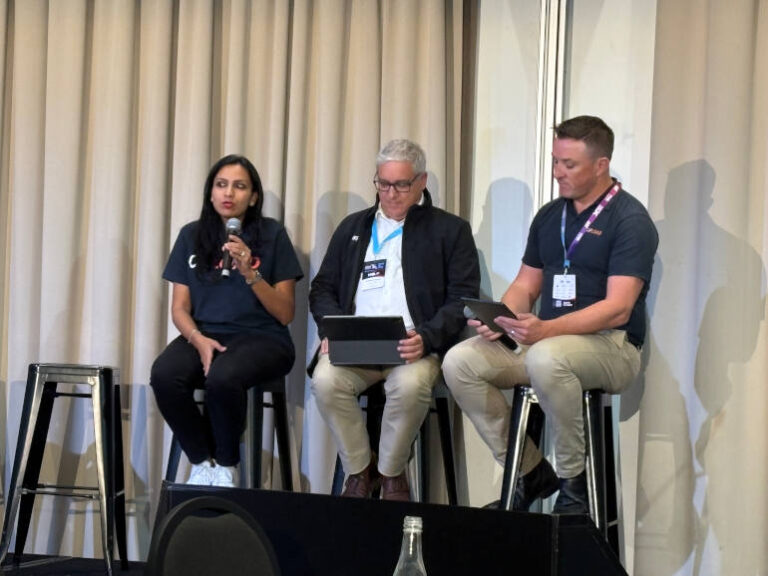
During a panel session, Hiringa Founder and CEO Andrew Clennett joined Ofload Director of Growth Drew McKinnel and Ofload Senior Director Karishma Bhatt to examine how hydrogen, freight data and greater collaboration between carriers and freight customers could strengthen Australia’s transport resilience.
The discussion highlighted that alternative fuels are no longer solely an emissions issue. Increasing diesel prices, international supply disruptions and pressure on transport operators’ working capital have made fuel security a more immediate commercial concern.

Fuel is becoming a national resilience issue
Bhatt said fuel had historically been treated as an operating expense or constraint, but Australia’s dependence on imported supply meant it should now be considered an issue of national resilience.
Australia’s geography makes the challenge particularly difficult. Freight must travel long distances between widely dispersed population centres, ports, farms, mines and regional communities, while much of the heavy vehicle industry remains dependent on diesel.
“Every time there is a disaster, a natural disaster or an event, everybody thinks about what now, and then it happens again,” Bhatt said.
She said recent fuel price volatility had placed significant pressure on transport businesses, particularly smaller operators that may lack the financial capacity to absorb sudden increases.
McKinnel noted that Australia has tens of thousands of transport businesses, with many operating fleets of fewer than eight vehicles. For these companies, a rapid increase in fuel costs can immediately affect working capital and cash flow.
Clennett said supply disruptions could eventually affect whether freight moved at all.
“At the end of the day, if the impact on your suppliers means the loads start to not go, someone will miss out,” he said.
Finding alternatives to diesel could therefore address two problems simultaneously: reducing transport emissions and improving energy security.
Long-haul freight needs more than one technology
The panel stressed that different freight tasks would require different technologies.
Battery-electric vehicles are already providing practical options for metropolitan and short-haul work, but Bhatt said they did not yet address every Australian freight application.
Some of the country’s largest industries, including agriculture and mining, operate far from metropolitan centres. Freight servicing these sectors must often travel long distances while maintaining strict delivery schedules.
“You couldn’t have fresh produce travelling long haul and having to stop five or six times along the way to charge,” Bhatt said.
She argued that Australia would need a blend of technologies rather than a single replacement for diesel.
“We need blended technologies. We need technologies that keep evolving as we go to support the industry and truly build that resilience we need,” she said.
Hydrogen’s potential advantage is its suitability for vehicles operating at high utilisation over longer routes where payload, range and refuelling time are critical.
New Zealand network provides the foundation
Hiringa has already established a hydrogen refuelling network in New Zealand, providing lessons that Clennett believes can be applied in Australia.
He said building the physical stations was only one part of the task. The project required cooperation between energy suppliers, landowners, governments, truck providers, fleet operators and freight customers.
“You need partners to align. You need governments to align, and you need an ecosystem to be able to be created,” Clennett said.
“Once you create that ecosystem, the barrier just comes down.”
Hiringa worked with TR Group to aggregate demand for hydrogen trucks while developing the refuelling infrastructure required to support them.
Clennett said fleets would not adopt the vehicles unless they could be confident that trucks could complete their required routes and deliver a dependable service to customers.
The network therefore needed to be developed at sufficient scale from the beginning, rather than through isolated demonstration stations.
“This needs to be a commercially viable solution,” he said. “It needs to be something that fleets can operate.”
Freight customers must help unlock demand
A central lesson from New Zealand was that carriers could not carry the transition risk alone.
Alternative-fuel trucks can involve higher initial costs, new operating requirements and uncertainty around vehicle supply, maintenance and resale. These risks are particularly difficult for smaller transport companies to manage.
Clennett said freight customers, or shippers, had an important role because many had emissions-reduction targets and needed to address emissions across their supply chains.
“Until we can start to truly aggregate into the end markets and activate the shippers, that’s what really unlocks these opportunities,” he said.
Ofload’s role is to connect freight customers with a broad network of carriers and identify routes where alternative-fuel vehicles could be deployed effectively.
The company can use freight data to understand where volumes move, which operators service those routes and which customers may be willing to support a lower-emissions service.
Clennett said this aggregation was particularly important because infrastructure providers needed confidence that sufficient fuel demand would exist before committing capital to new stations.
Pacific Highway identified as the first corridor
Hiringa and Ofload are initially focusing on major freight corridors along Australia’s eastern seaboard.
Clennett said the Pacific Highway between Sydney and Brisbane provided a logical starting point because freight volumes and distances suited the proposed network.
The plan could later expand south along the Hume Highway towards Melbourne and inland into agricultural regions across New South Wales and Victoria.
Stations would be positioned at major freight nodes, including city gateways, industrial precincts and strategic highway locations.
Hiringa plans to produce hydrogen at or close to many of its stations, reducing the need to transport the fuel over long distances.
Clennett said this model would also allow the network to take advantage of Australia’s renewable electricity resources through direct connections to solar generation and power purchase agreements with renewable energy suppliers.
Locating production at the point of use could help lower fuel costs while avoiding some of the logistical complexity associated with transporting hydrogen.
Initial network requires trucks from day one
Hiringa is targeting a substantial initial deployment rather than a small technology trial.
Clennett said the Australian network would need approximately 50 trucks committed when the first stations opened, followed by further fleet growth during the first 12 to 18 months.
The first stage is planned to begin operating in the fourth quarter of 2028.
“For us to go big, and these aren’t small investments, we need to be able to make sure that we’ve got the offtake available to pay for the investment made to build the infrastructure,” he said.
Vehicle manufacturers, carriers, freight customers, infrastructure providers and governments would therefore need to coordinate their decisions.
Hiringa and its partners plan to present fleets and freight customers with a portfolio of vehicle options, routes and operating models rather than expecting individual carriers to develop projects independently.
Small carriers need a practical pathway
Bhatt said interest in alternative technologies had increased among small and medium transport businesses, but these operators needed support to make the transition.
Their questions were increasingly practical: whether the vehicles would be affordable, whether operating costs could be controlled and whether the technology could provide a reliable service.
“How can you make it affordable? How can you make it sustainable? And how do you really simplify the cost of operation of the vehicle?” Bhatt said.
Ofload could help manage the transition by connecting carriers with appropriate freight volumes, supporting change management and helping smaller businesses access opportunities that may otherwise be limited to major fleets.
“It’s a perfect match in terms of enabling the small and medium providers through technology that wouldn’t be easily available,” Bhatt said.
She described the process as one of “crawl, walk, run”, with carefully selected early applications building confidence before broader deployment.
Early operators will shape the network
Getting carriers involved during the development stage would allow routes, vehicles and infrastructure to be designed around real operating requirements.
Clennett pointed to a New Zealand Post hydrogen truck that had travelled more than 250,000 kilometres as an example of the value created when customers and operators participated early.
The kilometres accumulated by one heavily utilised truck could deliver a significantly greater emissions impact than deploying lower-emissions vehicles in lightly used applications.
Carriers also provide essential information about scheduling, payload, refuelling, maintenance and driver requirements that cannot be understood through modelling alone.
“They committed early, and they were part of helping design the program,” Clennett said.
Government support remains critical
The panel acknowledged the role of government in helping new freight technologies move from trials to commercial deployment.
Clennett praised the New South Wales Government for connecting project partners and examining how public-sector freight tasks and fleets could support the emerging network.
However, he said more work was required to demonstrate to the Federal Government that hydrogen heavy vehicles were ready for larger-scale deployment.
“This is ready now. This is already happening,” Clennett said.
“We can go much faster, and the impact on both our fuel emission reduction and our fuel supply can be material, very material, very quickly.”
Partnership must extend across the supply chain
Bhatt said genuine partnership meant creating benefits for carriers, freight customers and infrastructure providers rather than shifting costs or risks from one party to another.
It would also require greater education. Freight customers may measure their supply-chain emissions, but they also need practical options for reducing them. Carriers need confidence that investing in new equipment will lead to secure work and commercially sustainable rates.
“For me, true partnership looks like driving that education piece with the shippers, with the carriers, and really bringing them on a journey,” Bhatt said.
Clennett said developing a new fuel network inevitably involved setbacks, operational lessons and shared risk.
“This is just a task that no one company can do alone,” he said.
The planned hydrogen network represents more than an emissions-reduction project. For an industry exposed to imported diesel prices and global supply disruptions, it could also provide a locally produced fuel option for some of Australia’s most demanding freight routes.
Its success, however, will depend on whether infrastructure providers, governments, freight customers and carriers are prepared to commit together—and commit early.