
Australian technology company EHAULA is developing an electric trailer system designed to help heavy freight operators reduce fuel use without sacrificing the payload and productivity that underpin their businesses.
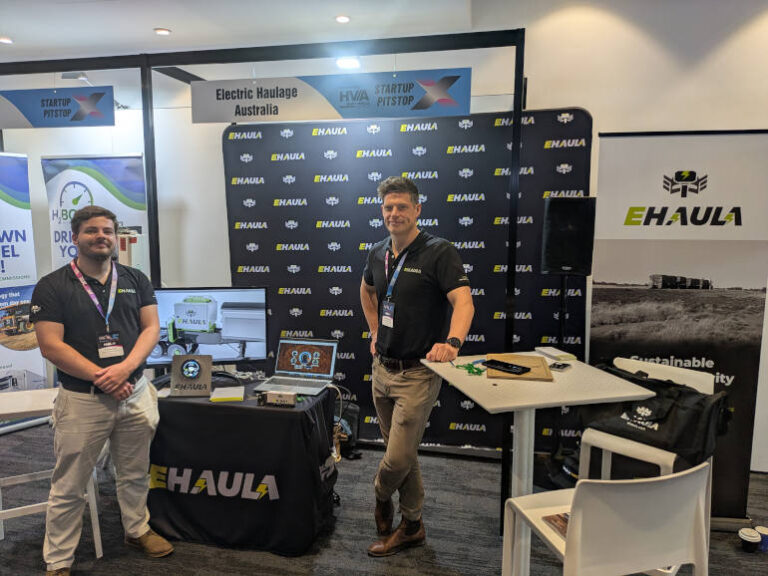
Speaking at TruckShowX, EHAULA Founder and CEO Dr Joshua Allwright said conventional battery-electric prime movers face significant challenges when applied to Australia’s heaviest combinations, particularly long-distance road trains operating at gross combination masses above 100 tonnes.
Rather than waiting for battery technology to make fully electric road trains practical, EHAULA plans to distribute electric propulsion and battery capacity across the trailer combination.
The approach could allow operators to introduce electrification progressively while retaining a conventional prime mover and adapting the system to individual routes.

Australia’s freight task changes the equation
Allwright said Australia’s longer, heavier vehicle combinations have delivered major productivity and emissions benefits by moving more freight with fewer truck movements.
However, the same characteristics make the transition to battery-electric power more difficult.
A combination moving more than 200 tonnes over several hundred kilometres could require several megawatt-hours of stored energy, depending on the route, auxiliary loads, aerodynamics and vehicle configuration.
The battery must also be sized to complete the task later in its operating life, not just when it is new.
“When you’re considering an electric vehicle, you’ve got to consider new loads, you’ve got to consider cooling, and a big one is the capacity and age of the battery,” Allwright said.
“Are you designing a new vehicle to work on day one, or are you designing it so that, at the end of your return on investment, it can still do the freight task?”
Battery weight competes with payload
The commercial problem becomes more acute as freight combinations get heavier because additional battery capacity adds weight that could otherwise be used for revenue-generating payload.
Allwright said Australian operators did not adopt larger combinations simply for their size. They use them because every additional tonne of freight can improve productivity.
“As soon as we start pushing the need for bigger batteries on those vehicles, we are asking operators to take off payload,” he said.
“Payload is what we’re paying for, so you’re taking a step back when you’re trying to push the industry forward.”
A reduction in payload can force an operator to run additional trips or vehicles to complete the same freight task. Any fuel or energy savings must therefore be assessed against the cost of moving less freight per journey.
Moving electric propulsion beyond the prime mover
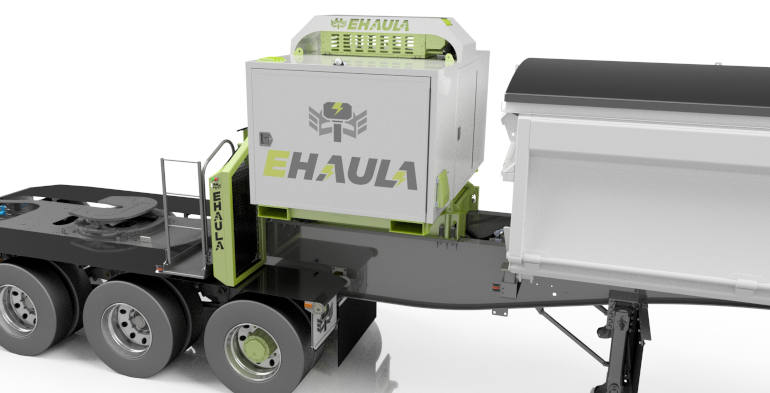
EHAULA’s proposed solution is a through-the-road parallel hybrid system that places battery capacity and powered axles on a trailer or dolly.
The electric drivetrain would assist the diesel prime mover without requiring an invasive connection to its powertrain. According to Allwright, the system would monitor information already available from the truck and could therefore operate with different prime mover brands and configurations.
Moving the batteries away from the prime mover also gives designers more flexibility to distribute weight across the combination.
Allwright said Australia’s Performance Based Standards scheme could play an important role by allowing combinations to be designed around their intended freight task, provided they satisfy the required safety and infrastructure performance standards.
“PBS gives us, to some degree, more freedom to start using axles to offset weight, increase length and design very long combinations, as long as they can comply with the standards,” he said.
Productivity must lead the business case
While reducing emissions remains an important objective, Allwright argued that productivity should be the primary commercial driver for adopting electric freight technology.
“The electric powertrain must improve road freight productivity,” he said. “If you put that out there as the way you are going to use it, and engineer it into the system, you will start to accelerate decarbonisation.”
Depending on the operation, the electric trailer could be configured to maximise fuel savings or provide additional power and traction where it delivers a stronger financial return.
Potential applications could include assisting a combination on steep gradients, improving traction on difficult surfaces, reducing diesel consumption on predictable routes or allowing a fleet to redesign a freight task around a more productive PBS combination.
Thunderbolt provides the electric drive
EHAULA is developing two main products as part of the system.
The Thunderbolt module will contain the control systems and electric drivetrain. It is designed to be fitted to the rear of a trailer or to a dolly, with either one or two powered axles depending on the required traction and performance.
A single powered axle may be sufficient where the main objective is reducing fuel consumption. Two powered axles could be used in operations where additional traction is required.
The module will also have its own low-voltage electrical system and cooling equipment, allowing it to operate independently without drawing auxiliary power from the prime mover.
Because the equipment is intended for harsh Australian freight environments, EHAULA is designing it to resist corrosion, dust, heat, vibration and water exposure.
Lightning Vault protects the batteries
The Lightning Vault is EHAULA’s modular battery system, which can be scaled according to the energy requirements of each route.
Allwright said thermal management and vibration protection would be critical because the system is intended to operate on rough roads and in extreme temperatures.
The batteries will be mounted on isolation systems to reduce vibration, while a combination of air and liquid cooling will be used to control temperature and minimise auxiliary energy use.
EHAULA is targeting a battery operating temperature of approximately 25 degrees Celsius to slow degradation and maximise cycle life.
“This is designed to see the sun at 50 degrees, and I don’t want any derating,” Allwright said.
“We want to go on very rough roads, on the hardest terrain possible, and be sitting in the hottest areas possible.”
Battery swapping avoids charging delays
EHAULA also plans to incorporate battery swapping into the system.
Allwright said even a 15-minute charging stop could be unacceptable for some high-productivity freight operations. Fast charging may also require electrical infrastructure that is unavailable at remote depots or along major freight routes.
Battery swapping could allow a combination to exchange a depleted module and return to service while the battery is charged separately.
It would also allow batteries to be charged more slowly where operational requirements permit, reducing heat and potentially extending their service life.
In other applications, operators may deliberately charge batteries more aggressively and use them intensively over a shorter asset life. The appropriate approach would depend on fleet size, vehicle utilisation, electricity supply and the number of spare battery modules available.
Every application will start with the freight task
Allwright said EHAULA would not offer the system as a standard product without first assessing the operator’s route and commercial requirements.
The process will begin by examining fleet movements, combination lengths, axle configurations, road access and opportunities to improve productivity.
EHAULA plans to work with PBS assessors and road managers early in the design process to determine whether a proposed combination is technically and commercially viable before progressing to construction.
The company will then decide whether the electric system should focus on reducing fuel consumption, delivering additional performance or supporting a broader redesign of the freight task.
EHAULA has secured two grants to support its development work and plans to begin testing its first systems after completing the initial build program.
Allwright believes fully electric Australian road trains will eventually become possible, but electric trailers could provide a practical pathway much sooner.
“You can sit back and wait 15 years for the technology to get there,” he said. “Or we can reframe how we use the technology and focus on productivity. If we improve productivity, we will accelerate decarbonisation.”