

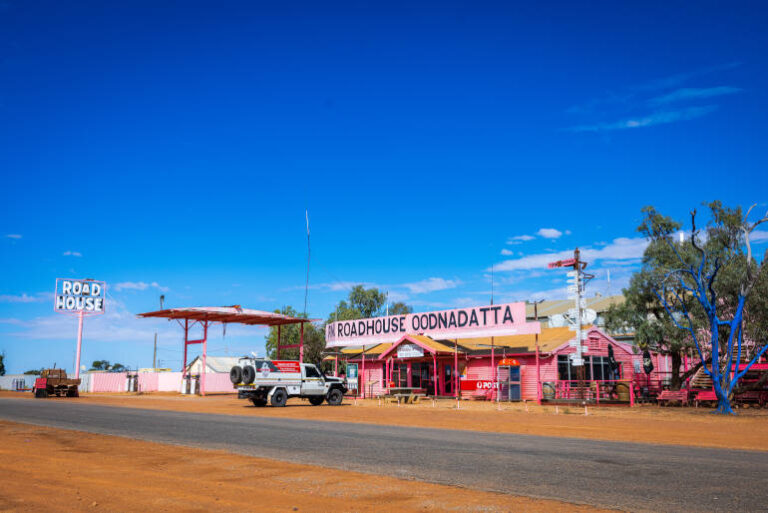
A new hybrid microgrid in one of Australia’s harshest operating environments is demonstrating how solar, battery storage and diesel generation can work together to improve energy security while reducing fuel consumption.
The new power station at Oodnadatta, more than 1,000 kilometres north of Adelaide on the edge of the Simpson Desert, combines approximately 450kW of solar generation, a 500kW/1.2MWh battery energy storage system and three 200kW diesel generating units powered by Isuzu Power Solutions 6UZ1 engines.
Commissioned by South Australia’s Department for Energy and Mining, the project was delivered by All Gen Solutions and Apex Energy Australia, with Isuzu Power Solutions supplying the diesel power units.
The system uses ComAp microgrid controls to manage the different energy sources and balance generation, storage and demand.
During daylight hours, solar and battery power carries much of the township’s electricity load, reducing the amount of time the diesel generators are required to operate.
All Gen Solutions Director Adam Lillecrapp said the microgrid is now supplying approximately 75 to 80 per cent of Oodnadatta’s energy requirements from renewable generation.
“What this project has done is create significantly more security in power supply for the community while taking away a large amount of reliance on diesel,” Lillecrapp said.
“With diesel pricing and fuel availability becoming increasingly challenging in remote Australia, that’s a major gain for communities like Oodnadatta.”
Diesel remains critical to remote reliability
Despite the high renewable energy contribution, dispatchable diesel generation remains an important part of the system.
The three generators provide additional capacity during periods of peak demand, extended cloud cover or adverse weather, while also providing redundancy for a community where an interruption to power can affect essential services.
The power station supports facilities including the town’s fuel supply, school, medical clinic, police station and infrastructure supporting the Royal Flying Doctor Service.
That makes reliability particularly important in Oodnadatta, where summer temperatures regularly exceed 45°C and equipment must contend with dust, extreme heat and the logistical challenges associated with maintaining infrastructure in remote locations.
“We chose Isuzu for this project based on reliability, fuel economy and overall robustness,” Lillecrapp said.
“Oodnadatta is classed as one of the hottest places on the planet, so we needed a product with the ambient capability to operate reliably in these conditions, while also delivering strong lifecycle cost performance.”
Heavy-duty engines adapted for stationary power
The generators use Isuzu’s 6UZ1, a 9.8-litre turbocharged and intercooled six-cylinder diesel engine.
In the Oodnadatta specification, the engine is rated at a maximum 228kW at 1,500rpm with a continuous output of 205kW at the same engine speed.
The engines use common-rail direct injection and were incorporated into bespoke generator packages assembled by the Isuzu Power Solutions product development team in Melbourne.
They were subsequently delivered to All Gen Solutions in Roseworthy, South Australia, where the complete microgrid was assembled and tested before being broken down and transported to Oodnadatta for installation.
The specification also incorporates high-capacity cooling systems designed for ambient temperatures above 50°C, dual-element air filtration, remote monitoring and IP65-rated engine management protection.
These features are particularly important in remote installations where maintenance crews may need to travel significant distances to reach the equipment and an unexpected failure can have consequences well beyond the power station itself.
Lower engine hours cut operating burden
An important operational benefit of the hybrid design is the reduction in generator operating hours.
With solar generation and the battery system carrying the majority of demand, the diesel engines accumulate fewer hours, reducing fuel consumption and scheduled servicing requirements.
Routine oil and filter servicing is carried out every 500 operating hours, while quarterly preventative maintenance covers the electrical equipment, alternators, control systems, batteries and solar infrastructure.
According to All Gen Solutions, the microgrid has been operating for around 12 months with only minor outages attributed largely to weather or distribution-line events rather than the power station itself.
The Oodnadatta installation reflects a broader shift in remote power generation.
Rather than diesel being the sole energy source, batteries and renewable generation can substantially reduce engine runtime while diesel continues to provide the dispatchable capacity and redundancy required when power supply is critical.
For remote operations, that combination has the potential to reduce fuel logistics, servicing requirements and lifecycle costs without removing the generation capacity needed when renewable energy is unavailable.