

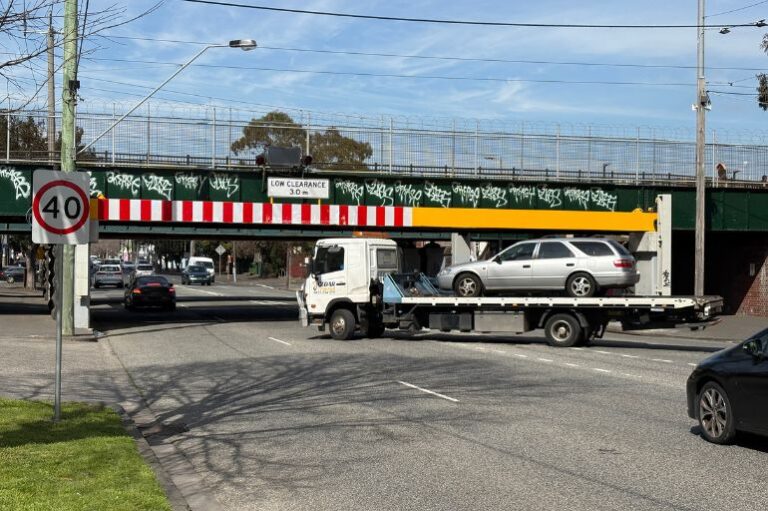
The most spectacular bridge strikes attract the headlines, but a new economic study suggests Australia’s biggest bridge-strike bill is being generated by much less dramatic incidents.
HoustonKemp Economists estimates protection beam and signage strikes accounted for 79 per cent of Australia’s approximately 1,220 bridge-strike incidents in FY2025.
Despite being the lowest severity category used in the study, these incidents generated an estimated $55 million in economic costs — 54 per cent of the national total.
The findings are contained in The economic costs of bridge strikes in Australia, prepared by HoustonKemp for HERE Technologies and the Australian Logistics Council.
The report estimates the overall economic cost of bridge strikes was approximately $101 million in FY2025.
Protection does not mean zero cost
Protection beams are designed to do an important job.
Installed ahead of vulnerable structures, they are intended to absorb an impact from an over-height vehicle before it reaches the bridge itself.
The report treats protection-beam and signage strikes separately from direct impacts with bridge structures because their consequences are generally less severe.
However, less severe does not mean inexpensive.
HoustonKemp estimates the average economic cost of a protection beam or signage strike at $56,824.
That includes an assumed $28,284 for infrastructure inspection and repair, approximately $11,157 in vehicle-related costs, $15,009 in congestion costs and smaller amounts associated with freight loss, business interruption and potential rail disruption.
The high frequency of these incidents means the cumulative bill is substantial.
HoustonKemp estimates 961 of Australia’s 1,220 bridge and protection-beam strikes during FY2025 fell into the protection beam or signage category.
Frequency changes the economics
By comparison, moderate bridge strikes are considerably more expensive individually.
HoustonKemp estimates an average moderate incident costs around $251,247 and accounts for approximately seven per cent of incidents.
Together, these incidents produce around $21 million in annual economic costs, or 21 per cent of the national bridge-strike bill.
Major incidents are estimated to cost approximately $729,491 each but represent less than one per cent of incidents.
Catastrophic events involving partial or complete bridge collapse are estimated at more than $6.25 million each, but the report assumes they occur only around once every 20 years nationally.
That creates an important distinction for fleets and infrastructure managers.
Rare catastrophic events clearly deserve attention because of their potential human and financial consequences, but reducing large numbers of lower-severity incidents may also offer substantial economic benefits.
Congestion is part of the problem
Even an incident that causes limited structural damage can affect many other road users.
HoustonKemp analysed traffic conditions associated with a sample of 56 bridge strikes in Queensland and Victoria using location-specific traffic data.
Across the sample, congestion costs varied from less than $10,000 to more than $2.7 million depending on traffic volumes, disruption duration and the availability of alternative routes.
For its base estimates, HoustonKemp calculated congestion costs of about $15,009 for a protection beam strike, rising to $38,341 for a minor bridge strike and $79,185 for a moderate incident.
A major incident was estimated to generate approximately $254,796 in congestion costs, while a catastrophic event could approach $900,000.
The report found additional vehicle operating costs made up the largest share of congestion costs on average, ahead of the value of time lost and emissions costs.
A prevention opportunity
HoustonKemp argues the cost estimates provide a basis for evaluating investment in bridge-strike prevention.
The report identifies in-vehicle height warnings, GPS-based route planning, warning signage and height-detection infrastructure among the measures that can help reduce either the frequency or severity of incidents.
For the heavy vehicle sector, one of the clearest lessons from the study is that preventing routine bridge and protection-beam strikes could have an impact well beyond reducing repair invoices.
When almost four out of every five recorded incidents sit in the lowest severity category, relatively small improvements across a large number of vehicle movements could translate into significant savings for operators, infrastructure owners and the broader community.