




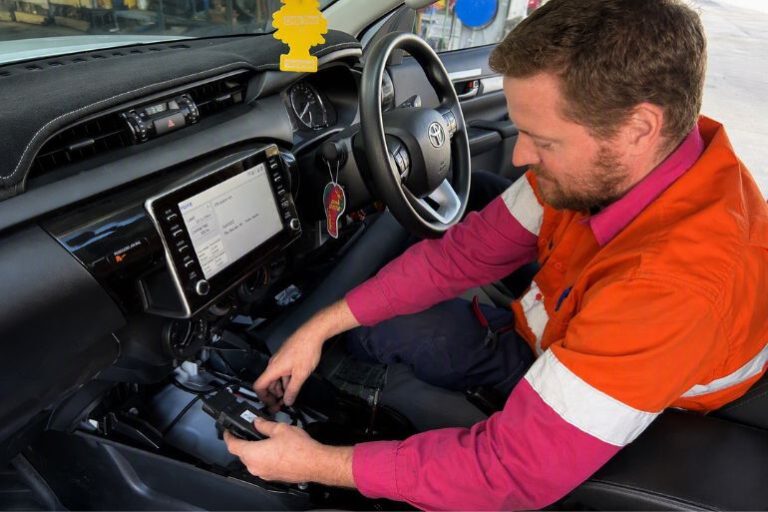
Telematics can tell a fleet manager where vehicles are, how they are being driven and where risks may be developing. But technology alone does not create a safe fleet.
That is the view of Andrew Hutson, Director at Geosecure, who says the strongest fleet safety programs are built around organisational culture, leadership and a willingness to act on the information technology provides.
Geosecure is a telematics and fleet management safety solution provider working with organisations across multiple industries. Hutson has spent more than 25 years in the telematics industry across several international markets and has watched the technology evolve from relatively basic vehicle tracking into a much broader source of operational and safety intelligence.
“If you can’t measure it, it’s very difficult to manage it,” Hutson said.
But measuring risk is only the starting point.

Speaking as part of Fleet News Group’s awards podcast series, Hutson said one of the major differences between organisations that make genuine safety improvements and those that struggle is whether safety has support throughout the business.
“It can’t just be a department that’s responsible in a silo. It’s more of an organisation, it’s a culture thing,” Hutson said.
“The organisations we see where risk and safety is an objective for the organisation and that then filters down through the organisation, we see way more success in those companies.”
That distinction is important as fleets invest in increasingly sophisticated telematics and driver monitoring systems.
Simply installing technology does not automatically change behaviour, reduce crashes or improve operational outcomes. The information needs to form part of a broader safety program with management support, reporting, coaching and follow-up.
Hutson said fleet safety also needs to look beyond individual driver behaviour.
“It’s not just about the driver. It’s about what’s the driver being asked to do, where’s he being asked to go, where’s she being asked to start. All those kind of things come into play,” he said.
That means examining the environment in which drivers are working.
Scheduling, workload, routes, vehicle selection and operational expectations can all contribute to risk. A driver completing 50 kilometres a week is operating in a very different environment to someone travelling 1,000 kilometres or more, making context important when organisations evaluate performance.
For Hutson, best-practice safety therefore requires fleets to take a broad view.
“What is the culture of the business and what is the appetite for risk and the focus to minimise it, and then what is the investment in the technology, in the vehicle types, in better operational processes to identify those areas to minimise risk?” he said.
“It has to be a top-down approach to safety.”
That philosophy is also one of the reasons Geosecure became a sponsor of the Fleet News Group Awards.
Hutson said the awards provide an opportunity to recognise organisations that are genuinely trying to improve fleet performance and reduce risk.
“We wanted to get involved to support the program and really to bring some recognition to some of those fleets out there that are striving towards excellence and ultimately striving towards minimising risk and minimising damage to people and everything else that happens out on those roads,” he said.
Working across different industries gives Geosecure visibility into how organisations approach common fleet challenges.
Hutson said this also provides an opportunity to take lessons and best practices from one sector and apply them in another.
“We’ve got a lot of clients across multiple industries that are tackling risk and safety in a number of ways, whether it’s through compliance or it’s actually just a top-down initiative from the organisation,” he said.
“We’re fortunate to see a lot of these clients and how they’re doing things and helping them and bringing some cross-industry best practice into other verticals.”
The technology available to fleet operators will continue to evolve, but the fundamental objective has remained largely unchanged throughout Hutson’s career: operate vehicles efficiently while keeping drivers and other road users safe.
The difference today is that fleets have access to more information than ever before. The challenge is making sure the organisation is prepared to use it.