





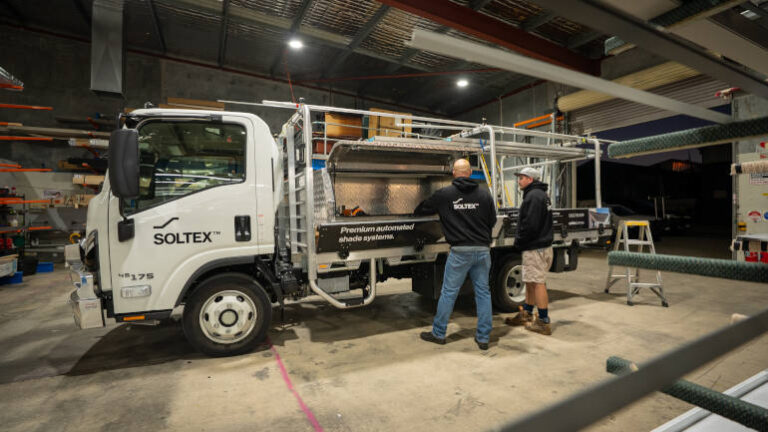
A move from utes to a light-duty truck is helping Perth-based outdoor shade specialist Soltex reduce multiple vehicle movements, carry long materials more efficiently and give its installation crews greater flexibility on the road.
Established in 2017, Soltex manufactures and installs retractable shade and weather protection systems across metropolitan Perth and regional Western Australia, with projects ranging from residential installations to major hospitality and public venues.
As the business has grown, so too have the transport demands placed on its existing fleet of utes.
That prompted Soltex to invest in an Isuzu NPR 45-155 Tradepack, with the company identifying the truck as a better fit for moving long aluminium extrusions, tools and installation equipment between its factory, external processors and customer sites.
Soltex General Manager Matt Harris said a standard aluminium extrusion used by the business is 6.5 metres long, creating logistical challenges when using smaller vehicles.
“One of the key reasons for moving to a truck was to be able to transport these lengths more easily on top of the truck tray with the ladder racks and we can also load the shorter lengths and other equipment in the tray itself,” Harris said.
“This is a lot better fit than what previously would have been two or three loads and potentially with trailers as well.”
An important consideration for Soltex was retaining operational flexibility across its workforce. The NPR 45-155 Tradepack can be driven on a car licence, allowing more employees to use the vehicle without the business relying solely on drivers with a heavy vehicle licence.
More capacity for installation crews
For businesses carrying bulky equipment rather than simply chasing maximum payload, the Tradepack’s body configuration is proving particularly useful.
The truck is fitted with a heavy-duty tray body with an aluminium deck rated to five tonnes, two heavy-duty ladder racks, a powder-coated window protector and external ratchet rails rated to 600kg.
Removable drop sides and a removable tailgate provide access for load restraint, while the vehicle also comes with a genuine Isuzu 3.5-tonne towbar, bullbar, underbody storage box, water tank and soap dispenser.
Those features have become particularly valuable when Soltex crews travel beyond Perth.
Harris pointed to a recent project in Margaret River, around three hours south of Perth, where the business was installing a dual-bay louvre roof system.
“Previously that would have involved multiple vehicles and extra staffing,” he said.
“With our utes and the tool boxes for the equipment and then the load of the materials, we were right up near the limit for the vehicles.”
By comparison, Harris said the additional capacity of the Tradepack means crews can carry the equipment and materials required for larger projects without having to squeeze loads onto smaller vehicles.
“We don’t have to worry about the Tetris game of getting a whole lot of stuff onto a smaller vehicle,” he said.
“Plus we’ve also got the added benefit of safety of not driving around in heavily laden utes.”
Bigger vehicle, but still suited to suburban work
Moving from a ute to a truck can raise concerns around access and manoeuvrability, particularly for businesses regularly working at residential properties.
However, Harris said the Isuzu’s turning circle had been an advantage when crews were working in narrow streets, laneways and established suburbs where trees and other obstacles could make vehicle access difficult.
“The manoeuvrability of the truck is definitely an advantage,” he said.
For Soltex, the decision illustrates how moving into a light-duty truck can be less about simply increasing carrying capacity and more about improving the productivity of the entire job.
Reducing the number of trips, avoiding trailers, consolidating staff and equipment into fewer vehicles and keeping the truck accessible to car-licence drivers can all contribute to a more efficient operation.
Soltex purchased the vehicle through Major Motors in Perth and also added a service agreement, giving the company greater visibility over ongoing maintenance expenditure.
“It was really about the known maintenance costs and it’s always nice knowing what’s going out the door each month,” Harris said.
“It fits with how we think about our business – there was a clear reason to buy the truck, it’s fit for purpose, the process was easy and our experience with it so far has been great.”