





Australia’s heavy vehicle industry will need to tackle safety, technology, energy, infrastructure, regulation and workforce challenges together as it prepares for the next phase of transport transformation.
That was one of the key messages from TechDRIVE Connect Brisbane, hosted by WHG and attended by transport operators, regulators, manufacturers, technology providers and industry leaders. Rather than pointing to a single technology that will reshape transport, the discussions focused on how different systems, policies and technologies can be integrated into practical fleet operations.
Safety systems move beyond policies
The event opened with Gavin Hill from Austroads and Transport Certification Australia (TCA) and Paul Daly from the National Heavy Vehicle Regulator (NHVR), covering Heavy Vehicle National Law reform, Safety Management Systems (SMS), EWD 2.0 and the increasing importance of trusted data.
One of the key messages for operators was that having safety policies and procedures is no longer enough. Fleets increasingly need to demonstrate how risks are identified, controlled and monitored in day-to-day operations — and provide evidence that those controls are actually working.
Technology and assured data can play an important role by improving visibility across fleet operations and helping businesses demonstrate both compliance and effective risk management.
The Safety Beyond Compliance panel expanded the discussion to fatigue, mental wellbeing, artificial intelligence, privacy, leadership and emerging technology.
A recurring theme was that simply installing more technology will not automatically improve safety. Drivers and operational teams need to understand why systems are being introduced, how information will be used and how technology can support safer decisions rather than simply adding another layer of monitoring.
The discussion also highlighted the opportunity to use data to identify risk earlier, shifting fleet safety management from responding to incidents towards more proactive intervention.
No single replacement for diesel
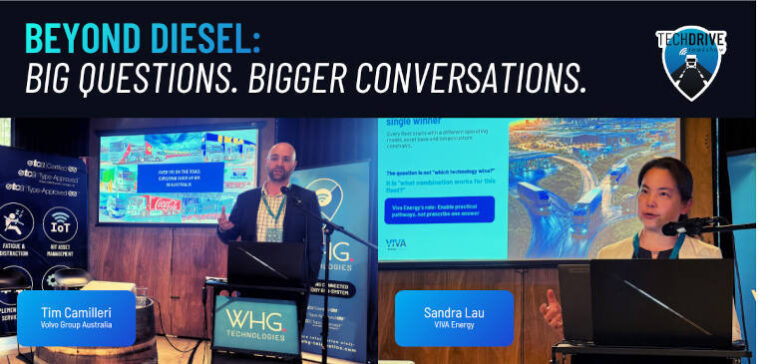
The transition away from conventional diesel was another major topic, with Sandra Lau from Viva Energy Australia and Tim Camilleri from Volvo Group Australia examining the practical challenges facing transport operators.
Rather than expecting one technology to suit every application, the discussion pointed towards a mixed future incorporating battery-electric trucks, hydrogen, renewable fuels and increasingly efficient conventional technologies.
Infrastructure, depot access, routes, duty cycles, commercial contracts and energy availability will all influence which technology makes sense for an individual operation.
Camilleri also discussed Volvo Group Australia’s work with battery-electric heavy vehicles and local manufacturing, while highlighting the importance of industry collaboration and scale.
The message for fleets was that changing the truck is only one part of the transition. Successful adoption of alternative technologies will also require suitable charging or refuelling infrastructure, energy supply, workable operating models and commercial conditions.
What should transport businesses prepare for by 2030?
An executive panel moderated by Harrison Hunkin from HVIA brought together Romesh Rodrigo from Daimler Truck Australia Pacific, Cameron Dunn from FBT Transwest, Susan Harris from ITS Australia and Dylan Hartley from WHG.
The group considered AI, autonomous vehicles, connectivity, fleet investment and workforce pressures as the industry approaches 2030.
The discussion challenged the idea that transport’s future will simply involve replacing today’s trucks with vehicles using different powertrains.
Instead, logistics optimisation, route planning, automation and infrastructure will increasingly need to be considered alongside lower-emission vehicles and fuels.
Technology is also expected to reshape jobs across driving, maintenance, logistics, fleet management and infrastructure rather than simply eliminating people from transport operations.
WHG launches new fleet technology
TechDRIVE Brisbane was also used to announce several WHG initiatives.
The company unveiled AssetIQ 730, an Australian-designed trailer and mobile asset management solution intended to provide fleets with a migration pathway from older solar-powered asset tracking technology approaching end of support.
WHG also outlined further development of FleetPREDICT, including the integration of connected Garmin wearables with OOGI AI camera technology to combine driver, wearable and vehicle information in support of more proactive fatigue-risk management.
WHG CEO – Australia Dylan Hartley said one of the strongest outcomes from the Brisbane event was the willingness of different sections of the transport industry to work through the challenges together.
“What stood out in Brisbane was the level of genuine collaboration across the industry,” Hartley said.
“Operators, regulators, manufacturers and technology providers are all dealing with different parts of the same challenge.”
He said there was no single answer to transport’s future, with the opportunity instead coming from bringing different perspectives together and identifying solutions that work in real-world operations and can be deployed at scale.