




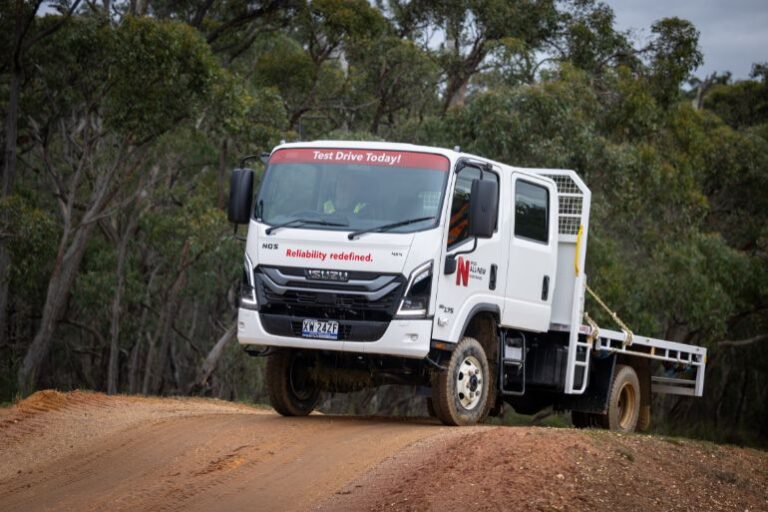
When Isuzu unveiled the new NQS 4×4 as part of its MY25 N Series range, it would have been easy to assume it was simply the replacement for the familiar NPS. It isn’t.
Instead, Isuzu has retained the NPS alongside the new NQS, creating two distinctly different 4×4 propositions for customers whose vehicles may look similar on paper but perform very different jobs in the field.
For Fleet Managers, understanding that distinction is important because the decision between the two is less about choosing the “newer” truck and more about understanding how the vehicle will actually be used.
The NPS remains a 7,500kg GVM 4×4, while the new NQS increases capacity to 8,000kg and introduces Isuzu’s nine-speed dual-clutch transmission as standard.
According to Isuzu Trucks Head of Product Management & CV Chief Engineer Simon Humphries, that additional capacity is particularly valuable for applications such as emergency services.
The extra payload available with the NQS could, for example, allow a fire service body to carry hundreds of kilograms more water than the previous-generation NPS-based vehicle.
But payload is only part of the story.
Two trucks for two different users
During Isuzu’s 4×4 drive program, Humphries explained that the NQS has been developed primarily around professional fleet applications such as emergency services, mining and remote field support.
The NPS has deliberately been retained for customers requiring a different combination of capability, particularly where towing or extensive vehicle modification is involved.
“The NQS is the one that’s really aimed squarely at the mining companies, the fire services, emergency services and the like,” Humphries said.
The NPS, meanwhile, continues with a six-speed manual transmission and maintains the ability to tow up to 4.5 tonnes.
That towing capability was an important consideration for Isuzu because many NPS customers — particularly in the recreational and specialist vehicle market — use their trucks to tow.
By comparison, the NQS’s nine-speed dual-clutch transmission delivers a two-pedal driving experience but comes with different Gross Combination Mass limitations.
That illustrates one of the realities of vehicle specification: improving one area of performance can involve compromises somewhere else.
For a fire service that rarely tows, the trade-off may make perfect sense. For a recreational operator regularly towing a trailer behind an expedition truck, it may not.
Making a 4×4 easier to drive
Perhaps the biggest difference between the two models is the transmission. The NQS uses Isuzu’s new MYR9 nine-speed dual-clutch transmission, while the NPS remains manual.
For emergency services and other multi-driver fleets, Isuzu sees the two-pedal transmission as a significant advantage.
Isuzu Trucks Head of Sales Craig White said many emergency vehicles are driven by volunteers or occasional drivers rather than people who spend every working day behind the wheel of a truck.
That means ease of operation becomes an important fleet consideration.
“The purpose of what we want to achieve out of this product is to make it user-friendly, make it easy to operate for the volunteers,” White said.
It is an important distinction for Fleet Managers.
A vehicle may have excellent off-road capability, but a fleet also needs to consider how many people will drive it, how frequently they will drive it and how much familiarisation or training will be required.
The nine-speed transmission also gives the NQS a much broader spread of ratios than the previous five-speed automated transmission used in earlier NPS models.
During the drive program, Humphries said the available ratios were particularly noticeable in low-range operation, with third gear often providing a useful balance of momentum and control through difficult terrain.
Why the NPS has a different safety specification
There is another important difference between the models: advanced driver assistance systems.
The NQS receives a broader safety package because Isuzu expects it to spend much of its working life in professionally managed fleets where vehicle configurations tend to remain closer to the manufacturer’s original specification.
The NPS takes a different approach.
Humphries said many NPS customers modify wheels, tyres, wheelbases and other components when creating expedition or specialist vehicles.
Those changes can potentially affect the calibration of systems such as electronic stability control and advanced driver assistance technology.
As a result, Isuzu deliberately chose a different safety specification for the NPS rather than simply transferring every system from the broader N Series range.
It still gains additional safety equipment compared with its predecessor, including stability and traction-control systems, but it does not receive the same stereo-camera-based driver assistance package used on other models.
The decision is a reminder that specifying an off-road fleet vehicle can involve more than simply ticking every available option.
Fleet Managers need to consider how the finished vehicle will be configured, what modifications will be made by body builders and how those changes interact with factory safety systems.
NPS isn’t disappearing
The arrival of the NQS therefore represents an expansion of Isuzu’s 4×4 offering rather than the replacement of an established model.
The NQS provides an eight-tonne, two-pedal platform aimed strongly at emergency services, mining and other vocational fleets where ease of operation, payload and driver accessibility are priorities.
The NPS retains the manual transmission, towing capacity and specification flexibility suited to customers requiring a more traditional off-road truck platform.
For Isuzu, that means attempting to serve two markets that have increasingly diverged. One wants an easier-to-drive fleet tool capable of being shared between multiple drivers.
The other wants a highly adaptable 4×4 platform that can be configured, modified and used for more specialised tasks.
For Fleet Managers comparing the two, the important question therefore isn’t whether the NQS is better than the NPS. It is which one better suits the job.