





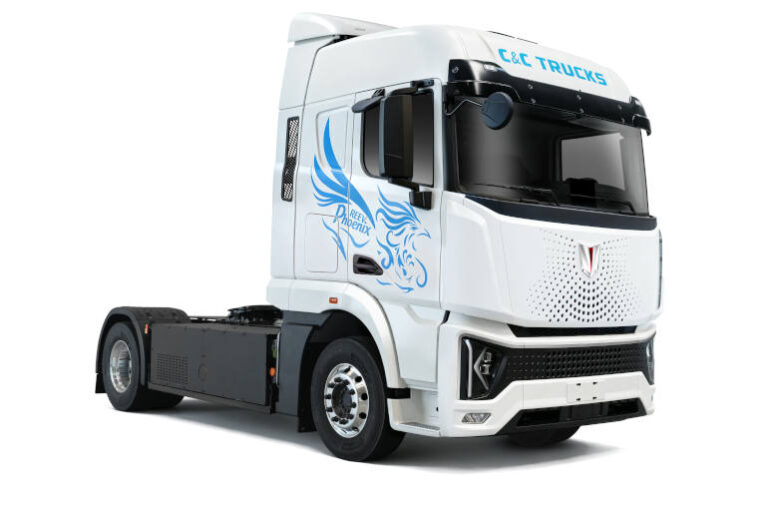
C&C Trucks has used IAA Transportation 2026 in Hannover to unveil two new-energy heavy-duty trucks alongside an integrated charging and battery-swap solution designed to make electric truck deployment easier across different operating environments.
The Chery Commercial Vehicle brand presented the Phoenix EV and Phoenix REEV at the show, while also completing its first customer vehicle handover for the Europe–Africa transport corridor. The handover represents an early commercial deployment of the company’s broader integrated fleet strategy.
For fleet operators, however, the more interesting part of the announcement may be the way C&C Trucks is approaching the infrastructure challenge.
Rather than treating the truck and its charging requirements as separate purchasing decisions, the manufacturer is combining vehicles, solar generation, battery storage, charging and battery swapping into a modular energy system that can be deployed alongside a fleet.
Two trucks for different duty cycles
The Phoenix EV is a battery-electric heavy-duty truck aimed at high-intensity short- and medium-haul freight applications.
C&C Trucks says the model combines a pure-electric drivetrain with rapid battery-swap capability, while targeting strong climbing performance, manageable energy consumption and operation in colder environments.
The Phoenix REEV takes a different approach.
Designed for medium- and long-haul regional operations, the range-extended electric vehicle is intended for markets and routes where charging infrastructure remains limited. Its range-extender configuration allows C&C Trucks to offer an electrified drivetrain without relying entirely on public or depot charging availability.
That distinction reflects a challenge increasingly facing heavy vehicle fleets: there is unlikely to be one electrification solution suitable for every route.
A metropolitan truck returning to the same depot each night has very different energy requirements from a vehicle operating across regional or international freight corridors. C&C Trucks is attempting to address those differences through a combination of battery-electric, range-extended and battery-swap technologies.
Infrastructure becomes part of the fleet solution
C&C Trucks has partnered with Gotion High-Tech on an integrated system combining vehicles, photovoltaics, battery storage, conventional charging and battery swapping.
According to the company, the modular equipment is designed to reduce the need for major civil works and can be relocated or reused as operational requirements change.
That approach could be particularly relevant for fleets that are reluctant to invest heavily in permanent charging infrastructure before understanding exactly how their future electric fleet will operate.
Temporary depots, project sites, mining operations and changing freight contracts can all make fixed infrastructure difficult to justify. A relocatable system could give operators greater flexibility as routes, vehicle numbers and energy requirements evolve.
It also shifts the fleet electrification discussion beyond vehicle range.
The operational question becomes how quickly energy can be replenished and how consistently vehicles can remain productive. C&C Trucks says its combination of charging and battery swapping is intended to improve vehicle uptime while providing different energy replenishment options for different duty cycles.
Battery swapping returns to the heavy vehicle conversation
Battery swapping has periodically been proposed as an alternative to very high-powered truck charging, particularly for vehicles operating intensive schedules.
Instead of waiting for a large battery pack to recharge, a depleted battery can be exchanged for a charged unit, potentially reducing the amount of time a truck spends stationary.
The practical challenge is that battery swapping requires standardised vehicles, batteries, equipment and sufficient utilisation to justify the infrastructure.
C&C Trucks appears to be addressing that issue by packaging the swap equipment with the vehicles and broader energy system rather than relying on a public battery-swap network.
The company plans to continue expanding its international vehicle portfolio and supporting service network following the Europe–Africa corridor deployment.