

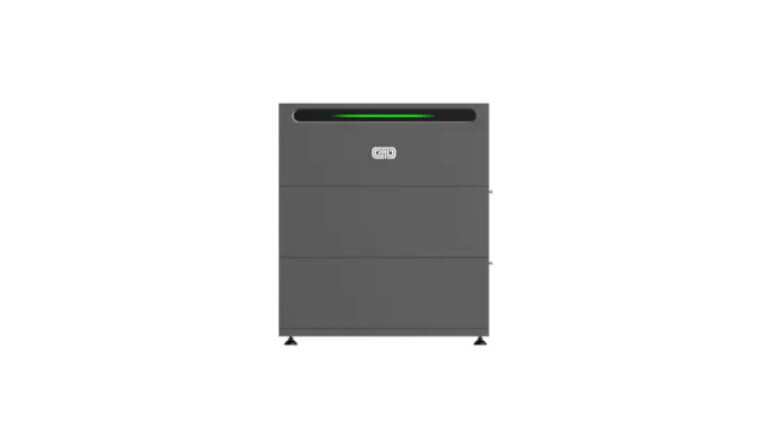
Chery Energy has used IAA Transportation 2026 in Hannover to unveil a suite of energy products aimed at supporting the growing power demands of commercial vehicle fleets, including bidirectional charging, modular battery storage and an off-grid ammonia-fuelled generation system.
The Chery Group subsidiary made its official European debut at the show with its V2G Charging Pile and Energy Cube, while also showcasing a megawatt-class solid-oxide fuel-cell (SOFC) power-generation solution. It also announced plans for a European partner and pilot city network.
For fleet operators, the announcement highlights how the transition to electric commercial vehicles is increasingly extending beyond the vehicle itself. Charging capacity, energy storage, electricity tariffs and grid constraints are becoming part of the fleet management equation.
V2G puts parked vehicles to work
Chery Energy’s V2G Charging Pile supports bidirectional charging and discharging, allowing compatible electric vehicles to draw electricity when tariffs are lower and potentially return energy when demand and prices are higher.
The system supports time-of-use charging strategies and virtual power plant remote dispatch, with Chery positioning parked vehicles as potential distributed energy-storage assets rather than simply vehicles waiting for their next shift.
That could become increasingly relevant for commercial fleets with vehicles that return to a depot overnight and have predictable operating schedules.
Rather than charging every vehicle as soon as it is plugged in, fleet operators could eventually coordinate charging around electricity prices, site demand and vehicle availability. Bidirectional capability also creates the potential for batteries to support a depot or participate in wider energy markets where local regulations and electricity market arrangements allow it.
The technology remains dependent on compatible vehicles, chargers and energy-market frameworks, but it illustrates the direction fleet charging infrastructure is moving.
Modular storage for smaller fleet sites
Chery Energy also unveiled its Energy Cube, an integrated solar, battery storage and charging system designed primarily for light-duty logistics operators, urban delivery stations, small dealers and residential applications.
The system combines photovoltaic generation, energy storage and vehicle charging in a single package, storing electricity generated during the day for use when vehicles return to charge.
Its modular battery design allows customers to start with a single module and expand to six modules with total storage capacity of 54kWh. It can also use a mixture of new and second-life battery modules.
The Energy Cube supports V2X, cloud-based energy coordination, over-the-air updates and virtual power plant dispatch. Chery says the system can also export electricity during peak tariff periods.
For smaller fleet depots, that modular approach could offer another pathway to electrification where a large standalone battery installation is difficult to justify from the outset.
It also reflects a broader change in fleet infrastructure planning. Solar generation, stationary batteries, vehicle batteries and charging equipment are increasingly being considered as one energy system rather than separate assets.
Off-grid power aimed at heavier applications
Potentially more significant for heavy vehicle operators is Chery Energy’s ammonia-fuelled SOFC generation technology.
The company is targeting applications including long-haul logistics hubs, ports, mining operations and remote charging stations where grid capacity may not be sufficient to support high-power vehicle charging.
The system is based on 25kW modular units that can be configured in series or parallel to create larger installations. Chery says the technology can operate using green ammonia and provide stable off-grid electricity for high-power charging facilities, while also potentially operating as a combined heat and power source for industrial sites.
For heavy vehicle fleets, grid capacity is emerging as one of the major practical issues associated with electrification.
Charging a passenger vehicle or light van is one thing. Supplying multiple electric trucks with hundreds of kilowatt-hours of energy during a relatively short depot window can require a substantial increase in a site’s electrical capacity.
At remote depots, mines or freight facilities, obtaining that additional grid connection may be expensive, slow or technically difficult.
Modular generation and energy storage therefore have the potential to become an important part of the heavy vehicle charging conversation alongside larger grid connections and renewable generation.
Charging becomes another fleet asset
Chery Energy also announced its European Partner & Pilot City Network, with the company planning to work with local partners on energy infrastructure projects across Europe.
There has been no announcement in the supplied material about bringing these products to Australia.
However, the technology on display at IAA Transportation provides another indication of how commercial vehicle electrification is evolving.
Fleet managers considering electric trucks will increasingly need to understand not only vehicle range and payload, but also electricity demand, charging windows, energy tariffs, site capacity and infrastructure utilisation.
For many heavy vehicle fleets, the biggest electrification decisions may eventually be made outside the truck itself.