

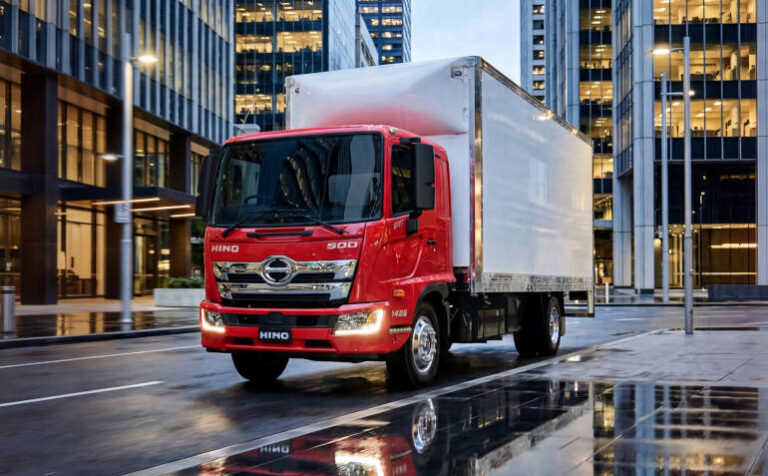
Hino Australia is preparing to restore supply of its medium-duty 500 Series in 2027, with fresh production expected early in the year as the range moves to Euro 6 compliance.
The return will reopen an important part of Hino’s Australian business after an extended production interruption forced customers to delay replacements, retain existing trucks or purchase competing brands.
Speaking at an exclusive media briefing during the Hino 300 Series Euro 6 launch and drive, Hino Australia President and CEO Richard Emery said the company had gone two years without building a 500 Series for the Australian market.
“The 500 Series is our heartland, and we have been a major player in this segment for many years,” said Emery.
“We know there is strong customer demand for the product, and we believe the 500 Series line-up will give us the opportunity to return to the market strongly in 2027.”

Production expected early in 2027
Emery said Hino was discussing the return of supply with customers, with fresh production expected early in 2027.
That provides a planning window for operators awaiting replacement trucks, although the briefing did not establish precise Australian arrival dates or delivery schedules for individual variants.
For fleets requiring a completed working vehicle, production is only one milestone. Shipping, dealer preparation and body installation will also determine when a truck can enter service.
The returning range will meet Euro 6 emissions requirements. Detailed engine specifications, outputs and the full model rollout were not outlined at the briefing.
A return to medium-duty fleet applications
The 500 Series sits in the medium-duty market, serving operators that need greater carrying capacity than a light-duty truck while retaining a chassis suited to a range of working bodies.
The customer discussion at the briefing highlighted applications such as street sweepers and waste collection vehicles, where the truck forms the platform for specialised equipment. These applications involve fleet operators and bodybuilders whose purchasing and production schedules need to align.
For council and contractor fleets, replacing a truck of this kind involves more than finding an available cab chassis. Body compatibility, equipment installation and commissioning all influence the replacement programme.
That makes the return of the 500 Series relevant to both customers awaiting trucks and the businesses that build the equipment mounted on them.
Some customers waited, others changed brands
Hino acknowledged that the supply interruption had changed buying behaviour.
Some customers extended replacement schedules to wait for the returning range. Others needed vehicles sooner and bought alternatives, while bodybuilders also had to source chassis to keep their own production moving.
Emery accepted that Hino would not recover every customer affected by the gap.
“There’s customers that we’ve probably lost that we won’t get back,” he said.
However, he said other operators had made it clear their move to a competing product was driven by availability.
“We’ve got a lot of customers who kind of put their hand up and say, ‘Look, I’ve got to go and buy something else, but I’ll be back.’”
Another group had adjusted fleet replacement programmes around Hino’s expected return.
“There was a lot of customers who just prepared to wait and restructured their fleet turnover timing,” said Emery.
Hino’s Daniel Petrovski added that bodybuilders were also indicating they would return when supply resumed.
Chassis continuity should help bodybuilders
One encouraging detail for fleets specifying specialised bodies is that the Euro 6 transition is expected to require relatively little change to existing body installations.
During the briefing, Petrovski described the returning 500 Series as mostly the same truck, with an OBD II addition and changes to particular models.
Hino’s Brian Wright said there would be “very little requirement for re-engineering our bodies” between the previous and returning generations. The team said the chassis would remain the same in most cases.
That continuity should help established bodybuilders resume installations, although compatibility will still need to be confirmed for each chassis and body combination.
Hino returns to a softer market
The 500 Series will return against a challenging market backdrop. Emery put the medium-duty segment’s decline at around 10 per cent at the time of the briefing, while suggesting Hino’s absence had contributed to the reported result.
He believes deferred purchases provide an opportunity when supply resumes, but the strength of that demand will depend on customers’ circumstances and purchasing confidence.
For fleet managers who have retained trucks longer than planned, the next step is to confirm availability for the required 500 Series variant and coordinate a realistic completion date with their dealer and bodybuilder.
Hino expects its return to restore an important option for medium-duty buyers in 2027. Winning back customers will depend on turning that production restart into dependable deliveries of finished working trucks.