

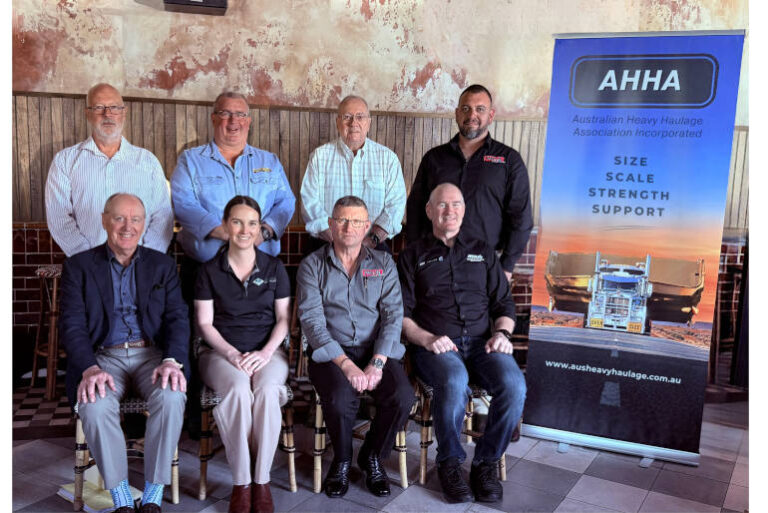
Heavy haulage operators have a new national advocacy group, with the Australian Heavy Haulage Association (AHHA) launching to pursue improvements in permits, interstate consistency and the way regulations are applied.
Australian Trucking Association CEO Mat Munro launched the independent association at a gathering of more than 40 operators in Melbourne, welcoming its formation as a boost to the profile of a small but significant part of the transport industry.
Inaugural AHHA president Nick Simpson said the association would represent oversize overmass (OSOM) carriers operating under permits, often with pilots or escorts.
“We’re here to represent the people who move those challenging loads that don’t fit neatly inside the box,” Simpson said.
For operators moving these loads, the association’s initial agenda addresses familiar operational challenges. Issues raised at the launch forum included accelerating permit processing, harmonising mass and dimension limits between states, simplifying third-party approvals and achieving greater consistency in the application of the Heavy Vehicle National Law.
The forum included presentations from the National Heavy Vehicle Regulator and Freight Victoria.
Simpson said heavy haulage had missed out on the productivity improvements achieved elsewhere in road transport, arguing that a lack of strong representation had contributed to a stagnant regulatory environment.
“The productivity boost that Class 2 vehicles have enjoyed in the last 30 years has been astronomical – whether you’re talking about prescriptive changes or performance-based changes, freight-carrying vehicles are delivering more freight with fewer trips,” he said.
“Heavy haulage has not seen any of those improvements – partly because no one notices us and partly because we haven’t made enough noise. That’s about to change.”
Simpson also pointed to heavy haulage’s role in supporting the expanding renewable energy industry as an opportunity for growth and reform.
Alongside changes to the rules, the AHHA wants a stronger voice in how requirements are interpreted and enforced.
“We’re not just about having a say in changing the rules, we also want a say in how the rules are applied – because how those rules are interpreted and enforced matters just as much as how they are written,” Simpson said.
“We want a regime that promotes safety, not rules.”
Developing an accreditation system is another task on the association’s agenda. Simpson said he wanted a scheme that delivered practical benefits to participating operators, with depot-based audits helping to reduce the burden of roadside compliance activity.
“We all agree that we’re over-regulated, and one of the solutions is to develop a green-tick-style system where we’re audited in the depot in our own time rather than out on the road by the NHVR on the customers’ time,” he said.
Simpson described accreditation as an opportunity to lift industry professionalism while easing regulatory pressure.
“Heavy haulage is an exciting industry that I love being part of, and I look forward to what the AHHA can achieve.”