

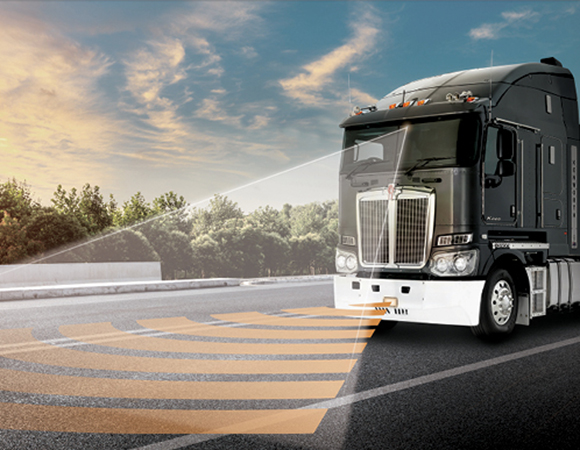
When buying trucks, it is easy to focus on engine output, payload, cab comfort, service intervals and price. But one of the most important procurement decisions is the active-safety specification.
Active safety technologies are designed to prevent a crash or reduce its severity before impact. They use cameras, radar, sensors, braking systems, steering assistance and driver-monitoring technology to identify risk and support the driver.
For fleet buyers, the challenge is that not every feature is standard across all models, cab configurations and applications. Some systems are optional, some have different levels of capability, and some may not suit every operating environment.
The right approach is to assess active safety as a package, based on the work the truck will perform.

Start with the fleet risk profile
Before comparing safety systems, fleets should understand where and how the truck will operate.
A long-haul prime mover travelling mainly on highways will have different risks to a refuse truck operating in dense suburban streets. A construction truck may need strong low-speed visibility and stability support, while a regional delivery truck may benefit most from fatigue detection, emergency braking and lane-support systems.
Key questions include:
- Does the truck spend most of its time on highways, rural roads or urban streets?
- Will it operate around pedestrians, cyclists or school zones?
- Does it make frequent turns, reversing movements or depot manoeuvres?
- Is the truck used on construction sites, unsealed roads or uneven terrain?
- Will drivers operate long shifts or high annual kilometre programs?
- Is the vehicle a rigid truck, prime mover, tipper, waste truck, tanker or specialist body?
The answers should shape the safety specification.
Ask what the emergency braking system can actually detect
Advanced Emergency Braking is now one of the most important active-safety technologies available on heavy vehicles.
However, not all systems operate in the same way.
Fleet buyers should ask whether the system detects:
- Moving vehicles ahead
- Slower vehicles
- Stationary vehicles
- Pedestrians
- Cyclists
- Motorcyclists
- Vehicles cutting in front of the truck
It is also important to understand what action the truck will take. Some systems provide a warning only, while others provide brake pre-charging, partial braking or full automatic emergency braking.
Ask suppliers:
- At what speeds does the system operate?
- Does it detect vulnerable road users?
- Can it brake for stationary vehicles?
- Does it operate in city traffic as well as highway conditions?
- What driver warnings are provided before automatic braking begins?
- Can the system be disabled, and how is this managed?
A fleet should not simply tick “AEB” on a specification list. It should understand the capability and limitations of the exact system being supplied.
Check lane-departure and lane-keeping functions
Lane-departure crashes remain a major risk for trucks operating on rural and highway routes.
Lane Departure Warning alerts the driver when the truck drifts from its lane without the indicator being activated. Lane Keep Assist can go further by applying steering support to help guide the truck back toward the centre of the lane.
Fleet buyers should ask:
- Is lane-departure warning standard?
- Does the system provide steering intervention or warning only?
- At what speeds does it operate?
- How does it perform on roads with faded or inconsistent lane markings?
- Can the warning intensity be adjusted?
- Does it work when the truck is towing different trailer configurations?
Drivers need to understand that these systems are a support tool, not an automated-driving function. Training is essential so drivers know what the truck will do and when the system may not operate.
Do not overlook blind-spot and turning safety
Blind spots are a significant risk for trucks operating in urban, local government, waste, construction and delivery environments.
Modern systems can use radar and cameras to detect vehicles, cyclists and pedestrians alongside the truck. Some provide visual or audible warnings, while others can apply steering resistance or braking intervention if the driver begins a turn or lane change into an occupied space.
Fleet buyers should ask for:
- Passenger-side blind-spot monitoring
- Turn-assist warnings
- Vulnerable-road-user detection
- Lane-change collision warning
- Side collision avoidance assistance
- A-pillar or in-cab visual warnings
- Camera views that activate with indicators or low-speed turns
The system should be assessed in the actual operating environment. A truck working in inner-city streets needs a different level of side detection to a prime mover operating mainly on interstate highways.
Specify front close-range protection
A high cab and bonnet can create a significant blind zone directly in front of a truck.
Front close-range detection uses cameras and radar to alert drivers if a pedestrian, cyclist or object is immediately in front of the vehicle. It is particularly useful in traffic queues, school zones, loading docks, construction sites and depots.
Ask:
- Is front close-range detection available?
- Does the system detect pedestrians and cyclists?
- Is the warning active only at low speed?
- Does the system integrate with the truck’s display, camera or emergency braking functions?
- Is the view affected by bullbars, body equipment or accessories?
This feature is especially relevant for fleets with frequent urban stops and starts.
Include reversing safety in the procurement specification
Reversing remains one of the highest-risk heavy-vehicle activities.
A reverse camera alone may not be enough, particularly where bodies, trailers, tail lifts, cranes or equipment create additional blind spots.
Fleet buyers should consider a combination of:
- Reverse cameras
- Rear radar sensors
- Rear cross-traffic alerts
- Audible reversing alarms
- External warning lights
- Rear vulnerable-road-user detection
- Automatic low-speed braking, where available
- Camera systems designed for the fitted body
Ask the truck supplier and bodybuilder to confirm how the safety systems will work once the vehicle is completed. A chassis may leave the factory with a strong camera package, but body installation can alter sight lines and create new blind zones.
Assess driver monitoring and fatigue support
Driver fatigue, distraction and inattention are major contributors to heavy vehicle incidents.
Driver-monitoring systems can use in-cab cameras and vehicle data to identify signs of fatigue, distraction, mobile-phone use, head position or prolonged eyes-off-road behaviour.
Fleet buyers should ask:
- Is driver monitoring available?
- Does the system use an in-cab camera?
- What fatigue and distraction behaviours can it identify?
- How does the truck alert the driver?
- Is event data recorded for fleet managers?
- How are privacy and driver-consultation issues managed?
- Can alerts be integrated with telematics or coaching programs?
Technology alone will not manage fatigue, but it can provide an important early warning and help fleets identify patterns that require intervention.
Review stability, rollover and traction support
Electronic Stability Control and rollover-support systems are particularly important for high-centre-of-gravity vehicles, tankers, tippers, truck-and-dog combinations, waste vehicles and trucks operating on uneven sites.
These systems monitor factors such as wheel speed, steering angle, lateral movement and yaw. If the vehicle is approaching a loss-of-control or rollover situation, the truck can reduce engine torque and selectively apply brakes.
Fleet buyers should ask:
- Is electronic stability control fitted as standard?
- Does the system include rollover mitigation?
- Is it compatible with all planned trailer and body configurations?
- Does it support articulated vehicles and multiple trailer combinations?
- How does it operate on loose surfaces, worksites or unsealed roads?
- Are there application-specific stability settings?
This is an area where the final body, load profile and operating environment need to be considered together.
Look beyond mirrors
Camera-monitoring systems are increasingly being offered as an alternative or supplement to conventional mirrors.
They can provide wider views, better night visibility, reduced glare and camera angles that activate during turning, reversing or lane changes.
However, they should be assessed carefully.
Fleet buyers should ask:
- Are cameras replacing mirrors or supplementing them?
- How are screens positioned in the cab?
- Is image quality reliable in rain, dust and low light?
- Are there heated lenses or cleaning systems?
- What happens if a camera or display fails?
- How much driver familiarisation is required?
- Does the system integrate with blind-spot and turn-assist warnings?
A camera system can improve visibility, but only when drivers are trained and the equipment is suitable for the operating conditions.
Ask how active safety data can be used
Many modern trucks can record safety-related events such as harsh braking, following distance alerts, lane-departure warnings, overspeeding and emergency-braking activations.
This data can be useful for driver coaching, route risk reviews and identifying recurring hazards.
Fleet buyers should ask:
- Which safety events are recorded?
- Can the data be accessed through the truck manufacturer’s fleet platform?
- Can it integrate with the fleet’s existing telematics provider?
- Are alerts available in real time or only through reports?
- Can data identify high-risk locations or repeated driver events?
- What support is available for driver coaching and safety review?
The objective should be continuous improvement, not simply monitoring drivers after an event.
Make active safety part of the tender scorecard
The strongest approach is to include active safety as a weighted component of the truck procurement process.
The scorecard should assess not only whether a feature is available, but whether it is standard, optional, compatible with the planned body and relevant to the fleet’s operating risks.
A practical active-safety checklist should include:
- Advanced Emergency Braking capability
- Forward collision warning
- Adaptive cruise control
- Lane-departure warning and lane-keeping support
- Blind-spot and turning assistance
- Front close-range pedestrian and cyclist detection
- Reversing cameras, sensors and low-speed protection
- Driver monitoring and fatigue detection
- Electronic Stability Control and rollover mitigation
- Camera-monitoring systems
- Speed assistance and predictive cruise-control functions
- Safety-event reporting and telematics integration
- Bodybuilder compatibility and driver-training requirements
The goal is not to buy the truck with the longest safety-options list.
It is to select the truck that gives drivers the most useful support in the situations they face every day — on the highway, in the depot, at the loading dock, in traffic and around vulnerable road users.